Protests are good for democracy: CBSE whistleblower Sarthak Sidhant
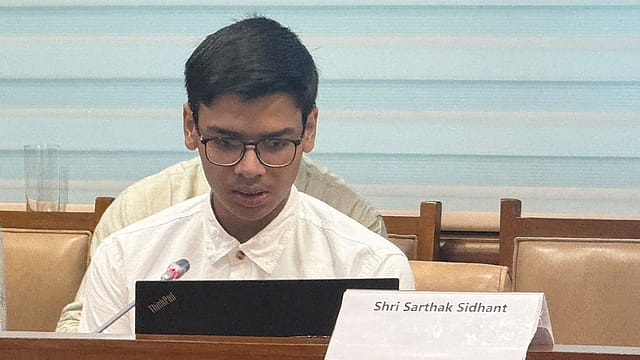
Sarthak Sidhant, the 17-year-old student from Ranchi, Jharkhand, who has shot to national fame by highlighting reported irregularities in the On-Screen Marking (OSM) system used by the Central Board of Secondary Education (CBSE), backs protests against exam paper leaks, faulty digital marking systems and other technical glitches.
“Protesting is the fundamental right that every citizen should have. Protests are good for democracy,” he told Open, even as the Cockroach Janata Party (CJP) and other outfits, including student organisations, raised their voices against leaks and other failures by authorities that have badly hurt students. Repeated leaks in high-stakes competitive exams have eroded public confidence, wasting the efforts of lakhs of aspirants.
Recent digital scanning and evaluation of board exams by the CBSE have resulted in severe grading errors, adding to the anxieties of students who are already grappling with hyper-competitive pressure and a coaching-centric system that lays stress not on holistic education but on cracking multiple-choice questions.
Sidhant, who himself was affected by the CBSE’s online marking system, recently appeared before a parliamentary panel where he explained issues with the tendering of the CBSE OSM contract. Sidhant is said to have presented a seven-page copy of his findings before the Parliamentary Committee on Education, Women, Children, Youth and Sports. To a question on what officials had asked him and the replies he had given, Sidhant offered a pithy response: “Can’t say.”

The Liberation of Bengal
05 Jun 2026 - Vol 04 | Issue 74
A silent revolution ends the reign of fear
Asked when it first occurred to him that there were likely irregularities in the OSM project, Sidhant told Open, “Me and Nisarga Adhikary (the 19-year-old ethical hacker) and (reporter) Sanjay Maurya from The Hindustan Times were in a group chat together after Nisarga started hacking CBSE. We were in a group chat to publish Nisarga’s findings, (and) I was acting as an intermediary. Nisarga started sending me more vulnerabilities (on a CBSE-linked platform). I understood that CBSE had given the contract to a very insecure platform.”
This followed confusion and chaos over the CBSE Class 12 results of 2026, forcing students to raise concerns about various anomalies in the online marking system. Sidhant, who calls himself a tech nerd, offers tutorials on programming for beginners and runs a blog. He soon wrote a post titled “How CBSE Rewrote Rules to Favor Coempt Eduteck” (original in lower case). Sidhant, who seems to have a penchant for using lower cases while writing, began by saying: “Hello, I am Sarthak Sidhant. I am a Class 12 student of the year 2025-26, and I am one of the 17 lakh students who have been affected by the On-Screen Marking system released by the Central Board of Secondary Education. For the past few days, I have been investigating the On-Screen Marking evaluation tenders issued by the CBSE. I feel that my findings are significant enough, and I would like to share them in the blog below. This is a story of how a massive public institution deliberately played with students’ futures by rewriting its own rulebook. BTW, this article gets very technical very fast, but fear not. I try my best to explain each term, and I have also added a glossary section at the end of the article for your reference. The language these bureaucracies use is unnecessarily complicated, a way to keep people away from their business, but fret not, for I have scoured the documents inside out.”
The blog, which has since been widely quoted and shared, alleged that “Before winning the CBSE tender, Coempt Eduteck was known as Globarena Technologies. This happens to be the same company behind the catastrophic, disgusting and vile 2019 Telangana Intermediate exam fiasco.”
Sidhant concluded his blog post by claiming: “When you map the timeline side by side, a clear pattern emerges. CBSE did not just pick a bad software vendor by accident. They lowered financial baselines. They dropped software security certifications. They cut the corrupt-practices cooling-off period in half. They removed the physical server isolation requirement. They erased the word ‘blacklisting’ from their penalty matrix via a last-minute corrigendum before bidding. And they bypassed their own mandatory CERT-In production audits. They gambled with our data security, our marks and our mental health. The institution failed us. I hope this gets covered more, and the institution answers my questions and provides clarity.”
Naturally, Sidhant is not pleased with the media for not unearthing these irregularities earlier. To a question on who, according to him, should be held accountable for all this trouble, he gives a straight answer: “Do proper investigation and figure out.”
What precipitated matters was a student's complaint about discrepancies between the physical and digital copies of his Class 12 Physics answer sheet.