Protest Tourism vs. Political Reality: The Anatomy of a Flop Show
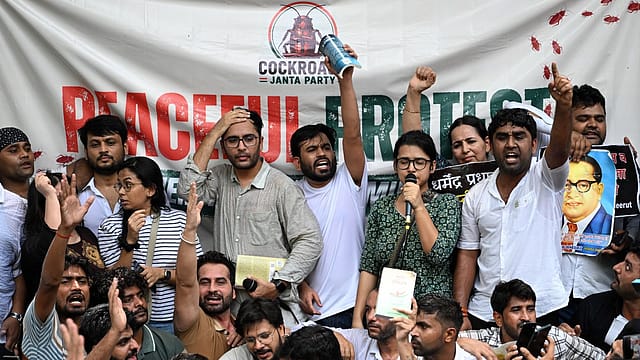
On Sunday, a day after he left Delhi for his hometown in Maharashtra Abhijit Dipke, the newly arrived leader of the Cockroach Janta Party (CJP), warned of more protests across the country if his demands were not met. In social media posts as well as statements to journalists, he said that, “I just want to say that yesterday (Saturday) was a trailer…over the coming days, we will expand this through protests across different locations in the country...Dharmendra Pradhan ji, there is still some time, resign…you have spoilt the future, lives of more than one crore students.”
Saturday was not the start Dipke, who returned home from the US in the morning, and his fledgling outfit had hoped for. Arriving at Jantar Mantar, the “national protest place” in New Delhi, he found just a couple of hundred “protestors” at the site. For a party that managed to gather millions of followers on social media platforms within days of its formation, this was a rude awakening for the student from Boston. Numbers at political protests often lead to invidious comparisons. But even a generous assessment would not put the number of people who gathered at protest site beyond one thousand. Dipke later claimed the number at around six to seven thousand.
Even if one ignores the number of protestors, their composition should ring alarm bells for this student of public relations. Instead of being an organic protest—the kind that threatens “undemocratic regimes”—the crowd was one of the usual Delhi suspects. There was Sonam Wangchuk, the activist who wants statehood for the Union Territory of Ladakh; then there were Leftist students from JNU with their trademark tambourines, probably making the best of the summer academic recess. Old uncles, famous for their disaffection across the NCR, including the odd hookah holding tau completed the mix. The most important constituency, the one for which the protest was allegedly organised, was missing: the students who had suffered from leaks in examinations and their cancellation.

Open Minds 2026
26 Jun 2026 - Vol 05 | Issue 26
The power of ideas and arguments in 50 portraits
Finally, there were practical considerations that probably could not be figured from the salubrious climate of Boston: One does not hold political events in India in June. Even by the unusually pleasant month this year, the heat and humidity at Jantar Mantar were of such degree that by the end of the event, Dipke had to be hand-escorted to his vehicle. Another founder, well-known in Delhi circles, was seen being fanned by an elderly man as he sat sipping a drink.
What had to go wrong on Saturday went wrong. But these issues reflect a fundamental misunderstanding of how politics works in India.
For starters, no protest has ever dislodged an elected government in India unless it indulges in extreme repression. The only known instance where mass protest has managed this was the Emergency. But that comparison does not meet the apples-to-apples measure. Multiple protests across different states, involving large number of students—and not your typical “civil society” crowd—and continued repression of different segments of Indians led to that outcome. Dipke was handed permission to protest at the tarmac when he arrived from Boston on Saturday. Delhi police escorted him to Jantar Mantar for the ceremonies. Far from repression, it was a facilitated protest. The leadership at the New Delhi police district took care that no harm came to the precious protestors.
Then there was the issue of students. Dipke gathered the wrong set of people for his “movement.” Students who have suffered from leaks and cancellations of examinations are least likely to come out at this time. All of them, except the unserious candidates, are under extreme stress even as they prepare to re-take their tests. They belong to a class of Indians who want to make the best of the opportunities that India can afford them. To use a Marxist expression, they belong to the bourgeois class and are in no way attracted to the revolutionary vanguard.
Dipke is yet to figure a solution to the collective action problem that haunts all such protest “movements” that want to turn into political outfits. India is a very diverse country with more than two dozen states, each with its own language, political culture and variations that can defy anyone but the most organised groups. There is an entire catalogue of failures here, from the Aam Admi Party (AAP)—with whom Dipke bears an uncanny resemblance—to the Maoists who chose a very different route for political change. AAP has been ensnared in misgovernance and corruption while the Maoists have been decimated. Dipke is more likely to be allowed his day under the sun. One has a hunch what he will achieve but it is best to let events unfold.
Finally, one must add the journalists who were present at the site in battalion strength. Newsgathering is tough in June and editorial pressures to get stories can be as brutal as the humidity. There were foreign press correspondents who naturally assume that any such event can lead to a revolution. But they can’t be blamed, they assume India is “South Asia” (think Sri Lanka, Nepal and Bangladesh) and are clueless about how politics works here. Their Indian counterparts were there to earn their daily bread. They could not be blamed but the tamasha was disappointing.