Prayagraj watches the clock as Ganga and Yamuna rise: Why the next 24 hours matter
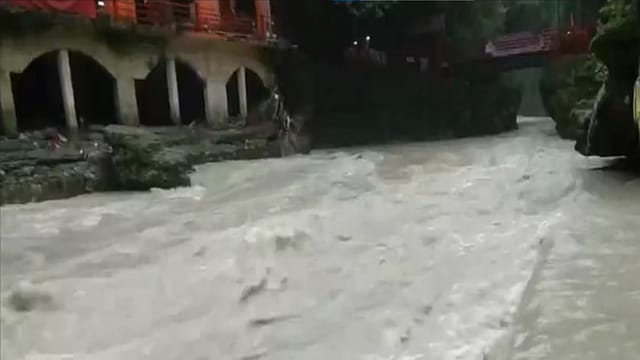
There is a peculiar kind of tension in Prayagraj right now: the floodwaters are rising, the rescue machinery is already moving, but the city is still waiting to see what the next few hours bring.
The Ganga and Yamuna are swelling after persistent rainfall, pushing water into low-lying areas and forcing authorities to put relief and rescue systems on standby. At 8 am on Tuesday, the Ganga stood at 82.62 metres at Phaphamau and the Yamuna at 82.20 metres at Naini. The danger mark for both rivers is 84.734 metres. By 4 pm, the Ganga had climbed further to 82.72 metres at Phaphamau. Hindustan Times reported that the Ganga was rising at around 4 cm an hour.
That is why officials are watching the clock.
The administration has already activated relief camps and deployed NDRF, PAC Flood Control and Jal Police teams at vulnerable locations. The district administration has warned that the next 24 hours could be crucial.
Why are Ganga and Yamuna rising in Prayagraj?
The immediate trigger is persistent rainfall upstream and across the river catchments.

Zeroing In on ECI
09 Oct 2026 - Vol 05 | Issue 41
Constitutional legitimacy versus political opportunism
As rain continues across parts of northern India, water levels in the two rivers have been climbing steadily. In Prayagraj, that rise is particularly important because the Ganga and Yamuna meet at the Sangam before flowing onwards as the combined river.
The effect is already visible along the riverbanks. Hindustan Times reported that water has reached residential areas in several low-lying localities, prompting authorities to intensify preparations.
The concern is not simply how high the rivers are right now. It is how quickly they are getting there.
How close are the Ganga and Yamuna to the danger mark?
They are still below it—but the gap is narrowing.
The danger mark for both rivers at Prayagraj is 84.734 metres. On Tuesday afternoon, the Ganga at Phaphamau was at 82.72 metres, while the Yamuna at Naini had reached 82.35 metres.
That means neither river has breached the danger level yet.
But officials are not waiting for that threshold to be crossed before preparing.
The reason is simple: by the time water reaches the danger mark, the window for moving people and equipment safely can become much smaller.
So what happens in the next 24 hours?
This is where the weather forecast becomes crucial.
The India Meteorological Department has forecast fresh rainfall, with similar conditions expected over the following two days, according to Hindustan Times. That means the rivers could continue receiving additional water even as authorities are dealing with the existing rise.
For Prayagraj, the next day is therefore less about a single water-level reading and more about the direction of travel.
Is the river still rising? How quickly? Are low-lying colonies seeing more water? Does fresh rain accelerate the rise? Do authorities need to move residents?
Those are the questions officials are watching.
What is Prayagraj doing before the situation gets worse?
The administration has moved into preparedness mode.
According to the Times of India, 26 relief camps have been set up in the city, while NDRF, PAC Flood Control and Jal Police teams have been deployed at identified vulnerable spots. Officials have also activated flood relief centres and appealed to people living in low-lying areas to stay away from floodwaters.
District Magistrate Manish Kumar Verma told TOI that preventive measures were already in place and that authorities would take further action depending on how the situation develops over the next 24 hours.
In other words, the city is preparing for a flood without waiting for the flood to fully arrive.
Has water already entered residential areas?
Yes.
Hindustan Times reported that rising waters have reached residential areas in several low-lying parts of Prayagraj. Authorities have consequently stepped up flood preparedness and kept relief camps operational.
The distinction matters, though: the situation is serious, but the latest reports do not indicate that the entire city is under floodwater.
That is precisely why the focus remains on vulnerable pockets and early intervention.
Why is the Sangam area being watched so closely?
Because the meeting point of the Ganga and Yamuna is also one of Prayagraj's most important cultural and religious spaces.
The rising waters have already reached the famed Bade Hanuman Ji temple near the Sangam. The Times of India reported that the river entered the temple premises during the traditional ritual bathing of the deity, prompting the Mangala Aarti.
For devotees, the annual bathing of Lord Hanuman by the Ganga is a revered event.
For disaster-management officials, however, the rising water around the Sangam is also a warning that the river is pushing closer to the city's vulnerable edges.
Is this only a Prayagraj problem?
No.
The rising rivers are part of a wider spell of intense monsoon weather affecting Uttar Pradesh and Uttarakhand.
The latest Uttar Pradesh government figures reported by the Times of India say floods have affected 17 districts, with around 1.70 lakh people impacted. The state has activated its administrative machinery for relief and rescue operations, while authorities said there had been no loss of human or animal life in the state so far.
In Uttarakhand, the situation has also prompted precautionary measures. Dehradun shut all schools from Classes 1 to 12 and Anganwadi centres on Tuesday following an Orange alert for heavy to very heavy rainfall, lightning and extremely heavy rain in some areas.
The Ganga has also risen in Rishikesh after heavy rainfall in the Garhwal hills, although the river remains below the warning mark there, according to officials cited by TOI.
What should residents in low-lying areas do now?
The message from authorities is deliberately simple: stay alert and do not enter floodwaters.
With the rivers still below the danger mark, there is no basis for treating the entire city as inundated. But people living close to the riverbanks and in low-lying colonies need to pay attention to official warnings and be ready to move if instructed.
That is also why relief camps are being kept ready before they are urgently needed.
Why do the next 24 hours matter so much?
Because Prayagraj is at the point where water level, rainfall and preparedness are all meeting at once.
The Ganga and Yamuna have not crossed the danger mark. But both are rising. Fresh rain is forecast. Water has already reached some low-lying residential areas. Rescue teams are deployed and relief camps are ready.
So the next 24 hours are not necessarily a countdown to disaster.
They are a window for the city to find out whether the rising waters stabilise—or whether the river keeps coming.
For now, Prayagraj is doing what flood-prone cities often have to do: watch the river, watch the sky and prepare before either one gives a clearer answer.
(With inputs from ANI)