Punjab Records 1,152 Farm Fires on Diwali, Its Biggest Daily Spike This Season
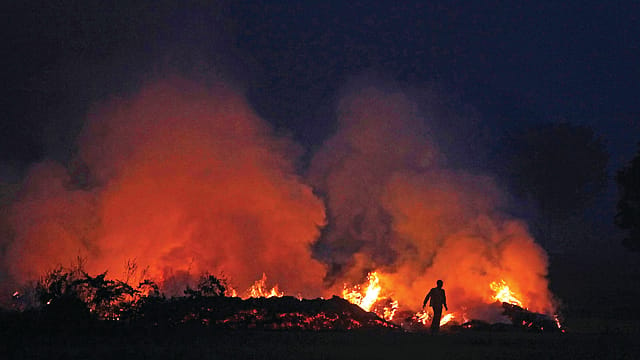
Punjab recorded 1,152 farm fires on Diwali, its biggest single-day tally this season. The November 8 spike lifted the cumulative count from 3,307 to 4,459 in a day, an increase of nearly 35%. More than one in four of the fires recorded this season were logged on Sunday alone.
The total has already passed the 3,316 fires recorded by the same date in 2025. Punjab logged 5,114 over the whole of last season. This year, harvesting was complete on 91.4% of the state’s 32.87 lakh hectares under paddy, according to the figures cited by ANI. The spike came as farmers faced a shrinking window to clear their fields for wheat sowing.

The Era of Forever Wars
30 Oct 2026 - Vol 05 | Issue 44
Coping with an explosive Middle East
Tarn Taran and Ferozepur Lead the Tally
Tarn Taran recorded the most incidents, followed by Ferozepur with 592. Sangrur reported 488, Bathinda 406 and Patiala 288. Field teams found evidence of stubble burning at 306 locations in Tarn Taran and 247 in Ferozepur.
The statewide tally includes incidents flagged for inspection. Teams had visited 2,998 sites by November 8. Their report put the number of locations where inspectors found evidence of burning at 1,310. That figure covers confirmed sites among those inspected.
Punjab Recovers Just Over Half the Compensation Levied
Authorities imposed environmental compensation in 1,228 cases, levying ₹62.55 lakh and recovering ₹32.60 lakh. Police registered 884 FIRs under Section 223 of the Bharatiya Nyaya Sanhita, and authorities made adverse entries, known as ‘red entries’, in the land records of 1,017 farms.
Enforcement also extended to officials responsible for monitoring farm fires. Prosecution proceedings were initiated against 18 nodal officers under Section 14 of the Commission for Air Quality Management Act.
Several Delhi Stations Record ‘Severe’ Air
Delhi woke to thick smog on Monday, November 9. An early citywide AQI of 400 was reported, at the upper limit of the ‘very poor’ category. As per the Central Pollution Control Board data, a citywide reading of 370 at 9 am was recorded, also ‘very poor’.
Several stations were in the ‘severe’ range in the early readings, including Burari Crossing at 441, Vivek Vihar at 437 and Delhi Technological University at 434. The station readings show where pollution was worst. They cannot establish how much came from Punjab’s farm fires.
Delhi Aam Aadmi Party chief Saurabh Bhardwaj alleged that the government had shut some monitoring stations, placed new ones in greener areas and used water sprinkling near monitors to influence readings.
With inputs from ANI