Pali Bangle Industry Explained: How Rajasthan’s 100-Year Craft Empowers Women
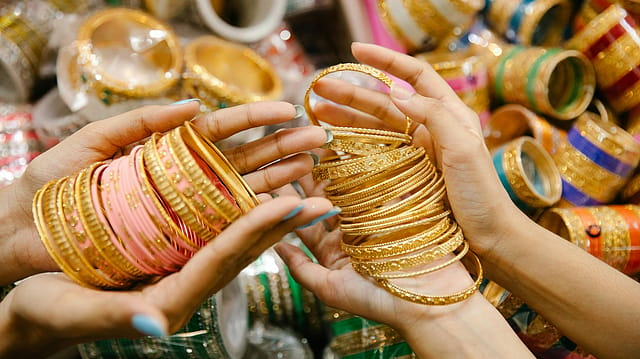
Rajasthan’s Pali district is home to a nearly century-old bangle industry that has transformed from a small craft tradition into a large-scale manufacturing ecosystem. What started around 1938 under the initiative of Babu Bhai (Khan) has today evolved into one of India’s most significant bangle production hubs, second only to the textile sector locally.
Initially, artisans crafted bangles from ivory and coconut shells, reflecting both resource availability and traditional aesthetics. Over time, innovation and changing material access reshaped the industry.
Altaf, a local shop owner, said, “Ancestors started making bangles in Pali around 1938. Initially, coconut bangles were common, followed by the popularity of modeled designs made from ivory. This continued for many years before eventually stopping.”
The Shift to Modern Manufacturing
The turning point came when plastic acrylic sheets were introduced from Japan, revolutionising production methods. This shift allowed for scalability, consistency, and cost efficiency. Eventually, plastic pipes replaced sheets, simplifying manufacturing through pipe cutting techniques.
Today, the production process is highly systematised. Plastic scrap is recycled into raw material, melted, and moulded into pipes. These pipes are then cut, shaped into bangles, and passed on for further design and decoration.
Mohammad Ayub Khan, a trader, describes the process: “Plastic scrap is first collected and melted to create raw material, which is then processed into pipes. These pipes are cut by hand to form bangles. After designing, they are sent to Pali city and nearby villages where women decorate them with stones and embellishments. This provides employment to women while also supporting the business. Women earn around Rs 9,000 to Rs 15,000 per month. The finished bangles are then packed and sold in Rajasthan and other states, where demand is high.”

Open Minds 2026
26 Jun 2026 - Vol 05 | Issue 26
The power of ideas and arguments in 50 portraits
A Decentralised, Women-Led Workforce
One of the defining features of Pali’s bangle industry is its decentralised, home-based work model. After initial production, unfinished bangles are distributed door-to-door, allowing women to work from home while managing household responsibilities.
Sajid Khan, a supplier, said, “After cutting the bangles, they distribute them to women door-to-door. Women design and decorate them with stones and return them, for which they are paid. This creates good employment opportunities for women. The bangles are then cleaned, packed, and prepared for sale.”
This model has enabled thousands of women to become financially independent without stepping outside their homes.
Income, Independence, and Everyday Impact
For many women, this industry is not just supplementary income but a reliable financial backbone. Workers typically earn between Rs 9,000 and Rs 15,000 per month, depending on output and skill.
Amina Banu shares her routine, saying, “She has become self-reliant through this business. After completing daily household work, she starts decorating bangles, working from around 10 am to 4 pm and preparing 3,000-4,000 bangles daily. She earns Rs 10,000 to Rs 12,000 per month from home, which helps cover school fees and household expenses.”
Similarly, Anju Karim notes: “After completing her daily routine, she makes bangles, producing around 1,000-1,200 bangles per day. She earns Rs 10,000 to Rs 12,000 per month, which helps her manage small expenses and her children's school fees without depending on others.”
Scale, Reach, and Global Demand
With around 1,000 factories operating in the district, the industry supports lakhs of livelihoods across production, trade, and distribution. Every day, massive volumes of bangles are shipped across India.
Mohammad Talib Ali explains the scale: “The history of bangles in Pali is over 100 years old, and the Chudighar community is credited as its originator. Every day, lakhs of bangles are supplied from Pali to all parts of India.”
Beyond domestic markets, Pali’s bangles have also found international buyers, including in Afghanistan, Pakistan, Japan, and previously China. While exports to China have declined, demand remains strong elsewhere.
A Sustainable and Tax-Free Advantage
Another key factor supporting the industry is its reliance on recycled plastic, making it both cost-effective and relatively sustainable. Additionally, the absence of post-production tax on bangles provides a competitive edge in pricing and distribution.
The Road Ahead
Despite shifts in global demand and material trends, Pali’s bangle industry continues to thrive as a hybrid model of traditional craftsmanship and modern manufacturing. Its real strength lies in its ability to generate large-scale employment while empowering women economically at the grassroots level.
(With inputs from ANI)