Mumbai’s Infrastructure Priorities: Clear Intentions
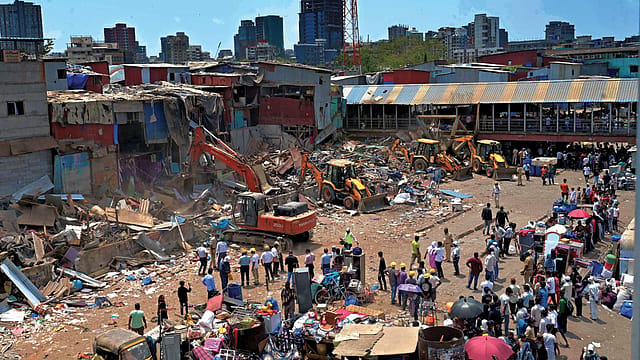
SATURDAY ARRIVES IN Garib Nagar with a warm, muggy morning. For several weeks now, Mumbai has been in the grip of a heat wave, but this morning, some dark, heavy clouds have gathered in the sky. Farzana Khatuna, a frail woman with a worried face, is sitting on a frame of plywood, at a little clearing beside the road. Everything she owns today—clothes, utensils and knickknacks—appears to have been placed in three plastic buckets that lie just behind her. All around her are the ruins of Garib Nagar, a large slum settlement in Bandra East, that has been demolished. Although Khatuna is 25 years old and a mother of three children, she looks no older than a teenager. And when she answers questions, she does so with a vacant expression, and it is her eldest child, a chatty nine-year-old daughter named Alisha, who must come to her mother’s rescue and complete her thoughts. “I don’t know what we will do now? Where will we go from here?” Khatuna says. Only to be corrected immediately by her daughter, Alisha. “That’s the wrong thing to say,” she reprimands her mother. “We won’t be going from here. They will want nothing more than for us to go.”
It is the fifth day since the demolition of this settlement that had grown on the eastern side of Bandra railway station began. As it will turn out later, it is also the last day.
The area is calm, but when the drive began, it had been a different story. On the second day, after two mosques were demolished, local residents turned violent and pelted stones, leading to a lathi charge and arrests. At the peak of the operation, more than 1,000 policemen were deployed. The drive continued in uneasy tension, unmarked by incidents. Now, the job is almost over; what remains is the clean-up.
Claims about how old this unauthorised settlement, which had come up over land owned by Indian Railways vary, although many of the individuals who lived here say it is several decades old. This mirrors the story of many slum settlements in Mumbai. It is hard to pinpoint when they began or how they could take gargantuan scales right under the noses of every authority which is supposed to protect public land. Mumbai has always been a magnet for migrants. Post-Independence, as its position as the financial capital grew stronger and it became one of the few places in the country where some form of employment was guaranteed, the numbers took a bigger scale. The city had no plan to house them, or whatever plan existed was overwhelmed. Garib Nagar was one among such slums. What marked it, however, was its location. Bandra is the centre of Mumbai, the meeting point between the western suburbs and the city, the hippest place to be. Movie stars, corporate executives, and businessmen, all have taken up residence at its western side. On the eastern side is the Bandra Kurla Complex, which is now the main business district of Mumbai. Separating the two is the railway station. Get down on the east side from its staircase, and the visitor would be greeted with the unruly sprawl of Garib Nagar.
This is not the first time demolition drives have been conducted on it. An NGO called Nivara Hakk, which works to protect slum dwellers, has on its website a list of slums on which the government had conducted demolition drives. For Garib Nagar, it says, “On 14th May 1998, Garib Nagar and Prem Nagar on Bandra East station were demolished. 240 huts were razed. All heads of the family were taken away in a truck on the pretext of giving them alternate accommodation, but at the same time, bulldozers were brought in to demolish the hutments. The Committee for Rights for Housing (CRH) visited the site at 2 p.m., decided to go to the truth of the matter and requested formation of committee. BMC needs this land to build road leading to Bandra Terminus. BMC tried demolition here in 1991, residents went to Supreme Court and after 8 years only 145 people were given alternate accommodation.”

Slums keep coming back because they have now intertwined into the politics and corruption of the state at every level. Being illegal, they start off without public amenities like running water or electricity. Soon, officials of the municipality and other services begin to get paid for either delivering the services or to turn a blind eye when the slumdwellers make their own arrangements. When the slum takes scale, as it inevitably does, then the sheer numbers turn it into a voting block with politicians courting them. The slums get regularised, making them legal even when the land has been encroached on. From the 1970s onwards, this phenomenon of regularising took root in Mumbai. By the 1990s, a new tweak was added to it. Private builders and the state government came up with policies to make residential buildings in the lands that slums occupied. The builder got land cheap for luxury projects while he housed the slumdwellers in buildings on the side. The Slum Rehabilitation Authority (SRA) scheme for redevelopment, initiated in 1995, is still in operation today. Because slums rapidly proliferate, the question then became the cutoff point before which slumdwellers get residency rights. That also keeps getting advanced. In 1971, the first law to give slums a legal standing was passed. The SRA cutoff date for slums was January 1, 1995. It has since been pushed to 2000. In the current demolitions, 100 houses were left untouched because the court found they had legal standing.
WHAT IS INDISPUTABLE is that the settlement kept growing over the years. Take a Times of India headline from 2017—‘BMC clears 8-acre slum sprawl near Bandra (E) station’. It begins with, “In one of the largest anti-encroachment drives, the BMC on Thursday freed up eight acres of land outside Bandra station (east) by razing the tightly packed illegal shanties, many of them three-storeys high, and rendering thousands of people homeless. A civic official said the land freed up was below the Bandra skywalk on one side and a large sprawl going towards the Bandra rail terminus on the other. These eight acres were taken on lease by the BMC from the railways to lay water pipelines many years ago. The two-acre plot belonging to the railways, which is also heavily encroached, was left untouched.” In the demolition initiated by the Railways this time, as many as 500 houses were removed. Illegal shanties grew not just horizontally, but vertically too, with many residents adding floors to their structures, some of which even rose above the height of the nearby railway footbridges, and, according to railway officials, came dangerously close to overhead electric equipment masts. There have been some big fires in this settlement too, once in 2011 and again in 2017. Every time the structures had returned, often much taller than the previous version.
The Railways have been trying to clear this settlement for a long time. It served eviction notices back in 2017, only for it to be stayed when it was challenged in the Bombay High Court. The issue resurfaced in 2021, when a survey that looked at the feasibility of a sixth railway line at the station identified some hutments within the ‘safety zone’ of the Railways and those outside it. And then earlier this year, the Railways demolished a few encroachments. The courts were approached yet again, but this time the Bombay High Court (HC) permitted the demolition of the settlement, while granting protection to around 100 huts. According to authorities, the freed-up land of some 5,200 square metres, which is estimated to be worth around ₹600 crore, will be used for expanding railway infrastructure around the station.
When the authorities showed up two days before the demolition began, asking residents to move out of the locality, Lubna Sheikh, a 35-year-old resident of the area, remembers everyone panicking for a while. “But then many of us thought it would follow the old pattern, where they would make some noises, but stop short of actually razing it down. One leader, Shams Khan [a close aide of Baba Siddique’s son Zeeshan and the husband of Ayesha Shams Khan, the corporator from this locality], even came and promised he would ensure the demolition wouldn’t take place. But he couldn’t do anything. He came when the demolition began, but the police detained him,” she says.
For the first four days of the razing of the settlement, the exits of the three railway footbridges that led to Garib Nagar were closed. Climbing onto the bridges today, one can see the sweep of the demolition. Nothing of the settlement remains except for mounds made of the rubble of broken wood, bits of tin and plastic sheets, concrete and jumbled coils. The 100 structures that the Bombay High Court mandated be protected, all of which stand closest to the walls around the railway station, haven’t remained unscathed either. Many of the residents in these structures, like the rest of Garib Nagar had built higher floors, and the authorities have razed most of these too. Standing on the central footbridge today, casting your eye to one end, amidst the JCBs, lie two trucks, which will soon begin transporting what remains of the settlement away. If you move your eyes to the other footbridge, one that connects to the Bandra East skywalk, you will find, living right underneath it in the open, most of the old residents of the settlement.
The place is a mess, there is refuse lying everywhere, and many of the residents have also spilt onto the roads, where thousands of autorickshaws compete with one another to pick up commuters alighting from the trains every day. The residents are refusing to move because they hope they can be let back in or that the authorities will feel compelled to offer rehabilitation. Tariq Ansari, a 70-year-old with a flowing white beard, is there. His eldest son, a 25-year-old tailor, was picked up by the police after the violence on the second day, where he is believed to have pelted stones.
“I don’t know what I am going to do now,” Ansari says. “On the first day, they took away my house. On the second day, my son.”
Walking amidst them today, the residents pull up photocopies of old documents that they have saved, which they claim prove their families have been living here for decades. Some are upset over claims on social media that depict them as Bangladeshis who have entered India illegally. And quite a few pull up their shirt sleeves or their pants to reveal injuries on body parts—allegedly struck by policemen during the lathi charge after the stone pelting.
The action of the Railways to clear Garib Nagar is because the land is necessary. Mumbai needs railway infrastructure development, and Bandra occupies a crucial spot. More tracks are needed for suburban trains to run through it. It is a terminus for long-distance trains, and that must be separated from local ones. Plus, there are links to other milestone projects. The Bullet Train, for instance, from Mumbai to Ahmedabad begins from a stop at Bandra Kurla Complex (BKC). And Bandra station is a major point of access to BKC. It is a nightmare to get from one to another because of the congestion. The land cleared by Garib Nagar will make that connection better.
This time, the Railways seems to be preempting the possibility of the land again being encroached once the demolition drive is over. Speaking in the official Instagram account of Western Railway, its Chief Public Relations Officer, Vineet Abhishek, said that the debris was already being cleared, and as soon as that is complete, the land would be fenced. “In the coming time, this place will be used to execute traffic, management and capacity augmentation projects,” he added.