Pahalgam Attack And The Wounds Jammu And Kashmir Still Carries
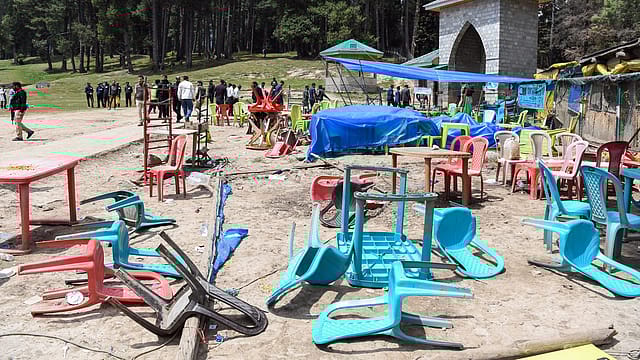
Residents of Doda town in Jammu and Kashmir reflected on the upcoming anniversary of the Pahalgam terror attack, expressing grief, resilience and a firm rejection of Pakistan-backed violence that shook the region.
A resident, Parvez Ahmad, described the attack as deeply tragic and against the ethos of the region.
"First of all, it was a very unfortunate incident. Jammu and Kashmir has never accepted such incidents,” he said.
“After the Pahalgam attack, you saw how the entire Jammu and Kashmir came out onto the streets and strongly opposed it. The firing attack that took place in Pahalgam was completely wrong," he added.

Zeroing In on ECI
09 Oct 2026 - Vol 05 | Issue 41
Constitutional legitimacy versus political opportunism
"Even in the past, whenever such incidents or terror attacks have occurred, Jammu and Kashmir has never accepted them and has always responded strongly,” Ahmad said.

The attack, which took place in Baisaran, a picturesque meadow surrounded by dense pine forests and accessible on foot or horseback, proved to be the biggest terror attack in decades in the region.
The site, often referred to as ‘mini-Switzerland’, is a popular tourist destination.
Why Did The Pahalgam Attack Specifically Target Hindu Men Among Tourists?
Tomorrow, April 22, marks one year since the attack that claimed 26 lives, all Hindu men, including a Nepalese citizen.
The Pakistan-backed terrorists burst out of the forests and raked a crowd of tourists with automatic weapons.
The meadow, enclosed by a seven feet high chain link fence with only two gates, became a trap as the attack began near the exit gate. There were no security personnel present at the time.
Survivors said the three terrorists separated men from women and children and shot them at close range before fleeing into the dense jungle.
Multiple reports at the time indicated that the attackers specifically targeted men after asking whether they were Hindus or Muslims.
Officials who first examined the bodies found that the trousers of around 20 victims were unzipped or pulled down, seen as confirmation that the terrorists had established the faith of tourists before killing them.
Who Claimed Responsibility For The Pahalgam Attack?
The Resistance Front, a proxy of the Pakistan-based Lashkar-e-Taiba, claimed responsibility for the attack twice, on the day of the incident and the day after. The National Investigation Agency later took over the probe.
The aftermath disrupted life for several months, with tourism, the backbone of the region’s economy, suffering severely. Hoteliers, taxi drivers and others dependent on visitors faced heavy losses.
Despite this, people organised candle marches and protests, raising slogans against terrorism and demanding firm action.
Fayaz, another resident, highlighted the broader consequences.
"Look, the attack that happened in Pahalgam was very unfortunate. It directly impacted tourism here,” he said.
What Haunting Memories Of The Pahalgam Attack Still Linger Among Residents?
“Jammu and Kashmir's economy largely depends on tourism. We want peace, stability, and development in Jammu and Kashmir. Such things should not happen. Peace and development should prevail, and our brotherhood should grow stronger,” he added.
Residents said people from all communities came together in protest, sending a strong message against terrorism.
They stressed that the loss of innocent lives, irrespective of religion, was a blow to humanity and called for an end to such violence so future generations can focus on education and progress.
Another resident, Adil Sufi, recalled a haunting image from the aftermath.
"I remember going home and opening a social media app. The first image I saw was heartbreaking, one that still reminds me of the incident,” he said.
“It showed a newlywed couple; the husband was lying dead, and the bride was sitting beside him. That image became the symbol of the attack,” he added.
That image was of Himanshi Narwal, sitting beside the body of her husband, naval officer Lieutenant Vinay Narwal, whom she had married a week earlier.
The couple was on their honeymoon when he was shot at point-blank range.
"I was eating bhel puri with my husband when a man suddenly came and said he's not Muslim...then shot him," a stunned Himanshi was heard saying in one of the many videos from the attack site.
Mourning her husband, Himanshi later appealed for peace.
"We don't want people going after Muslims and Kashmiris," Himanshi Narwal said, adding, "we want peace and justice. People who have done wrong with him should be punished."
US Vice President JD Vance was present in India when the attack took place on 22 April 2025.
How Did The Pahalgam Attack Impact India-Pakistan Relations?
New Delhi suspended the Indus Waters Treaty, expelled Pakistani diplomats and closed borders, while Islamabad responded by suspending the 1972 Simla Agreement.
India launched Operation Sindoor in retaliation, targeting terror infrastructure in Pakistan and Pakistan-Occupied Kashmir. After four days of intense military conflict, both countries announced a ceasefire on May 10.
On July 28, 2025, a PARA Special Forces team carried out a meticulously planned operation, trekking three kilometres over ten hours through difficult terrain before neutralising all three terrorists in a swift engagement.
(With inputs from ANI)