#Independence Day 2026: PM Modi Turbocharges Viksit Bharat, Signals the Politics Ahead
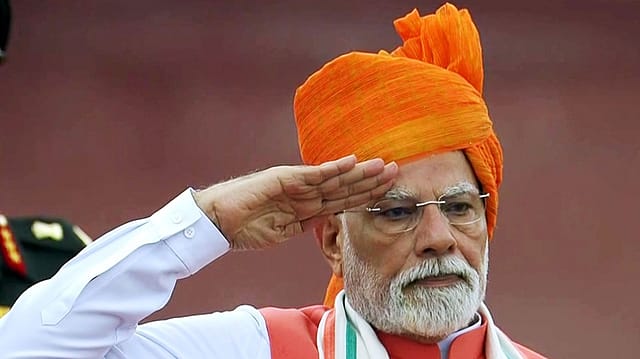
In his trademark fashion Prime Minister Narendra Modi threw a broad political hint about reservation for women in legislatures in a speech that was otherwise devoted to nation-building and developmental themes.
Towards the later part of his speech, the PM said that his government had made efforts to realise the dream of reservation for women in legislatures but this had been held back due to political reasons. “I appeal and urge all political parties in the country to come forward and give a hand in furthering women empowerment and implement reservation for women in state legislatures and Parliament.”
The context for the PM’s assertion gains salience as the Delimitation Bill, a legislation needed to operationalise the women’s reservation legislation, was expected to be introduced in the just-concluded Monsoon Session of Parliament.
PM Modi’s speech also highlighted the end of Maoism/Naxalism the country. The PM said that a large population of the country had been kept supressed under the “barrel of a gun.” “Naxalism/Maoism now does not have the strength even to take a last gasp.”

The Age of Anger
31 Jul 2026 - Vol 05 | Issue 31
A raging generation makes the government relent. What's next?
At the same time, he elaborated on the theme of dimagi naxalism or mental Naxalism. While armed insurgency in India’s far-flung areas had been defeated, people with a Naxal/Maoist mentality had established themselves in the corridors of power and managed to influence policy for long. They need to be identified and isolated, he said.
The PM specially highlighted the key role that India’s youth play in nation-building and how rapid economic progress was ushering in new opportunities for the youth. In the coming time, one crore youth would be trained and imparted AI skills. The speech was not a typical “programmatic” speech in which welfare schemes and policies for youth were highlighted but one where the vital role played by youth in the progress of India was explained in detail. To give one example, the PM asked for “help” from youth in the Census process where he asked them to ensure a glitch-free enumeration process. This was his way of signalling importance for a key constituency.
The bulk of his speech was devoted to developmental themes that focused on achieving the goal of Viksit Bharat or India as a developed country by 2047. Here, the PM drew a sharp contrast between India’s past decades (1950 onwards) and the period between 2004 to 2014 that was effectively “lost” as the country did not use this time to push ahead on almost all developmental parameters. The PM listed dozens of areas where India had made rapid progress after 2014. He added that much needed to be done very quickly if India were to reach its goals by 2047.
The Prime Minister outlined the Saptadhara Shakti or “seven streams of power,” that reflects the immediate priorities for India in a changing and challenging world. These seven streams of power include manufacturing prowess, agriculture and food production, technology, and innovation, gatishakti or procedural speed in government and economic processes, progress in the defence sector, green technology and blue economy and India’s soft power.
These themes encompass a large fraction of India’s economic priorities and prowess. They also represent crucial bottlenecks and chokepoints in a world that is conflict-ridden. The PM made a point to emphasise how resources had been weaponised and even the world’s landmass itself had been weaponised. He said that in such a situation, India had to prepare itself for any exigency.