The Fire Reaches India
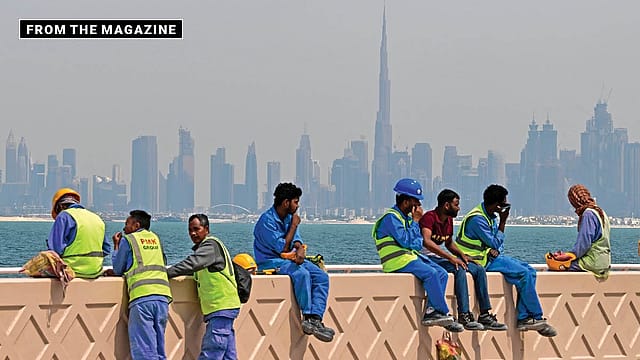
Ramesh Kumar (name changed at request) lives in Deira and works in a tonier part of Dubai, one of the seven emirates that form the United Arab Emirates (UAE). It is also the most populous of the seven, home to four million people, more than 90 per cent of whom are expatriates. Once a fishing settlement, it is now one of the most modern cities in the world, connecting cultures and businessmen from afar. It was also considered one of the safest thanks to exceptionally low crime rates. Also called the City of Gold, it is a dream city for the likes of Kumar, who works in a clerical job and has been able to “finance” the weddings of his two sisters and build a home in the past 20 years. But he notes that he is far from being financially secure—which is why he was hoping to spend around 10 more years. “I came here as soon as I finished studies in my early 20s. I have struggled a lot, but things changed and I felt I was lucky because this place gave me everything. But now I earn 30 per cent less than I used to. This happened during Covid, but then it was temporary because we were not working. Now I have to work fewer hours and the rest of the time I am worried and uncertain about the future,” says the man who fears that his lower-level white-collar job is on the line since the US, with backing from the Gulf states, launched a war on Iran in February this year.
Military brains behind the US-Israeli airstrikes expected the war to not last long. But it has, and the fear among the likes of Majeed, who lives in Bahrain and works in construction, and Rajan, who is based in Doha, Qatar, and works in accounting, is that, although the Gulf countries have realised that war is not good for them, the conflict may escalate amid reports that Gulf Arab allies have been told by the US and Israel to prepare for a short, intense military campaign following the US mid-term elections on November 3, with President Donald Trump ratcheting up the war rhetoric.
In Abu Dhabi, as in other cities in the Arab monarchies of Saudi Arabia, the UAE, Qatar, Kuwait, Bahrain, and Oman, which form the Gulf Cooperation Council (GCC), tourism has been badly hit, according to various reports, including one by Reuters which said that visitor traffic has fallen by around 50 per cent during “peak disruption periods in early 2026”. Even if the numbers have begun to improve—what a Gulf-based businessman of Indian origin calls “baby steps” to recovery—many jobs have been lost, and Indians, whose population in the GCC bloc touches around 10 million, face disastrous prospects, especially those employed in sectors such as tourism, hospitality, logistics, and so on. Although these countries have been harsher on Shias and people from countries like Pakistan, people whom Open spoke to across the region aver that the plight of the rest from Asia is no better. Shias were singled out because Iran, which has launched a series of attacks on these Gulf allies to unsettle them, is largely Shia. Among the Indians in the region, according to data from India’s Ministry of External Affairs (MEA), the UAE is estimated to employ around four million, Saudi Arabia 2.75 million, Kuwait one million, Qatar 829,000, Oman 675,000, and Bahrain 315,000.
Javed from Oman, who travels across the region, tells Open that the sectors that are visibly hit include, surprisingly, what are considered recession-proof and relatively war-proof segments such as high-end fashion and food and beverages. Indeed, international arrivals have fallen alongside a flight of Western expatriates. Besides, there are price fluctuations in various logistics sub-segments, at least three people involved in the business told Open, adding that “material price shifts” mean prices are arbitrary, especially those for the construction segment, which has somehow not seen much slowdown. “Human resources, marketing, etc are badly hit by salary deductions and job losses,” says Shamnad from Kuwait City, who is also a frequent traveller across the region on business. He adds that many of his American and British business partners have gone back home for the time being.
Open shared with many people in the region a list of questions, inviting responses from Jeddah in Saudi Arabia and Ras Al-Khaimah in the UAE to places in Oman and elsewhere.
The first was about what has changed the most in their daily lives since the Iran war began and various countries came under Iranian attacks, with people living in fear of threats to life and amid warning sirens of aerial strikes.
Mohammed Hussain (name changed at request), who is employed in Abu Dhabi, says that “mostly it is uncertainty”. He adds, “I work in a field that supports major oil producers, and since the war started it has become difficult to manage our seagoing crew in an organised way. We have to make a lot of compromises with the onboard staff, and their concerns are often about safety, so pushing them to get the work done is a real challenge. As a result, maintenance suffers and costs go up, both in wages and in operating expenses. Seafaring has become very demanding since the war began. Companies are spending heavily on opex (operating expenses) and insurance premiums. Client pressure is huge, and only the big players can really sustain it.”
It is obvious that low-income working classes are not the only ones hit by the crisis, which is worst psychologically because, overnight, there is a perception that, despite promises of protection by the biggest military power in the world in exchange for allegiance, the region is unsafe to live in—which was partly the intent of the Iranian attacks.
Lekha S Chakraborty, an economist who works at the National Institute of Public Finance and Policy , an autonomous research institute of the Indian Ministry of Finance, and who has closely watched the latest trends, breaks down the situation for Open: “Gulf labour markets are dualistic. Nationals cluster in protected public sector jobs. The private sector—construction, hospitality, logistics, oil services, retail, domestic work—runs on temporary expatriates. Low and mid-skill workers who borrowed to migrate and support families back home have the thinnest cushions. When a contract ends or a salary is delayed, the kafala (sponsorship) system makes switching employers difficult; exit is often the only option.” She explains the negative effects of a major development. “The scarring mechanism travels through five channels: One, employment hysteresis—layoffs and hiring freezes outlast the output drop. Two, skill atrophy and lost work experience—interrupted projects mean lost on-the-job learning. Three, compositional and structural shifts in labour markets—employers accelerate localisation, automation or preference for higher-skilled staff. Four, debt, immobility and precariousness traps—migration loans plus restricted job mobility turn a temporary shock into a balance sheet crisis. Five, confidence effects—geopolitical risk raises the perceived cost of expanding payrolls or committing to multi-year projects.”
A Delhi-born senior executive in the region says that there have clearly been job losses in many sectors, especially hospitality and entertainment. “Taxi drivers can’t meet their targets because tourist numbers are down. Hotel rates are at rock bottom; even five-star hotels are affordable now. In the service sector, many people have lost their jobs, and we see this clearly through our own contacts. Real estate has also dipped, which you can see in the way properties are being advertised. Some of our Western friends now say the UAE is ‘no longer a Switzerland’. That tells you how they see a country that used to promote healthy living and was open to people of all nationalities, especially wealthy investors.” He adds that he hears about layoffs in many sectors, though it isn’t discussed openly, because migrants in this region always stay hopeful and simply look for other options. “Car sales, including the second-hand market, are down too. It’s hard to sell a car now because there are no buyers,” he points out.

Another senior-level employee in the shipping business, Sajaad, says that grocery and food prices have gone up across the region. Fuel prices have risen by roughly 80 per cent since the war started in February, and that has hit people hard because in the Gulf the car is the main way of getting around, he argues, and yet adds, “But those already living in the Middle East, and in the UAE in particular, are very confident in and comfortable with the government’s actions, so that faith remains strong, even though job losses are visible in many sectors.”
A Riyadh-based NRI tells Open, that people in Saudi Arabia no longer feel that American military protection is a reliable guarantee of their security, which hurts aspirations and goodwill. He adds, “In my opinion, if the Gulf countries engage positively with Iran, they won’t need to depend on the US. It’s obvious that the US is making life difficult for these countries.”
An executive in the shipping business tells Open that an energy shock feeds into food, transport and manufacturing costs. Central banks would be forced to keep rates high, and equity and bond markets would follow, he says, adding that about 84 per cent of the crude passing through Hormuz goes to Asian markets, so refiners and importing economies there would feel it immediately. “War-risk insurers have already paid out around $2 billion in claims. Cargo financing, letters of credit and charter contracts would face force majeure disputes,” he says, emphasising that “many seafarers accept these voyages because their own families depend on the pay. The burden should not fall on the individual seafarer. Flag states, the International Maritime Organization (IMO) and charterers should make safe passage a precondition, not something that danger money buys. During Covid, seafarers kept the world supplied. The least the world owes them is not putting a price on their lives.”
For his part, Vimal Kumar, CEO of Omnispay, who was a banker across 20 markets for 30 years and is now a fintech entrepreneur with offices on Sheikh Zayed Road, Dubai, narrates how things have changed for investors. “Honestly, the first few weeks after February 28 were rough,” he notes, adding that “portfolio money ran for the exit, events got cancelled, and I took more than one call from investors abroad asking, very politely, whether we were still operating. We were. So was everyone else.”
He adds, “What I have seen since then is more interesting. The fast money left, and the patient money stayed. Some of it came in. DP World said over 40 per cent of the investment committed at Jebel Ali Free Zone in the first four months of this year was signed after the war began, mostly by food, healthcare and manufacturing businesses. Those are not people chasing a quick return.”
“In my own world—payments for small and medium businesses—I haven’t seen anyone shut shop. Owners kept paying suppliers, kept invoicing, kept going. A few investors have pushed back their timelines, yes. But I haven’t met one who moved operations out. A pause is not an exit,” cautions Kumar.
According to him, the case for the Gulf was never that nothing bad happens here. “It was that things work here. Dubai put together a billion-dirham support package for businesses within weeks—that gave a strong message to investors. Every serious investor knows there is risk everywhere. What they want to know is how a place behaves under pressure. The Gulf has now answered that question in public,” he avers.
He places a lot of faith in the region. “I’ve worked across more than 20 markets in 30 years, some of them genuinely fragile. I know what instability looks like when institutions give way: banks freeze, salaries stop. That is not what I saw here. Airports reopened, banks worked, the government communicated, and people went back to their desks. That matters more to me than any guarantee that nothing will ever go wrong, because no place on earth can give you that guarantee. So, I am still building here. In my startup, we haven’t moved a single role out of the UAE, and we are still hiring. My family is here, and we never seriously discussed leaving—we talked about it for one evening and decided to stay. Will there be another conflict? Possibly. But I would rather raise a family and build a company in a place that has shown me how it handles its worst weeks than in a place that hasn’t been tested yet,” he says.
According to economist Chakraborty, however, the IMF’s October 2026 numbers are unambiguous. “The GCC is projected to contract 4.8 per cent in 2026—sharper than the Covid-time oil-output collapse—before rebounding 9.1 per cent in 2027 if the conflict eases and routes reopen. Hydrocarbon production (oil and gas) itself fell from roughly 33 million barrels a day to about 19 million at the trough. This crisis is not mere oil price volatility; it is a ‘quantity shock’ layered on top of oil price swings, shipping disruptions and a freeze in confidence. Non-oil activity—aviation, tourism, logistics, investment—has taken a direct hit,” she says, adding that she would be cautious about calling it a short, sharp shock. “The real risk is scarring,” she stresses.
Buffers have cushioned the first blow, but buffers are finite, Chakraborty warns. “Investment decisions delayed today often never restart. That is the classic scarring mechanism—temporary disruption that permanently lowers the growth trajectory,” notes the economist and author.
Economists like her have noted that the pain in the region is highly uneven. “Kuwait, Qatar and Bahrain face double-digit contractions (roughly 16.7, 15.6 and 11.3 per cent) because they depend more heavily on the Strait of Hormuz and have fewer alternative outlets. Saudi Arabia and the UAE are in milder recession territory (around 3-4 per cent), helped by pipelines and deeper fiscal space. Oman is the outlier, still growing near 4 per cent thanks to geography. That ranking maps almost one-for-one onto vulnerability for Indian workers. Those in Kuwait, Qatar and Bahrain confront the sharpest demand destruction—project cancellations, delayed salaries, non-renewals. Saudi Arabia and the UAE offer more cushion. Oman is relatively protected. Temporary migrants on sponsorship contracts are always first in line to absorb the adjustment.”
Asked if the crisis could lead to a significant decline in remittances to India, Chakraborty says it could, if the labour-market weakness persists. “Gulf remittances are a large part of India’s total inflows. Kerala will feel it most acutely, followed by other high-migration corridors. The households that depend on these flows for daily consumption, school fees and housing are the ones who have the least room to absorb a sustained drop. The remittance channel is the main way Gulf labour-market scarring travels back to Indian households,” she says.
People close to the matter working in the travel business said there is a slight and temporary rise in tourism from India thanks to the Deepavali festival season. One of them says that tariffs for rooms in some areas of Dubai have fallen from 275 dirhams to 150 and suite rooms in luxury hotels costing 6,000 dirhams a night to 3,000 dirhams, on average. “Many people who are on leave and back home in India have been asked not to return till informed, and some others here asked to take leave till further notice,” one travel industry professional notes.
On practical steps that Indian workers can take to protect themselves financially, Chakraborty says: “Build whatever liquid savings you can, keep careful records of contracts and payments, look for internal transfers or skill upgrading if the firm allows it, and stay in close touch with the embassy and community networks. Reduce high-interest debt if possible and prioritise the most essential remittances. Individual agency exists, but it is constrained by the sponsorship system. Real protection requires collective and official support.”
The Delhi-based economist notes, “Reverse migration has already begun. It could intensify if the slowdown deepens. Temporary workers are the first to leave. That reduces pressure in the Gulf but places the burden of reintegration on Indian states. History suggests that many of these workers do not quickly regain the same level of earnings or employment quality—again, the scarring effect at work.”
Can this crisis teach us lessons in overcoming? Chakraborty says that for the Gulf, this is a reminder that diversification, alternative export routes and regional cooperation on energy security are not optional. For India and its diaspora, she says, it strengthens the case for moving workers into higher-value non-oil activities, improving formal remittance channels and deepening partnerships with the more resilient Gulf economies. Clearly, hope has long sustained Indian expatriates in the Gulf, but this time it may not be enough.