NASA Invites ISRO to Join Moon Base Programme as India-US Space Partnership Goes Lunar
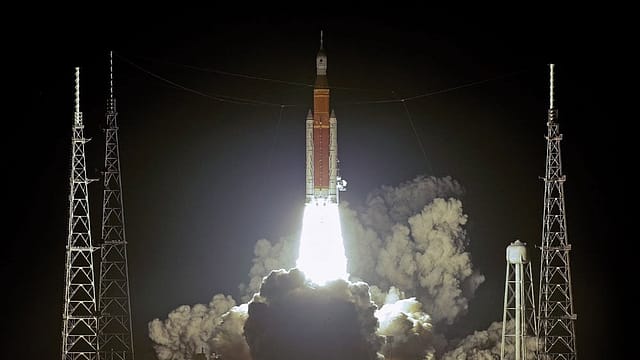
The India-US space partnership is moving into a new orbit. NASA has invited the Indian Space Research Organisation (ISRO) to join its Moon Base programme, US Ambassador to India Sergio Gor announced on Tuesday.
“NASA has invited @ISRO to join its Moon Base programme, deepening the U.S.-India deep space partnership!”
The invitation came as India and the US held the 9th meeting of their Civil Space Joint Working Group at ISRO headquarters in Bengaluru on August 5-6. The meeting focused on expanding civil and commercial space cooperation, future science missions and human-spaceflight technologies.
According to the US Embassy, the two sides are also working to advance cooperation on open scientific data sharing under the Artemis Accords.

Zeroing In on ECI
09 Oct 2026 - Vol 05 | Issue 41
Constitutional legitimacy versus political opportunism
What exactly is NASA building? This is not simply another lunar mission. NASA describes Moon Base as a phased effort to establish a long-term human presence near the Moon's South Pole. The programme starts with robotic missions and technology demonstrations before progressively building the systems needed for sustained lunar operations.
NASA says the programme will bring together government, private industry and international partners, with work spanning lunar mobility, power, communications, logistics, science and habitation.
The agency has already announced its first three Moon Base missions. The first is targeted for launch no earlier than fall 2026, while subsequent missions are designed to test lunar mobility, deliver cargo and conduct scientific investigations.
Why ISRO's invitation matters? For India, the significance goes beyond another bilateral space project. ISRO has already demonstrated that it can deliver complex lunar missions, including the Chandrayaan programme, while its partnership with NASA has produced the joint NISAR Earth-observation mission.
NISAR, launched in July 2025, is the first satellite jointly developed by NASA and ISRO and uses NASA's L-band and ISRO's S-band radar systems. NASA describes it as a major US-India civil-space collaboration.
The mission is already producing science data. NASA recently highlighted NISAR imagery from Antarctica showing how its radar can track changes in ice and Earth's surface.
Now that partnership is being extended from watching Earth to working towards a sustained presence on the Moon. NASA's invitation also builds on India's participation in the Artemis Accords, the framework through which the US is developing international cooperation around peaceful and sustainable lunar exploration.
NASA has said the Moon Base is intended to put those principles into practice and has invited Artemis Accords signatories to participate in the endeavour.
The agency's broader lunar strategy is ambitious: NASA says the Moon Base is intended to create an enduring presence on the lunar surface and help develop technologies and experience needed for future missions, including Mars.
From NISAR to the Moon, the progression is striking. First, India and the US built a satellite to look back at Earth. Now, NASA is inviting ISRO to become part of an effort designed to establish a long-term human presence on another world. The direction is unmistakable. The India-US space relationship is moving from Earth observation to lunar exploration. And the next big collaboration may have the Moon as its destination.
(With inputs from ANI)