Meet Ram temple’s first CEO: From Operation Sindoor to Ayodhya, who is Air Marshal Jeetendra Mishra?
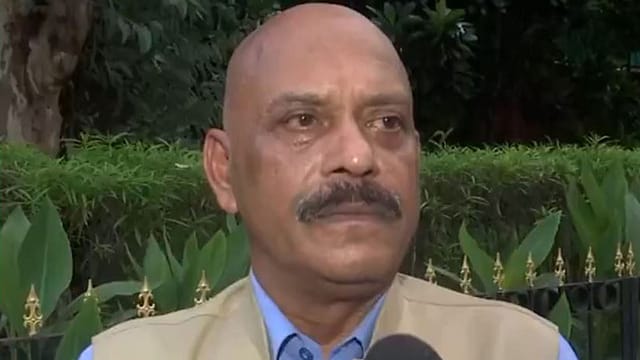
The Ram temple has had priests, trustees, engineers and administrators.
Now, it has a CEO.
And the man chosen for the job comes from an unusual background.
Air Marshal (retd) Jeetendra Mishra, who commanded the Indian Air Force’s Western Air Command during Operation Sindoor, has been appointed the first full-time chief executive officer of the Shri Ram Janmabhoomi Teerth Kshetra Trust, which oversees the Ram temple in Ayodhya.
The decision was taken at the Trust’s meeting in Ayodhya on Wednesday, September 2. It comes after an elaborate selection exercise that began with thousands of applications and eventually produced a three-name shortlist.
So, who is the man moving from military command to temple administration — and what exactly will he be expected to do?

Zeroing In on ECI
09 Oct 2026 - Vol 05 | Issue 41
Constitutional legitimacy versus political opportunism
Who is Jeetendra Mishra, Ram temple’s first CEO?
Mishra is a retired Air Marshal of the Indian Air Force who served for nearly four decades.
Born in Bhopatpura village in Uttar Pradesh’s Deoria district, he was commissioned into the IAF’s fighter stream on December 6, 1986. Over his career, he served as a fighter combat leader and experimental test pilot, accumulated more than 3,000 flying hours and flew more than 18 types of aircraft.
His training included the National Defence Academy in Pune, the IAF Test Pilots School in Bengaluru, the Air Command and Staff College in the US and the Royal College of Defence Studies in the UK.
In other words, this isn't a career bureaucrat being moved into a new office.
It is a senior military commander taking charge of the administrative machinery of one of India’s biggest religious institutions.
What was Jeetendra Mishra’s role in Operation Sindoor?
This is the part of Mishra’s résumé that has put his appointment in the spotlight.
On January 1, 2025, he took over as Air Officer Commanding-in-Chief of the IAF’s Western Air Command — one of the force’s key operational commands. He remained in the position until his retirement on April 30, 2026.
He was heading the command when India launched Operation Sindoor in May 2025 following the Pahalgam terror attack.
For his role in the operation, Mishra was among the military officers awarded the Sarvottam Yudh Seva Medal, one of India’s highest military decorations for distinguished service during war, conflict or hostilities. He has also received the Ati Vishisht Seva Medal and Vishisht Seva Medal.
Before his final command, Mishra held a string of operational, testing and strategic positions, including Deputy Chief of the Integrated Defence Staff (Operations) and Chief Test Pilot at the Aircraft and Systems Testing Establishment.
Why did the Ram temple trust choose a former Air Marshal as CEO?
The answer may lie less in his military rank and more in what comes with it.
The Trust is now running an increasingly complex operation around the temple — from managing devotees and employees to coordinating security, finances, government agencies and major religious events.
That requires systems.
And Mishra's career has largely been about systems: operational planning, coordination, logistics, personnel and managing large organisations under pressure.
India Today reported that the CEO role is intended to give the temple administration a more professional structure, with responsibilities extending beyond routine operations to legal, administrative and financial systems.
The transition is therefore striking.
From coordinating military operations involving thousands of personnel to coordinating the machinery around one of India's most important pilgrimage sites.
Different institution. Very different mission.
But plenty of management involved.
How was Jeetendra Mishra selected as Ram temple CEO?
This wasn't a quick appointment.
The Trust received 5,585 applications for the newly created post.
According to The Times of India, a search committee constituted on July 6 examined the applications and narrowed them to 1,580 candidates considered eligible and suitable. A further 108 candidates took part in online interactions, before 16 finalists were called to Ayodhya for face-to-face interactions.
The committee eventually recommended three names to the Trust in a 75-page report submitted on September 1.
Mishra was selected the following day.
The search committee itself brought together three different fields: retired Justice Pramod Kohli, retired Lieutenant General V.K. Chaturvedi and nuclear scientist Suresh Haware.
So the first CEO of the Ram temple wasn't picked through a conventional political or bureaucratic appointment.
He emerged from a formal search process that began with thousands of applicants.
What will Ram temple CEO Jeetendra Mishra actually do?
Think beyond the sanctum.
The CEO's job is essentially to manage the enormous administrative ecosystem surrounding the temple.
That includes day-to-day administration, pilgrim facilities, staffing, financial processes, coordination with security agencies and government departments, and preparations for major religious occasions that can draw huge crowds to Ayodhya.
The role is particularly important as the temple complex and the ecosystem around it continue to expand.
The Trust will have to manage not just a temple, but a vast pilgrimage operation.
And that means queues, crowds, employees, security, money, infrastructure, technology, logistics and thousands of moving parts.
Why has the CEO post been created now?
The timing matters.
Mishra's appointment comes as the Ram temple Trust undergoes a broader organisational reshuffle.
On Wednesday, the Trust also appointed three new trustees — Mahesh Bhagchandka, Madan Mohan Pandey and Nirmala Yadav. Swami Govind Dev Giri was appointed general secretary, while Bhagchandka was named treasurer.
The changes come amid allegations concerning donation-related irregularities at the temple and the resignation of senior Trust office-bearers. Those allegations are under investigation and should not be treated as established wrongdoing. The Indian Express has reported the organisational changes in that context.
Against that backdrop, the creation of a dedicated CEO position signals an attempt to build a more structured administrative system around the temple.
What did Jeetendra Mishra say after becoming Ram temple CEO?
Mishra's first reaction was notably personal.
Speaking to news agency ANI, he expressed gratitude to Lord Ram and said he considered the appointment a great fortune after his years of service in the Air Force. He also said he prayed for the capability to shoulder the responsibility well.
It is a rather different kind of mission from the ones he spent his military career preparing for.
But Mishra now has a new institution to manage.
And his first task may be to bring the same thing that defined much of his previous career to Ayodhya: discipline, coordination and a system that can handle scale.
(With inputs from agencies)