Karnataka’s Budget and the Congress Model
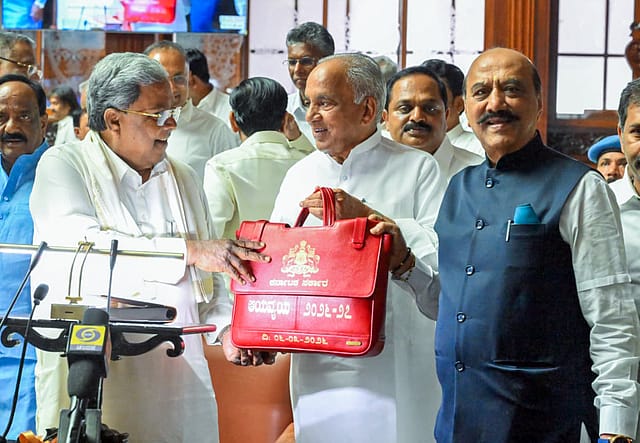
Days after Karnataka Chief Minister Siddaramaiah presented the 2026–27 state budget, proposing an outlay of Rs 4.48 lakh crore, a revenue deficit of about Rs 22,957 crore and a fiscal deficit of 2.95% of GSDP, it continues to invite both praise and criticism. The budget doubles down on the political compact that brought the Congress to power in 2023: an expansive welfare state financed by a still-buoyant regional economy. The five guarantee schemes—Shakti, Gruha Jyoti, Gruha Lakshmi, Yuva Nidhi and Anna Bhagya—remain at the centre of state policy. These are no longer framed as temporary relief measures but as the architecture of governance.
That position reflects Siddaramaiah’s long-standing politics. Few Indian chief ministers have embraced the language of welfare and social justice as consistently as he has. From the AHINDA coalition he built around backward classes, minorities and Dalits to the guarantees that defined the 2023 campaign, his approach has been to widen the state’s redistributive role. It also echoes the direction in which Rahul Gandhi has been pushing the Congress nationally. Over the past few years, his politics has increasingly revolved around inequality, social justice and state-backed economic security. The Karnataka guarantees became a template that the party now promotes across India. By expanding them despite fiscal pressure, the Karnataka government is signalling that this model is not merely campaign rhetoric but an experiment in governing.

Exclusive: To the Heavens and Back
19 Jun 2026 - Vol 04 | Issue 76
Shubhanshu Shukla relives the space odyssey that put India into orbit
Critics argue that the experiment will bleed the state. Karnataka continues to run a revenue deficit, and the welfare outlays consume a large share of annual expenditure. The opposition has framed the budget as fiscally reckless, warning that the state risks financing consumption through borrowing. A related concern lies in the composition of spending itself. Economists have pointed out that the budget tilts heavily toward consumption expenditure rather than capital investment. Welfare schemes raise household incomes and provide immediate relief, but long-term growth depends on sustained investment in infrastructure, research and industrial ecosystems. If redistribution begins to crowd out capital spending over time, the state’s growth engine could weaken.
Another uncomfortable arithmetic sits beneath the welfare model: the state’s growing dependence on excise revenue from alcohol sales. Karnataka’s liquor taxes have become a crucial contributor to government finances. Opponents have seized on the irony of a welfare state partly financed through rising alcohol consumption, arguing that the government is leaning on a socially contentious revenue stream to sustain its commitments.
Yet the government appears to be making a calculated bet: that Karnataka’s growth engine, particularly its technology sector, will continue to generate enough revenue to sustain redistribution. This explains another layer of the budget, which is to do with reasserting Karnataka’s position as India’s technology capital. The announcements around artificial intelligence research, robotics clusters and digital education initiatives are meant to remind investors and entrepreneurs that the state’s future still lies in innovation.
The arithmetic is telling, however. With liquor excise expected to bring in about Rs 45,000 crore and net capital spending barely touching Rs 75,000 crore, the budget leans heavily on consumption taxes to sustain a redistribution-heavy state.
Urban policy forms a third piece of the puzzle. After years of criticism about flooding, congestion and crumbling infrastructure, the budget allocates additional funds to Bengaluru’s transport networks and drainage systems. The spending is significant, but the deeper challenge remains institutional. The city’s fragmented governance structure and absence of metropolitan planning authority remain key challenges not solvable with money alone.
There is also a sharper ideological note running through the budget. The proposed Rohith Vemula legislation seeks to address caste discrimination in universities and reintroduce student union elections. It is a signal that the government intends to place social justice debates at the centre of campus politics. For supporters, it is an overdue correction. For critics, it risks politicising higher education. Either way, it fits within the Congress’s broader attempt to foreground questions of caste and institutional power.
Can Karnataka remain a high-growth innovation economy alongside being a permanent welfare state? That balance is easier to announce than to sustain.