Justice Gurvinder Pal Singh Takes Oath as Additional Judge of Delhi High Court
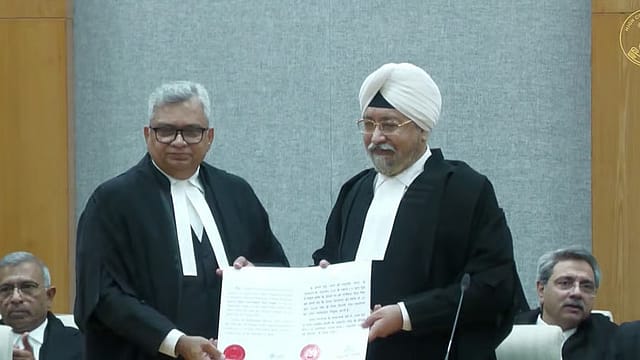
Justice Gurvinder Pal Singh on Wednesday took oath as an Additional Judge of the Delhi High Court, completing his elevation from the Delhi Higher Judicial Service to the High Court Bench.
Justice Singh was administered the oath of office by Acting Chief Justice Nitin Wasudeo Sambre at the Delhi High Court. Justice Sambre took charge as Acting Chief Justice on October 6, following the elevation of Justice Devendra Kumar Upadhyaya, the former Chief Justice of the Delhi High Court, to the Supreme Court.
The appointment places another experienced judicial officer on the Delhi High Court Bench at a time when the court continues to deal with vacancies against its sanctioned strength of 60 judges.
A LONG CAREER IN THE DELHI JUDICIARY
Justice Gurvinder Pal Singh began his judicial career after joining the Delhi Judicial Service in 1992. He was subsequently elevated to the Delhi Higher Judicial Service in 2006 and went on to hold several important judicial and administrative positions across the capital.

The Modi Years
02 Oct 2026 - Vol 05 | Issue 40
A Nation Rebuilt
Among his significant assignments were District Judge of the Commercial Court-02 in New Delhi, Principal Judge of the Family Courts at Rohini and Principal District and Sessions Judge of the North-West District.
In November 2025, he was posted as Principal District and Sessions Judge of the South District at Saket Courts, one of Delhi's most important district court complexes.
His career has therefore spanned both trial-level judicial work and senior administrative responsibilities within Delhi's district judiciary.
ELEVATION TO THE HIGH COURT BENCH
The Union government notified Justice Singh's appointment on October 5 after the recommendation received the approval of the President.
The Department of Justice said the President, after consultation with the Chief Justice of India, appointed Singh as an Additional Judge of the Delhi High Court under Article 224(1) of the Constitution.
His tenure as an Additional Judge is scheduled to continue until June 25, 2028.
The appointment formally took effect from the day he assumed charge and took the oath.
COLLEGIUM RECOMMENDATION
Justice Singh's elevation was part of a larger recommendation made by the Supreme Court Collegium at its meeting on September 10, 2026.
The Collegium had recommended the elevation of eight judicial officers to the Delhi High Court. The Centre subsequently cleared seven of those recommendations in September, while Justice Singh's appointment was notified separately on October 5.
The sequence highlights the multi-stage process involved in the appointment of High Court judges, with recommendations of the Supreme Court Collegium requiring government processing before the appointments are formally notified.
RETURN TO HIGH COURT OFFICE
Justice Singh's elevation also comes after his superannuation from the Delhi district judiciary earlier this year.
His appointment as an Additional Judge means that he now returns to judicial office at the High Court level, bringing more than three decades of experience in the Delhi judicial system to the Bench.
As an Additional Judge, he will initially serve for the period specified in the appointment notification. His tenure is currently set to run until June 25, 2028.
The appointment comes against the broader backdrop of efforts to strengthen the Delhi High Court's judicial capacity and address vacancies in its sanctioned strength.
With inputs from ANI