Beating the Odds, Again and Again
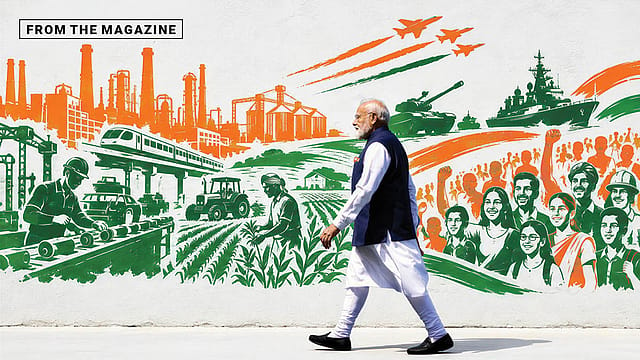
The hustle of everyday politics leaves little room for introspection. Even secure parliamentary majorities do not guarantee freedom from the immediate present. For one, there is no gentleman’s agreement that the victor be granted some initial leeway in policymaking, in keeping with the electoral mandate. The proverbial ‘honeymoon’ period is a misnomer. Within a few weeks of Prime Minister Narendra Modi being sworn in for his first term in May 2014, Congress and Left leaders sought to use their numbers in Rajya Sabha to subvert the Bharatiya Janata Party’s (BJP) single-party majority in Lok Sabha, a first since 1984. If the use of an indirectly elected House to thwart the will of Lok Sabha seemed cynical, no one said so. Rather, Delhi’s commentariat either hailed obstructionism as grand strategy or simply kept mum.
In the beginning, Modi felt the noise in Parliament was not out of the ordinary. Asked about the opposition to major government business and BJP’s vulnerability in Rajya Sabha, he told a group of journalists in an early interaction that the Gujarat Assembly was quite cacophonous too. It soon became apparent that Congress was far from reconciled to its defeat. Stung by BJP’s refusal to grant Leader of the Opposition status to its floor leader in Lok Sabha, since the party had failed to meet the criterion of 10 per cent of House seats, Congress launched a determined bid to stall Modi government initiatives in the Upper House, believing this would take the sheen off the new regime. Beginning with the legislation to free land acquisition of red tape, Congress opposed every Bill, including the rollout of the Goods and Services Tax (GST), Aadhaar-enabled services and the Insolvency and Bankruptcy Code.
But the new prime minister was used to fighting the odds. As a party organiser in charge of various states, he regularly encountered sloth, complacency and an unwillingness to consider the need for change. Alongside a thorough and disciplined approach to the minutiae of political work, Modi was open to innovation and quick to grasp the opportunities offered by technology. Just as he stressed the importance of process, of the fidelity of party membership records and booth organisation, he understood the importance of computerisation beyond its usual applications. An ability to attract talent meant that the right person got picked, and the 2014 Modi campaign was a lesson in centralised decision-making, run from a call centre and back office in Ahmedabad. A record 17 crore electors voted for BJP, a little more than 31 per cent of the vote share. This did not convince his opponents, though, who insisted that more than two-thirds of voters “did not vote Modi”, deliberately ignoring BJP’s overwhelming dominance in straight contests with Congress, its sweep of western and northern India, and the fact that the party was not a factor in some important geographies. The selective commentary did not, however, prevent BJP from raising its votes to 22.6 crore, or 36.5 per cent of the vote share, in 2019.
By the mid-1990s, BJP had established itself as a premier political force in Gujarat but power was accompanied by intense factionalism, leading to the “Hajuria versus Khajuria” crisis sparked by Shankersinh ‘Bapu’ Vaghela’s revolt against Chief Minister Keshubhai Patel. The fallout of Modi’s support for Keshubhai, as BJP’s organising secretary for Gujarat, was that when the rebels agreed to a truce, Vaghela insisted that Modi be kept away from the state. The weak compromise accepted by the BJP’s central leadership was bound to be impermanent, and party affairs in Gujarat remained unsettled. Suresh Mehta was made chief minister but lasted barely a year. Vaghela did become chief minister after he floated his own outfit, but Keshubhai was back in March 1998, after BJP won again. The signs of wear and tear in the state BJP were evident, though, and Keshubhai floundered when faced with the massive challenge of reconstruction and rehabilitation after the 2001 Bhuj earthquake. BJP turned to Modi, the only leader it could count on to ensure that its fortress of Gujarat remained intact. The communal riots of February 2002, in which 790 Muslims and 254 Hindus died, many of the latter in police firing, saw Modi accused of complicity in the violence. A Supreme Court-appointed Special Investigation Team (SIT), which questioned Modi at length, found no evidence against him. The 10-year tenure of the United Progressive Alliance (UPA) witnessed repeated efforts to enmesh Modi in other cases as well, but these failed. Within days of becoming prime minister, Modi received an invitation from US President Barack Obama to visit America. If the US had ever denied him a visa, Modi showed no sign of it, as he recognised the importance of the India-US relationship. Obama, the toast of the liberal establishment, even wrote a joint oped with Modi in the Washington Post.
Modi’s decision to spend close to 18 hours in solitude, in meditation in a cave at Kedarnath, after the conclusion of the 2019 Lok Sabha election was a pointedly public act, one that fused the personal with the public. It was not, as his opponents held, a show to create a PR moment. It could well have been seen as such, but it was not, because the meditative retreat, full of religious and cultural symbolism, did not seem put-on; it seemed very much a part of Modi’s belief system. In 2014, after the election campaign concluded, Modi visited the famous Maratha fort at Pratapgad in Maharashtra’s Satara district, replete with tales of valour and resistance such as Chhatrapati Shivaji’s swift dispatch of Bijapuri general Afzal Khan. After the 2024 election, Modi chose the Vivekananda Rock Memorial as his retreat, after offering prayers at the Sri Bhagavathi Amman temple. The saffron clothing, the sacred ash on the forehead and the head bent in prayer, the affirmation of Hindu asceticism and observance, were deliberate but not forced. The prime minister’s association with a cultural identity he sees as just as organic and legitimate as his duties to his office is never hesitant or accompanied by counterbalancing ‘secular’ acts. He refused to accept a Muslim skullcap at a public event, settling for a shawl instead. The prayers preceding the placing of the Sengol in the new Parliament, or leading the rites of consecration of the Ram Lala idol at the Ram temple in Ayodhya, are an expression of national ethos as far as Modi sees it. The spirituality that runs through the prime minister’s actions draws on his early wanderings after he left his family home. In his book Modi's Mission, Berjis Desai dwells at length on Modi’s travels through Himalayan states and his encounters with mendicants and sadhus. The book provides details of his travels for two years after he decided that he was not cut out for a more ordinary life. His detachment from worldly ties is apparent, apart from his lasting love and respect for his mother. “He clinically severed all family ties save and except his mother and has never felt a twinge of regret in doing so,” Desai writes.
His experiences as a Rashtriya Swayamsevak Sangh (RSS) volunteer, second-class travel on trains and later visits to the US all come together, in various strands, in the Modi we know. Unlike some rightwing politicians, Modi never developed a sneering sense of superiority about Indian traditions or looked down on ‘decadent’ Western culture. He was quick to recognise the technological and economic achievements of the US even as he was unapologetic about his Indianness. His political journey is akin to that of a yatri who keeps setting goals for himself and considers the journey a revelatory process. Sometimes the goal reveals itself. It is the task of the traveller to hold his values and self-belief to be true and worthy of sacrifice. RSS swayamsevaks are motivated by a sense of self-sacrifice and preparedness to accept hardship. In his time away from Gujarat, Modi was put in charge of several states, such as Himachal Pradesh, Haryana, Jammu & Kashmir, and Punjab. He is also familiar with Madhya Pradesh, Rajasthan, Chhattisgarh, and Uttarakhand. The practical experience he gained made Modi aware of, and sensitive to, local norms and beliefs. Although he embraces Hindu symbolism, his election rallies in the Northeast often begin with a Christian priest reciting prayers and seeking Modi’s success.
Just as his politics is imbued with religio-cultural shades, his governance is committed and oriented towards the public good even as it furthers his party’s ideological agenda. As chief minister of Gujarat, he began by throwing himself into the reconstruction of Kutch, which was severely affected by the earthquake of January 26, 2001. He made a name for himself by leading the region’s infrastructure and economic revitalisation. The Gujarat State Disaster Management Authority proved an efficient vehicle of rehabilitation, and Modi’s presence gave survivors a sense of hope and belonging as many rebuilt their lives from scratch. It was about this time that the “Gujarat model” began to take shape. Similarly, his effort to bring electricity, schooling, sustainable agriculture and health infrastructure to far-flung tribal areas carried a modernising message, even if it carried a political one too: if the Scheduled Tribes felt connected and cared for, they would be less vulnerable to the efforts of foreign-supported evangelical organisations keen on religious conversions. But Modi understood that if a large segment of the population lagged behind, it could only be a recipe for social tension. Today, Gujarat offers employment to people from all over India, and its unemployment rate hovers around 2 per cent. Muslims in Gujarat have higher literacy rates and school attendance, while income levels are better than in states with higher Muslim populations. This could be put down to all communities doing better on average (a rising tide lifts all boats), but it is evident that their lot has not declined. By 2012, publications hostile to BJP and Modi began to grudgingly acknowledge that Muslims in Gujarat had advanced in education and wealth, albeit arguing that this was due to their hard work.
After the early challenges of cleaning up a banking sector habituated to acting on political prompts and a public resource distribution system marked by graft and sloth, Modi faced a series of challenges, starting with the 2016 jihadist attack on the Indian Army camp at Uri, the 2017 Chinese intrusion at Doklam, the 2019 Pulwama attack and the 2020 Chinese challenges in Ladakh. Beginning with the Covid pandemic in 2020, India had to grapple with global factors not of its own creation. The pandemic was followed by the Russian invasion of Ukraine, the second Donald Trump presidency and the accompanying tariff warfare, the flare-up in Gaza after Hamas’ October 7, 2023, attack on Israel, and then the US-Israeli war against Iran. In dealing with each of these hurdles, the Modi government displayed quick-footedness and a preparedness to withstand pressure to take sides.
The prime minister’s determined pursuit of what he saw as the national interest meant that US pressure to halt energy purchases from Russia was accommodated only partially. In the initial phase of the tariff war unleashed by Trump in 2025, India reduced its dependence on cheaper Russian crude but never ceased its purchases. To do so made little sense given the long-running military tensions with China. Alienating Russia at a time when its leader, Vladimir Putin, was under the pump was hardly a great idea. So Modi simply ignored the bellicose statements of Trump cabinet members such as Scott Bessent and Howard Lutnick and avoided retaliatory comments. The strategy paid off, and in February 2025, a Trump-Modi phone call ended the punitive tariffs imposed by the US. But the US Supreme Court’s ruling that Trump’s “Liberation Day” tariffs were unconstitutional changed things. The extent to which India has negotiated tariff threats can be gauged by the confidence in official circles that Trump will not use the recently passed bill that empowers him to impose 100 per cent levy on countries like India and China for buying Russian oil. The Modi government has clearly conveyed the implications of such a move to Trump aides. India is buying more than 60 per cent of its LPG supplies from America, something anti-Russia hawks in the US Congress choose to ignore.
Modi’s decision to attend a ‘bhajan clubbing’ event at a park in Delhi recently, on the occasion of the 110th birth anniversary of BJP’s leading ideologue Deendayal Upadhyaya, was not just a routine event. Photographs showing Modi lost in the rhythm of devotional music, a traditional khanjari in hand, were his way of conveying that he was at home and in his element. The young people who sat next to him were far removed from the abusive lot gathered at Jantar Mantar. Social media mobilisation, the agitational toolkit of leftist student bodies and a restless section unhappy about their circumstances made up a “coalition of the aggrieved”, but not an undifferentiated ‘Gen Z’ revolt. This is not to say the protests following the leak of NEET entrance examination papers lacked other participation. Students from elite schools and colleges expressed their anger and disappointment too. But that was a moment, and a particular issue that catalysed opinion.
The prime minister has time and again shown that he is capable of gauging the public pulse and keeping ahead of the opposition. But in reading the mass mind, he does not stray from his fundamentals, something his cause-hopping opponents miss.
The passage of power: From Gandhinagar to New Delhi to the global high table

2001: Sworn in as Gujarat Chief Minister
Narendra Modi was installed as chief minister, replacing Keshubhai Patel. He entered the Assembly through a by-election in February 2002.
2002-13: The Riots and the ‘Gujarat Model’
Modi was cleared in 2012 of allegedly failing to stop the 2002 riots. Meanwhile, he won three Assembly elections and launched the Vibrant Gujarat summit. His development-first image made him India’s most prominent chief minister.
2014: Sworn in as Prime Minister
After Modi’s presidential-style campaign, BJP won the first single-party Lok Sabha majority since 1984. Modi’s swearing-in was attended by SAARC leaders, a signal of a new ‘Neighbourhood First’ diplomacy.
2014: UNGA and Madison Square Garden
Modi addressed the UNGA in Hindi. Around 19,000 Indian Americans filled Madison Square Garden for a rock-star reception. This was the template for his diaspora diplomacy: Silicon Valley (2015), Wembley (2015), and Houston's ‘Howdy Modi’ (2019).
2014: Swachh Bharat Launched
Launched on October 2, the campaign set a five-year deadline for ending open defecation. Modi framed sanitation as a matter of dignity, safety and public health, particularly for women. More than 100 million household toilets were built and the target met.
2015: International Day of Yoga
In December 2014, the UN had accepted Modi’s proposal made in his first address to the General Assembly in September that year. The first International Day of Yoga was celebrated on June 21, 2015, with Modi leading the programme in New Delhi.
2016-17: Economic Reform and Demonetisation
The bankruptcy code and real-estate regulator arrived in 2016. On November 8, 2016, Modi announced demonetisation, withdrawing `500 and `1,000 notes, which caused hardship but pushed digital payments. GST took effect on July 1, 2017, unifying a fragmented indirect-tax system.
2017: Assertive Foreign Policy in Place
He enhanced Indian diplomacy with personal outreach and travel: ‘Act East’, the International Solar Alliance (2015), a surprise stop in Lahore (December 2015), the first prime ministerial visit to Israel (2017). He built visible rapport with Obama, Shinzo Abe, Putin, Macron, Netanyahu, and later Trump.
2019: Vande Bharat
Flagged off by Modi in February 2019, the indigenously built Vande Bharat Express first linked Delhi and Varanasi, becoming a showpiece of his infrastructure push: modern, homegrown, politically potent, accessible and useful.
2020-21: Steering India through the Covid Pandemic
Janata Curfew and lockdown came respectively on March 22 and 24, 2020. Free grains for 80 crore people, especially migrants, were distributed. The vaccination drive began on January 16, 2021, just before the second wave hit. Free vaccination for adults began in June 2021 and India crossed 100 crore doses in October 2021.
2023: G20 Summit
India’s G20 presidency culminated in the New Delhi summit of September 2023, attended by world leaders. The summit secured a consensus declaration and the admission of the African Union.'
2024: Ayodhya and a New Cultural Narrative
After the Ayodhya verdict of November 9, 2019, Modi had performed bhoomi pujan for the Ram temple on August 5, 2020. He led the consecration on January 22, 2024. The Kashi Vishwanath corridor, the new Parliament (2023) and renaming Rajpath as Kartavya Path reinforced a civilisational theme.
2025: Pahalgam and Operation Sindoor
After 26 civilians were killed at Pahalgam, India suspended the Indus Waters' Treaty and on May 7, 2025 struck Pakistan and Pakistan-occupied Kashmir. Four days of missile and drone exchanges ended in a ceasefire on May 10. Modi declared a “new normal” wherein any terror attack would be treated as an act of war. India also rejected Trump’s claims of mediation.
2026: Iran War and the Oil Shock
The war disrupted the Strait of Hormuz. In May, Modi appealed to citizens to cut fuel use, overseas travel and gold purchases, and asked farmers to halve fertiliser use. India and China set out to repair their damaged relations even as Delhi kept buying Russian oil. Also in May, Modi and BJP earned a significant political victory as West Bengal voted BJP to office and re-elected the party in Assam.