Jaishankar’s ‘Goldilocks’ Pitch: Navigating US-China Rivalry, Building India-EU Ties
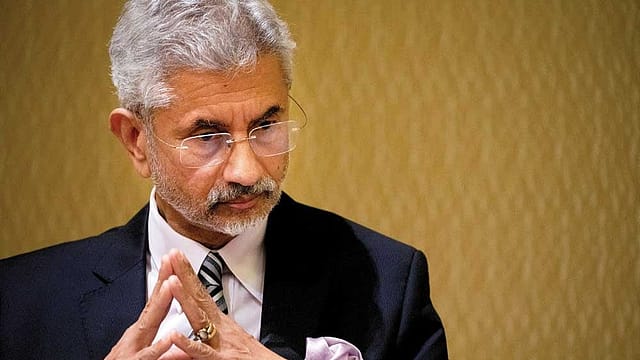
The world needs US-China relations at the “right temperature”, External Affairs Minister S Jaishankar said on Sunday, arguing that emerging and middle powers must build flexible partnerships to protect their interests in an increasingly competitive global order.
Speaking at the Munich Leaders Meeting in New Delhi, Jaishankar linked that strategic challenge to a wider agenda: stronger India-Europe ties, resilient supply chains, cooperation in defence and space, and artificial intelligence that serves public needs.
His starting point was a world being reshaped by Washington’s choices and Beijing’s rise.
“The landscape today is primarily marked by a radical repositioning of the United States,” he said, describing it as a “posture of choice” through which America had “deliberately become a lonelier power”.
China’s growing influence was the second defining feature. The resulting competition, he argued, extended well beyond the two countries and had encouraged governments to weaponise whatever advantages they possessed.

The Health and Wellness Issue
25 Sep 2026 - Vol 05 | Issue 39
THE ‘GOLDILOCKS’ BALANCE
Jaishankar used the idea of a “Goldilocks scenario” to describe the balance other countries would seek in US-China relations.
“You don’t want it to be too hot; you don’t want it to be too good; you want it somewhere in between at the right temperature,” he said.
The challenge was complicated by economic interdependence. Countries could exercise influence through their control of production, their importance as suppliers, the size of their markets or their purchasing power.
“The question in an interdependent world is: who leverages what?” he asked.
The advantage, he said, lay with the player commanding a greater combination of these factors and possessing the determination to use them.
For emerging and middle powers, that meant paying closer attention to their own strengths, reducing vulnerabilities and broadening their partnerships.
COOPERATION WITHOUT IDENTICAL WORLDVIEWS
Jaishankar argued that countries no longer needed to agree on everything to work together.
“The days when you have to have an identity of views or a very strong congruence of interest, I think that’s too high a bar today. If you have enough touch points, that is good enough for countries to work together,” he said.
Such arrangements were already taking shape as governments diversified economic and security relationships and sought more resilient supply chains.
He also drew a distinction between countries emerging from colonial histories and those reassessing the security and predictability previously offered by established alliances. The first group included countries such as India; the second included powers in the Global North.
Their circumstances differed, but they shared a desire to become more relevant and exercise greater influence.
“In this process of de-risking, diversifying, and hedging, slowly a new architecture is coming into place,” he said.
FROM CHIPS TO HEALTH SECURITY
The minister proposed cooperation across conflict resolution, critical technologies, healthcare, connectivity, climate action, defence and space.
On peace and security, he asked whether countries beyond the largest powers could pool resources and support one another’s diplomatic efforts to address conflicts and tensions.
In technology, national size did not necessarily determine influence.
“You don’t have to be the biggest country in the world to dominate the world of chips or to even dominate machine production,” he said.
Health security, meanwhile, required more diversified production of active pharmaceutical ingredients and medicines. The movement of skilled workers could help address mismatches between countries with labour demand and those with the demographics to supply it.
Jaishankar also identified changes in defence production and space technology as opportunities for new partnerships.
“There is today a substantial agenda for emerging and middle powers to cooperate,” he said. “The world is changing, its agenda is changing, the landscape is changing, the architecture is changing.”
INDIA-EU FTA’S WIDER IMPACT
Much of that agenda, Jaishankar said, also applied directly to India’s relationship with Europe.
Responding to former German ambassador Wolfgang Ischinger, he identified advanced manufacturing, semiconductors, innovation and life sciences as areas where cooperation could deepen.
He described the India-EU free trade agreement as a potential catalyst for changes extending beyond commerce.
“With the European Union, having an FTA makes you a serious partner. It is a real game changer in how you perceive each other,” he said.
Greater familiarity between businesses, regulators and government institutions could encourage cooperation in areas not directly covered by trade, he argued.
“I expect the FTA to actually have almost like a cascading impact through the entirety of our relationship with Europe.”
The agreement was jointly announced by Prime Minister Narendra Modi and European Commission President Ursula von der Leyen at the India-EU Summit in New Delhi on January 27, according to the report.
Bilateral goods trade stood at $136.54 billion in FY25, while services trade reached $83.10 billion in 2024.
DEFENCE, SPACE AND CLEAN ENERGY
Jaishankar pointed to Europe’s efforts to rebuild its defence industry and strengthen its space capabilities as openings for collaboration with India.
Indian startups and established defence manufacturers were finding partners abroad, he said, while the country was expanding its space launch capabilities and supporting infrastructure.
On climate action, he emphasised the role European technology and business expertise could play in India’s renewable energy ambitions. Cooperation would need to involve companies as well as governments.
“When I laid out what could be an emerging middle power agenda, frankly, in my mind a lot of it was really an India-Europe agenda,” he said.
But he cautioned against limiting the relationship to immediate commercial or strategic gains. India and Europe also needed to discuss the international institutions and arrangements that would shape their future.
“What we need is a better UN. The idea is not to throw away the UN, but to fix the UN,” he said.
‘AI FOR HUMANITY’
Turning to artificial intelligence, Jaishankar said India wanted the technology to be accessible, affordable and relevant to everyday needs.
He cited the country’s use of digital capabilities for governance and social transformation, along with the vision presented at the AI Impact Summit in New Delhi in February.
“It is a sort of AI for humanity; develop user cases which are relatable to people’s needs. That is the kind of vision that we have,” he said.
He also highlighted safety and security concerns, making a case for policy oversight.
“This is too major an issue to leave it to the market, so to speak.”
Jaishankar said there was considerable convergence between Indian and European thinking on AI. He also described global capability centres as a growing link between their economies, enabling knowledge-based collaboration without requiring workers to move physically between countries.
GROWTH BRINGS GREATER RESPONSIBILITY
Asked about India’s position over the next five to 10 years, Jaishankar said the country had the potential for sustained economic expansion, supported by its demographics.
“In the case of India, because we have decades of high growth ahead of us, and we have all said and done, a demography that will sustain that growth,” he said.
India would need to develop an approach suited to contemporary opportunities rather than simply reproduce earlier industrialisation models, he added.
He cited interest in BRICS as evidence that countries wanted a wider range of diplomatic choices. The grouping’s next task, he said, was to build a deeper agenda to match its expanding role.
The broader shift also carried obligations. As US support for the existing international system diminished, other countries would have to contribute more.
“As our economy grows, our standing grows, our responsibility and contributions also have to grow,” Jaishankar said.
“Where global goods are concerned, we can’t speak of a multi-polar world for everything else and say we remain unipolar for certain things.”
With inputs from ANI