Intruder Alert: District after district in Assam has seen a rapid growth in the numbers of illegal immigrants from Bangladesh
It is easy to miss the temple dedicated to Lord Shiva at Dhalpur in Darrang district. Perched on the top of a forested hill, one cannot see the temple except from a close approach. At the base of the southern slopes of the hill, the Brahmaputra flows quietly.
The temple is famous among devotees in Assam and other parts of India as well. But the history of the temple and the area around it has been turbulent. As one goes down the large, artificially created embankment close to the temple area, one enters Gorukhuti, the location of an agricultural research station of the Assam government. A large portion of the research station’s land had been encroached on by illegal immigrants from Bangladesh, almost all of them Muslim. An anti-encroachment drive in 2021 turned violent and became a rallying point for ‘secular’ activists on how Bengali-speaking Muslims were being ‘victimised’ in the state.
The truth is considerably more complex. Only a portion of the land was unencumbered. Today elephant grass and wild vegetation grow over that small portion. But a much larger area to the south, near the banks of the Brahmaputra, remains in the clutches of illegal immigrants. One part, the large settlement in Phuhuratoli, described by locals as “mini-Bangladesh”, is out of bounds for everyone except the illegal immigrants. At the western end of this huge island mass of land lies Khalihai Gaon, the de facto ‘border’ that separates the Bangladeshi Muslim-dominated area from locations populated by Assamese, both Hindu and Muslim.

Losing Memory
16 Oct 2026 - Vol 05 | Issue 42
The making of a medical and social emergency
“We dare not cross this line,” Dijan Kalita, a local land rights activist told Open in March this year, as he pointed to Phuhuratoli from a high bank at Khalihai Gaon.
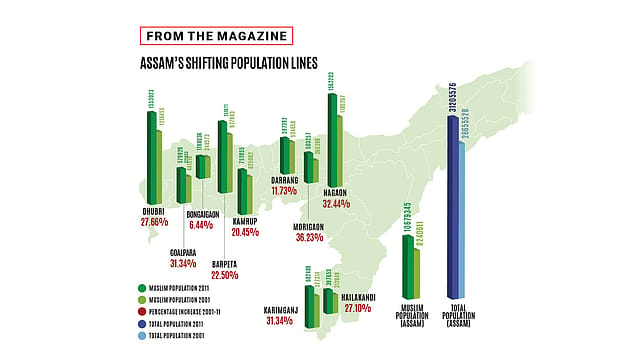
Darrang is a typical district of Assam where encroachment of land by illegal immigrants from Bangladesh has caused unrest among indigenous people of all religious and ethnic backgrounds. Darrang was the epicentre of the anti-illegal immigrant agitation in the state back in 1978 when the death of the sitting MP of Mangaldoi constituency led to the discovery of an unnatural increase in the number of voters. The demographic situation in Darrang was repeated all over Lower Assam, the middle Brahmaputra Valley districts of Morigaon and Nagaon, and the Barak Valley districts of Karimganj and Hailakandi.
These districts, in the graphic shared above, have witnessed a larger than average growth in the Muslim population compared to Assam as a whole. The rate of population growth in the state and the rate of Hindu population growth in the state between 2001 and 2011—the last decade for which Census data on religion is available—is lower than the growth of the Muslim population. These trends cannot be explained by fertility alone. Assam’s total fertility rate (TFR) has fallen below the replacement level going by the sixth edition of the National Family Health Survey (NFHS) (2023-24) at 1.6. But TFR for Muslims in the state stands at around 2, significantly higher than the overall TFR. The unnatural growth of the Muslim population in the state’s demographically challenged districts continues to raise political concerns.
At the national level, among academics and activists who write about Assam—and the two groups march in lockstep on this issue—the demographic problem is either dismissed outright or elided as something insignificant. The concerns of Assam’s people about land steadily falling into alien hands are also dismissed as imagined. This, however, is a lived reality in the state. District after district has witnessed a large growth in the numbers of Bangladeshi Muslims.
It is interesting to note how these concerns are dismissed. When the anti-encroachment drive began in Gorukhuti in 2021, the story of the Dhalpur temple’s priest—Karna Das—attracted attention once again. Das was allegedly murdered by Muslims a decade ago (in 2011) and his wife, Parbati Das, was converted to Islam. No sooner had the anti-encroachment drive begun that stories in ‘progressive’ outlets began appearing that Parbati had converted of “her own free will.” Anyone who has gone and examined the situation in this part of Darrang knows that there is no ‘free will’ in those remote and demographically forbidding areas. That is the reality of Assam’s demographic challenge. Everything else is ‘progressive” fiction.