India’s Onion Problem: Why Tamil Nadu’s ₹35 Fix May Still Leave Families Crying
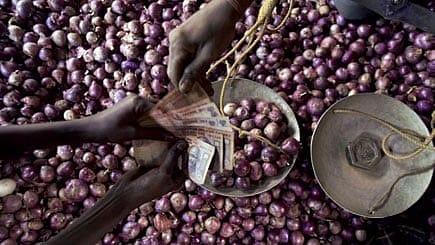
An onion can make you cry even before you cut it. Tamil Nadu has become the latest state to discover this uncomfortable Indian truth. From September 3, the state government will sell onions at ₹35 a kg through 8,739 urban ration shops, cooperative outlets and Amudham stores. Open-market prices have climbed to approximately ₹56–₹60 a kg, pushed up by lower arrivals, adverse weather and higher transportation costs.
The intervention appears substantial. Around 80 lakh family-card holders are expected to benefit, with each family allowed to purchase one kilogram.
Then comes the arithmetic. The government has initially procured 1,000 tonnes of onions through the National Agricultural Cooperative Marketing Federation of India, or NAFED, and the National Cooperative Consumers’ Federation, or NCCF.

Losing Memory
16 Oct 2026 - Vol 05 | Issue 42
The making of a medical and social emergency
One thousand tonnes equals 10 lakh kilograms. At one kilogram per card, that is enough for 10 lakh families.
Tamil Nadu has identified 80 lakh potential beneficiaries. Unless more onions are procured, the first consignment can reach only one in eight eligible families, and that too only once. Supplying all 80 lakh cardholders with a kilogram each would require 8,000 tonnes. The state’s subsidised sale may offer immediate relief to the fortunate families who reach the counter in time. Whether 1,000 tonnes can influence prices across a market as large as Tamil Nadu is another question. And that exposes the larger Indian onion problem. Governments usually begin peeling the crisis after households have already started crying.
Why Are Onion Prices Rising Again?
India grows onions in three seasons, but all onions are not equal. The rabi crop, harvested largely between March and May, accounts for around 60 per cent of annual production. It has lower moisture content and can be stored for several months, making it the bridge between harvest seasons.
Kharif onions generally arrive between October and December, while the late-kharif crop follows early in the year. These crops have higher moisture and shorter shelf lives. If the stored rabi stock begins rotting or running out before the fresh kharif crop reaches markets, India enters its familiar late-monsoon onion squeeze.
That is what appears to be happening in 2026.
Onion prices at Lasalgaon in Maharashtra, the country’s most influential onion-trading market, reportedly jumped by approximately 25 per cent within a week in August. Delayed kharif arrivals, weather-related damage and deterioration in stored rabi onions tightened supplies just as the lean season began.
Tamil Nadu depends significantly on arrivals from producing states such as Maharashtra and Madhya Pradesh. When fewer trucks leave those markets, or the onions loaded on them have already become more expensive, Chennai pays for it.
The irony is that the warning signs were visible months ago.
In February and March, onion farmers were struggling with collapsing wholesale prices. Late-kharif onions reportedly sold below the estimated cost of production in parts of Maharashtra. Farmers with rabi onions stored their better-quality produce in the hope of securing higher prices later.
By August, the cycle had reversed. The farmer who had cried over ₹8 or ₹10 a kilogram watched the consumer pay ₹60. The onion had changed hands. The tears had changed faces.
If India Produces So Many Onions, Why Do Prices Keep Exploding?
India is among the world’s largest onion producers. Its recurring crises are therefore rarely as simple as the country “running out” of onions.
The problem lies between the field and the kitchen.
Onions are semi-perishable. They need ventilation, controlled humidity and careful curing after harvest. Unlike potatoes, they cannot simply be placed in conventional cold storage and forgotten. Once removed from very low temperatures, onions can sprout rapidly.
The Indian Council of Agricultural Research says 30–40 per cent of onions can be lost during storage. In natural calamities, the loss can exceed 40 per cent. Traditional storage structures can suffer even greater deterioration over four months, while a controlled storage design developed by ICAR recorded dramatically lower losses. Yet such infrastructure has not become widely accessible across the farm economy. ICAR’s onion-storage assessment
This means a bumper crop on paper can become a much smaller supply by the time the lean months arrive.
A few weeks of unusual heat can accelerate moisture loss. Excess humidity can cause rotting. Rain can damage onions in the field and those awaiting transportation. Farmers without adequate storage are forced to sell when arrivals are heavy and prices are low. Traders or larger farmers capable of holding stock gain greater influence over when onions return to the market.
Research into India’s onion market has also pointed to uncertain market arrivals, fragmented supply chains, intermediary power and abrupt trade policies as contributors to volatility. Export restrictions may suppress overseas demand, but they do not instantly repair a damaged crop or transport onions to the city where prices are rising. Research on onion-price volatility
India produces onions in millions of tonnes. It still struggles to preserve, transport and release them with equal efficiency.
Doesn’t the Government Maintain an Onion Buffer?
It does. The Centre uses the Price Stabilisation Fund to procure rabi onions through NAFED and NCCF when supplies are plentiful. Those onions are released during the lean season through retail outlets, mobile vans and state governments.
For 2026-27, the Centre set a procurement target of two lakh tonnes. Around 1.21 lakh tonnes had reportedly been procured by late August, well short of the target. Media reports subsequently indicated that roughly 30 per cent of the available buffer had suffered damage.
That is the other arithmetic capable of producing tears. The buffer is meant to compensate for market losses. The buffer itself can rot.
In July, the Centre raised the procurement price by 13 per cent, from ₹1,875 to ₹2,125 per quintal, to encourage farmers to sell to NAFED and NCCF. At that point, the government said onion arrivals remained robust and the all-India average retail price was approximately ₹31 a kilogram. Union government’s July 2026 procurement update
Within weeks, the Centre began releasing onions at ₹35 a kilogram through vans and retail points. Special trains carrying buffer onions were dispatched to consumption centres. An “Onion Express” carrying around 840 tonnes arrived in Chennai from Maharashtra ahead of Tamil Nadu’s subsidised sale.
Trains can move onions faster. They cannot restore the stock that was never procured or has already spoiled.
Why Does a Humble Onion Terrify Indian Politicians?
Because the onion has an electoral history.
Unlike an expensive fruit or an occasional vegetable, onion forms the flavour base of meals across income groups, regions and cuisines. Its price is visible. It is purchased frequently. A sudden spike enters the household budget before an official inflation index has time to explain it.
In 1980, Indira Gandhi turned rising onion prices into a powerful campaign weapon against the government led by Charan Singh. The contest became known as the “onion election”, and Gandhi returned to power with a landslide.
In 1998, onions struck again.
Prices soared ahead of the Delhi Assembly election. The ruling BJP government was defeated, and Sheila Dikshit led the Congress to power. The onion spike was not the only factor behind the result, but it became the enduring symbol of the government’s inability to protect household budgets. The World Bank later described the supply shock and price escalation as a major contributor to the ruling party’s rout. World Bank account of the 1998 onion shock
The political memory has survived every change of government.
In 2010, heavy rain damaged crops and onion prices rose by 346 per cent over 20 days, forcing the Union government to ban exports. When fresh arrivals subsequently drove prices down, the ban angered farmers and had to be lifted. Reuters account of the 2010-11 onion crisis
In 2019, Finance Minister Nirmala Sitharaman’s remark in Parliament that her family did not consume much onion or garlic became the defining soundbite of another price spike.
In December 2023, India banned onion exports after domestic prices more than doubled in three months. The decision sought to protect Indian consumers before the 2024 general election, but it raised prices in neighbouring countries and angered domestic growers deprived of lucrative overseas markets. Reuters on India’s 2023 export ban
Every government remembers 1980 and 1998. That is why an onion price of ₹60 can produce political panic far beyond its numerical contribution to inflation.
Will Tamil Nadu’s ₹35 Onion Bring Prices Down?
It may provide targeted relief. It is unlikely to solve the underlying problem by itself. Selling at ₹35 gives a family purchasing one kilogram a saving of roughly ₹21–₹25 compared with prevailing market prices. For low-income households, that relief is real.
The quantity, however, is modest.
Even if all 1,000 tonnes reach consumers without leakage or spoilage, the onions can serve only 10 lakh families once. Distributed equally among 8,739 shops, the initial stock works out to roughly 114 kilograms per outlet. At one kilogram per card, an average shop could serve approximately 114 families before exhausting its share.
The actual distribution will vary according to local demand and allocation. Yet the broad mismatch remains: 80 lakh eligible cards, 10 lakh kilograms of onions.
Subsidised sales can also exert limited pressure on private retailers if the released quantity is large enough and concentrated in markets experiencing the sharpest spike. A thinly spread intervention may create long queues without materially changing the wider price. The programme therefore needs two measurements.
How many cardholders actually received onions? And did retail prices outside ration shops fall? The first measures welfare. The second measures market stabilisation. Announcing the number of eligible cardholders answers neither.
Why Is There Never a Permanent Fix?
Because India’s onion policy is forced to protect two groups whose immediate interests can point in opposite directions. When prices collapse, farmers want government procurement, unrestricted exports and compensation. When prices rise, consumers want subsidised sales, export restrictions and rapid releases from the buffer.
A policy that pleases the kitchen can punish the field. A policy that rewards the field can become dangerous at the ballot box.
Governments therefore swing between interventions. They buy onions after farmers complain about low prices. They increase procurement rates when the buffer target is missed. They release stock when retail prices rise. They restrict exports when urban anger intensifies. Then they relax restrictions when farm-gate prices collapse.
The onion travels from glut to scarcity and back without acquiring the storage and market architecture that could soften both extremes.
A lasting response requires better farm-level storage, wider adoption of low-loss controlled structures, real-time tracking of privately held stocks, predictable export rules and procurement before distress sales hollow out farmer incomes. Buffer onions must be audited for quality throughout storage, rather than counted only when purchased. Releases must be large enough and accurately targeted if they are expected to influence market prices.
Otherwise, India will continue performing the same seasonal ritual. Farmers will dump onions when prices collapse. Consumers will ration them when prices climb. Governments will load them onto trains, vans and ration-shop counters. And the onion will keep doing what it does best. Making everyone cry.
With inputs from ANI & agencies