India's Newest Science Classroom Has No Walls. Here's Why Lucknow's New Eco Hub Matters
Can a walk through a garden teach climate change better than a textbook? Can scanning a QR code on a centuries-old banyan tree make science more accessible than a classroom lecture? The government believes the answer is yes.
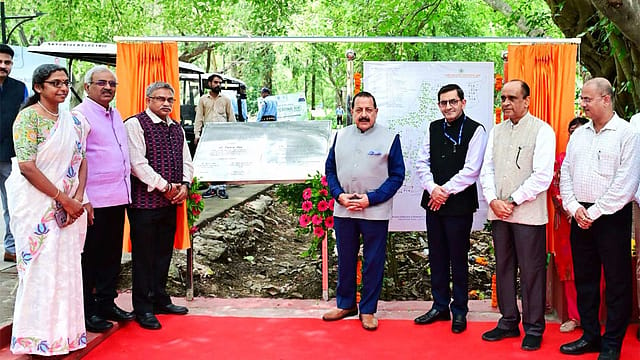
Union Science and Technology Minister Jitendra Singh has inaugurated Prakriti Gyan Dham, India's first dedicated Eco-Educational Hub, at the CSIR-National Botanical Research Institute (NBRI) in Lucknow. Developed as a "living laboratory", the project aims to bridge the gap between scientific research and everyday life through immersive learning, heritage conservation and digital technology.
What exactly is Prakriti Gyan Dham?
It is not a conventional botanical garden. The new facility combines botanical research, biodiversity conservation, environmental education and India's cultural heritage into a single interactive campus. Instead of simply displaying plants, the hub encourages visitors to understand how ecosystems function, why biodiversity matters and how science can solve real-world environmental challenges. According to the Ministry of Science and Technology, the project is designed as a national destination for students, researchers, educators, entrepreneurs and ordinary citizens interested in nature and sustainability.

Zeroing In on ECI
09 Oct 2026 - Vol 05 | Issue 41
Constitutional legitimacy versus political opportunism
Why is the government calling it a first-of-its-kind initiative?
Because it attempts to merge science with storytelling. Visitors don't merely see plants. They learn the history behind them. One of the centrepieces is PAaVan Path—short for Plants and Associated Vegetations for Appreciating Nature—an interpretive trail that guides visitors through India's diverse ecological landscapes. The concept was developed by CSIR-NBRI to transform botanical collections into immersive learning experiences using digital interpretation and curated landscapes.
What's special about the Heritage Garden?
Perhaps the most fascinating attraction is the Indian Heritage Garden. It brings together descendants of some of India's most historically significant trees. Among them are the Bawan Imli tamarind tree associated with the sacrifice of 52 freedom fighters in Uttar Pradesh, the original Dussehri mango from Lucknow, descendants of trees linked to Mahatma Gandhi's Dandi March, the Patalpuri Banyan of Prayagraj and the mango tree Gandhi planted at Bhitiharwa in Bihar. Visitors can scan QR codes to hear the historical, cultural and botanical story behind each tree, effectively turning the landscape into an open-air digital museum.
Why are endangered plants getting a dedicated space?
Because India is one of the world's 17 megadiverse countries, yet faces growing biodiversity pressures from urbanisation, climate change and habitat loss. The Vibhav Enclave showcases rare and threatened plant species from across India, while the Bhairav Enclave brings together the official state plants of every Indian state and Union Territory. The idea is to make conservation tangible rather than abstract, helping visitors understand what is being lost and why protecting native species matters. India has also committed to expanding biodiversity conservation under its updated National Biodiversity Strategy and Action Plan, which aligns with global targets for protecting ecosystems by 2030.
Why is bamboo getting so much attention?
The hub includes a Bamboosteum housing more than 40 indigenous and exotic bamboo species. That reflects bamboo's growing importance in India's green economy. Scientists see bamboo as a renewable material capable of supporting sustainable construction, ecological restoration, carbon sequestration, soil conservation and rural livelihoods. As countries search for climate-friendly alternatives to conventional materials, bamboo is increasingly viewed as an important bioresource rather than merely a traditional craft material.
Why is CSIR-NBRI important in the first place?
The Lucknow-based institute has been one of India's leading botanical research centres for decades. Its historic botanical garden, spread across 65 acres, houses more than 6,000 plant species collected from India and around the world. It is part of the global Botanic Gardens Conservation International (BGCI) network and has long served as a centre for plant conservation, education and scientific research. In recent years, the institute has also embraced digital technologies. It has introduced AI-powered herbarium management, QR-enabled interpretation systems and satellite-based tools for ecological restoration, signalling a broader shift towards technology-enabled conservation.
Why does this matter beyond Lucknow?
Because the project reflects a larger change in how science is being communicated. Instead of expecting citizens to visit laboratories or read research papers, institutions are increasingly trying to bring science into public spaces through interactive exhibits, digital storytelling and experiential learning. Speaking at the inauguration, Jitendra Singh argued that scientific institutions should move beyond their campuses and use technology and public engagement to connect farmers, entrepreneurs, students and industry with scientific knowledge and innovation.
Could this become a model for other cities?
That appears to be the long-term ambition. If successful, Prakriti Gyan Dham could become a template for future science parks and biodiversity centres that combine conservation, education, tourism and technology. In an era defined by climate change, biodiversity loss and environmental awareness, the next generation may not learn about nature only through textbooks. They may learn it by walking through forests, scanning heritage trees and discovering that science is sometimes best understood outdoors.
(With inputs from ANI)