INDIA’S ILLEGAL GOLD RUSH | Why Smugglers Are Back Inside Bodies, Borders & Airport Corridors
The iron box contained more than iron. A passenger arriving at Kozhikode from Jeddah carried what appeared to be an unusually heavy household object. Officers from the Directorate of Revenue Intelligence dismantled it and discovered cavities carved into its metal body. Inside sat 549 grams of 24-carat gold.
The iron box was almost conventional compared with what DRI found elsewhere during the same nationwide operation.
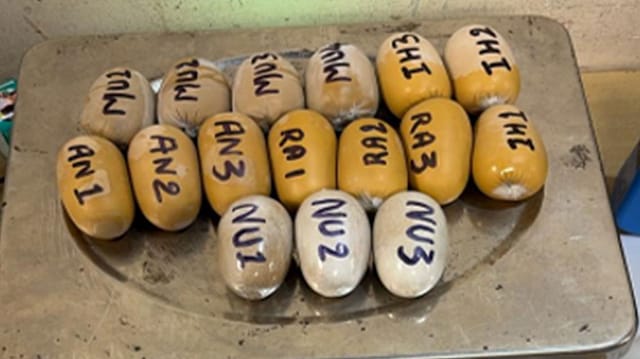
At Kolkata, semi-solid gold paste had been packed into undergarments and jeans. Eleven thick, unfinished chains had allegedly been handed from one passenger to another before they crossed the airport’s Green Channel. Four other carriers were caught during a domestic road journey with five capsules of gold paste concealed inside their bodies.

Zeroing In on ECI
09 Oct 2026 - Vol 05 | Issue 41
Constitutional legitimacy versus political opportunism
Near the Bangladesh border in West Bengal, officers recovered 125 gold bars weighing 15.61 kg from the home of a woman in Nadia district.
At Mumbai airport, the smuggling operation had reportedly reached behind the security cordon. Foreign passengers travelling through Mumbai from Dubai, Bangkok and Malé allegedly handed over gold to an airport employee who could remove it without passing through the ordinary customs route. DRI recovered 6.85 kg of gold dust mixed with wax and packed inside 16 capsules. Five foreign nationals and the employee were arrested.
In Assam, gold bars allegedly entered through the Bangladesh border. In Tamil Nadu, gold and nearly 10 kg of silver reportedly crossed the sea from Sri Lanka. In Kerala, a passenger arriving from Ras Al Khaimah carried two packets of gold compound on his body.
Over a few days, the same metal entered India by aircraft, car, village home and coastal route.
The DRI seized more than 42 kg of foreign-origin gold and almost 10 kg of silver, together valued at over ₹65 crore. Twenty-five people were arrested.
India has rarely lacked gold. Why, then, is the country still smuggling it through rectums, underwear and iron boxes? The immediate answer is hidden inside another number: Fifteen per cent.
When the Duty Rose, the Smugglers Returned
India reduced the import duty on gold and silver from 15 per cent to 6 per cent in July 2024.
The decision attacked the economics of smuggling. A syndicate risks seizure, arrest, confiscation and payment to couriers only when the price difference between legal and illegal gold is large enough to reward the journey.
Reduce the tax and the reward begins to disappear.
The policy appeared to work. ICRA said official bullion imports increased during 2024-25 even though overall gold demand remained broadly stable. More of the metal was entering through declared channels and less appeared to be travelling through the shadow economy.
Customs seizures reflected that shift. Authorities seized 4,971.68 kg of gold in 6,599 cases during 2023-24. The figure declined to 2,600.40 kg across 3,005 cases in 2024-25. In 2025-26, Customs reported the seizure of 646.66 kg in 836 cases, according to data placed before Parliament.
A seizure is not a direct measure of total smuggling. Lower recoveries can indicate reduced trafficking, weaker detection or both. Yet the fall followed precisely the economic logic expected after the duty cut.
Then India reversed course.
On May 13, 2026, the government raised the import tariff on gold and silver from 6 per cent to 15 per cent. The new structure comprised 10 per cent basic customs duty and a 5 per cent Agriculture Infrastructure and Development Cess. Imported gold also faced 3 per cent integrated GST.
The purpose was macroeconomic. India was spending heavily on imported precious metals while its currency and foreign-exchange reserves faced pressure. Raising the duty could curb legal imports, reduce dollar demand and generate revenue.
It also restored the smuggler’s margin.
Between April 1 and May 12, Customs seized 86.16 kg of gold in 165 cases. Between the May 13 duty increase and June 30, it seized 160.91 kg in 287 cases.
The quantity caught nearly doubled in seven weeks. Arrests rose from 67 to 116, according to the parliamentary data. Silver seizures leapt even more dramatically, from 49.53 kg before the increase to 535.95 kg afterwards.
Those periods are not identical in length, and seizures fluctuate with intelligence and individual consignments. The direction nevertheless arrived with remarkable speed. Raise the legal price of entry and the illegal route becomes valuable again.
A ₹15-Lakh Margin on a Briefcase
Gold is unusually suited to smuggling.
It carries enormous value in little physical space. It does not rot, leak, expire or require refrigeration. It can be melted, recast and stripped of identifying marks. Once a foreign bar enters a local refining or jewellery network, establishing its origin becomes difficult.
At a domestic price of roughly ₹1.5 lakh per 10 grams, one kilogram of gold is worth approximately ₹1.5 crore. A 15 per cent import duty creates a theoretical tax difference exceeding ₹20 lakh on that kilogram before other costs and price variations are considered.
The syndicate must pay for tickets, couriers, handlers, transport and losses from intercepted consignments. Even after those expenses, a substantial illicit margin can survive. The 42 kg seized in the latest DRI operations represented more than ₹65 crore in metal. At that scale, avoiding even part of the formal import burden can create several crores of rupees for the network.
The carrier receives only a fraction. Some are frequent travellers recruited for repeated journeys. Others are migrant workers offered a free ticket, cash or help with travel expenses. Organisers may divide one consignment among several bodies so the loss of one courier does not destroy the entire shipment.
The people caught at the airport are, therefore, often the most visible and disposable members of the enterprise. Behind them may stand foreign suppliers, travel coordinators, airport insiders, border handlers, transporters, refiners, jewellers and financiers.
The capsule ends in the rectum. The business begins much farther away.
The Gold Paste Revolution
Traditional gold bars are easy to recognise on an X-ray. Smugglers responded by changing the physical identity of the metal.
Gold can be pulverised and mixed with wax, chemicals or binding substances to create a paste or semi-solid compound. The mixture can be moulded into packets, sewn into clothing or concealed against the body. After it reaches its destination, the compound is heated and processed to recover the metal.
The method sacrifices some purity and requires extraction. It gains flexibility.
In Mumbai, the latest consignment arrived as gold dust in wax. In Kolkata, officers found gold-containing paste inside clothes and bodily cavities. At Kochi, compound-form gold was carried in packets concealed on a passenger.
Chains offer another disguise. Instead of importing recognisable bullion stamped with a foreign refinery’s mark, gold can be worked into crude ornaments and presented as personal jewellery.
Vehicles carry specially fabricated compartments. Domestic flights can be used to move gold away from the international airport at which it entered. Coastal boats avoid airports altogether. Couriers travelling through northeastern land routes can merge with ordinary road and rail traffic after crossing the frontier.
The evolution has turned gold smuggling into a logistics industry. Every enforcement improvement produces another experiment in concealment.
The Man With the Airport Pass
The Mumbai operation reveals why the airport employee may matter more than the passenger.
A traveller ordinarily encounters immigration, baggage screening, customs surveillance and the possibility of physical examination. An employee with legitimate access can move between controlled spaces and public areas more easily.
The alleged system used transit passengers.
Travellers from Dubai, Bangkok and Malé did not necessarily need to clear Indian Customs as ordinary arriving passengers if their onward journey placed them inside the international transit area. The gold could be transferred to someone with airport access and removed through an employee route.
This changes the risk calculation. The courier carries the metal only as far as a controlled handover point. The insider supplies the bridge around Customs.
Airport involvement is not unprecedented. Gold networks have previously recruited airline employees, ground-handling staff, loaders, cleaners and other workers with access to aircraft or restricted zones. Gold has been hidden inside washrooms, under seats or behind panels and collected after the international aircraft begins operating on a domestic sector.
The latest arrests suggest DRI was pursuing the chain rather than stopping at the carriers.
That distinction is crucial. Arresting five couriers may interrupt five journeys. Identifying the employee, handler, financier and receiving jeweller can damage the route itself.
India Imported $72 Billion Legally. The Smugglers Still Found Customers
India imported a record $71.98 billion worth of gold during 2025-26, an increase of 24 per cent from the previous year, according to Commerce Ministry data.
The physical quantity actually declined by 4.76 per cent to 721.03 tonnes. India was buying slightly less gold and paying vastly more for it as international prices surged. Business Standard
That divergence matters. Gold is purchased in tonnes but smuggled for margin. When the price rises, the value compressed into every capsule rises with it.
India’s appetite remains formidable. The World Gold Council estimated demand at 802.8 tonnes in 2024, the highest in nine years. Record prices weakened jewellery purchases during 2025, but investment demand remained resilient as households sought protection from inflation, market volatility and geopolitical uncertainty.
Gold in India performs several jobs simultaneously. It is wedding jewellery, inherited wealth, emergency collateral, religious offering, status symbol and investment. In communities with limited access to formal finance, it remains a portable savings account that can be pledged or sold without waiting for a bank.
Morgan Stanley estimated that Indian households held approximately 34,600 tonnes of gold by June 2025. The estimate valued that stock at $3.8 trillion at prices prevailing when the calculation was published.
The precise total varies sharply across studies because private gold cannot be counted like a central bank reserve. The broader fact does not. India has one of the largest private gold hoards on Earth. A market that deep can absorb legally imported bullion, recycled jewellery and smuggled metal without visibly changing its appearance at the retail counter.
Where Does the Illegal Gold Go?
A seized foreign bar carries evidence of its journey. A melted bangle does not.
Smuggled bullion can pass to aggregators and refiners who erase foreign markings. It may then enter jewellery-manufacturing clusters, wholesale markets or informal cash transactions. Documentation can be created downstream, particularly when illegal metal is mixed with recycled domestic gold.
India’s enormous old-gold market provides natural camouflage. Families routinely exchange jewellery, sell ornaments or give metal to jewellers for remaking. Refiners legitimately process scrap from thousands of sources.
The illegal gram can disappear inside the legal kilogram. Cash-heavy transactions add another attraction. Gold allows wealth to be compressed, transferred and stored outside conventional banking channels. It can settle informal obligations or convert unaccounted money into a physical asset with an internationally understood price.
This does not make every independent jeweller or cash buyer part of a smuggling network. It does explain why enforcement cannot end at the border. Demand for undocumented metal exists because somebody downstream is willing to melt, finance, certify or sell it. A successful investigation should follow the gold until it becomes jewellery.
Is Enforcement Winning?
The latest seizures demonstrate impressive coordination. DRI worked with the Border Security Force along the Bangladesh frontier, Customs personnel at airports and field units across Mumbai, Kolkata, Kochi, Kozhikode, Guwahati and Ramanathapuram. Officers detected consignments at multiple points in the chain.
But 42 kg can tell two opposing stories. It may show that intelligence has become sharper and agencies are penetrating organised networks. It may also show that trafficking has increased enough to generate frequent large recoveries.
No agency can know precisely how much gold crossed without detection. Smuggling estimates depend on differences between demand, legal imports, recycling and other imperfect measurements.
The historical seizure decline after the 2024 duty cut and the sharp increase following the May 2026 hike nevertheless provide a policy warning. Enforcement affects the probability of being caught. Tax policy affects the reward for taking the risk.
India cannot eliminate smuggling merely by lowering duties whenever illegal imports rise. The government must also manage foreign-exchange pressures, protect revenue and prevent trade arrangements from being abused. Nor can it assume that a 15 per cent wall will simply suppress demand. Gold demand in India has survived wars, currency crises, import restrictions and generations of government disapproval.
When the legal gate becomes expensive, part of the market searches for another entrance. This time it found an airport employee in Mumbai, a village home near the Bangladesh border, a boat from Sri Lanka and an iron box from Jeddah.
The DRI seized the gold. The duty recreated the treasure map.
(With inputs from ANI)