India’s Global Push: Spotlight On BRICS Meet and PM Modi’s Five-Nation Tour
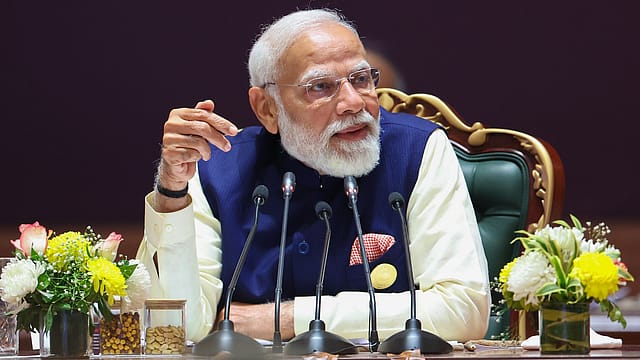
India’s foreign policy calendar for May 2026 reflects an assertive global strategy, combining multilateral leadership with high-level bilateral outreach. The Ministry of External Affairs has outlined a dual-track approach that aims to strengthen India’s position within global groupings while also “securing national interests” through key international engagements.
At the centre of this strategy is India’s role as host of the BRICS Foreign Ministers' Meeting, alongside a five-nation visit by Prime Minister Narendra Modi starting May 15.
What makes the BRICS meeting in New Delhi significant?
New Delhi is set to become a major diplomatic hub as it hosts the first significant ministerial-level BRICS engagement since the 2025 discussions held on the sidelines of the United Nations General Assembly.
The ministry noted that while participation details remain the “prerogative of member states,” visiting leaders are expected to “call on Prime Minister Modi” during the event. This underscores India’s central role in shaping dialogue within the expanded grouping.
The Modi Years
02 Oct 2026 - Vol 05 | Issue 40
A Nation Rebuilt
Addressing the evolution of BRICS, the ministry emphasised that the bloc functions “strictly on the basis of consensus.” It added that after two rounds of expansion, any future growth or policy changes will require “unanimous agreement,” a principle India is actively advocating during its chairship.
How does the Quad fit into India’s broader strategy?
Alongside BRICS, India is also engaging with the Quadrilateral Security Dialogue, commonly known as the Quad. The ministry confirmed ongoing and upcoming engagements, stating, “We are the host for Quad this year. As part of it, we have several meetings... We have some high-level meetings. We will keep you informed.”
This indicates that India is balancing multiple strategic platforms to expand its influence across regions and issue areas.
What are the key goals of Prime Minister Modi’s five-nation tour?
Prime Minister Modi’s visit from May 15 to 20 spans the United Arab Emirates, Netherlands, Sweden, Norway, and Italy.
The first stop in the UAE is particularly critical, focusing on energy security and the welfare of the large Indian diaspora. Talks with President Mohamed bin Zayed Al Nahyan are expected to prioritise “strengthening fuel supply chains” in a volatile regional environment.
The European leg shifts focus to sustainability and advanced technologies. Engagements in Norway and Sweden will centre on innovation and the blue economy, while Modi’s visit to Oslo for the 3rd India-Nordic Summit marks the first trip by an Indian Prime Minister to Norway in over four decades.
In the Netherlands and Italy, discussions are expected to focus on semiconductors and the “Joint Strategic Action Plan 2025-2029,” reflecting India’s push into high-tech and industrial partnerships.
How is India managing its neighbourhood ties?
The ministry also addressed regional relationships, describing ties with Nepal as “multifaceted.” Responding to reports about a missed engagement involving Foreign Secretary Vikram Misri, it pointed to a recent productive ministerial interaction in Mauritius as evidence of strong bilateral engagement.
On Bangladesh, the ministry maintained that relations are moving in a “positive direction,” supported by regular high-level communication.
What does this reveal about India’s global ambitions?
Taken together, India’s hosting of BRICS, its leadership role in the Quad, and the Prime Minister’s multi-country tour reflect a deliberate effort to expand its global footprint. By combining consensus-driven multilateralism with targeted bilateral partnerships, New Delhi is positioning itself as a key player in shaping geopolitical and economic outcomes.
(With inputs from ANI)