Indian Scientists Discover New ‘Viral Alarm Switch’ in Human Cells
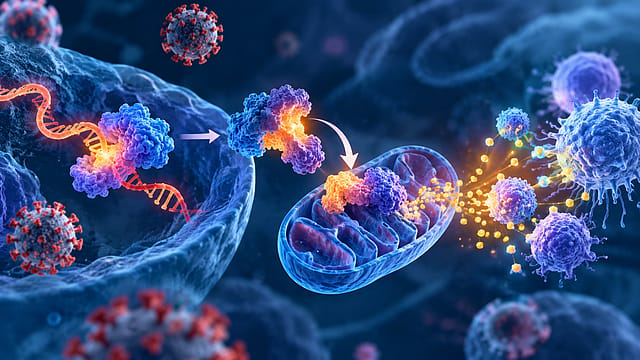
Scientists at the CSIR-Centre for Cellular and Molecular Biology (CSIR-CCMB) in Hyderabad have uncovered a key mechanism that human cells use to detect and fight viral infections.
Dr Santosh Chauhan’s group identified a dual-action protein that works as both an early warning sensor and an activator of the immune system. The study is published in The EMBO Journal.
THE PROBLEM: SPOTTING THE INTRUDER FAST
When a virus enters a cell, the host has to identify it quickly and sound the alarm before the virus can multiply. About seven years ago, Chauhan’s group hypothesised that a specialised group of human proteins could play a double role: detecting viral genetic material directly, and immediately tagging key cellular proteins to set off the immune alarm.

Losing Memory
16 Oct 2026 - Vol 05 | Issue 42
The making of a medical and social emergency
HOW DZIP3 WORKS
The team has now found that a protein called DZIP3 does exactly that. When DZIP3 detects viral RNA inside a cell, it changes shape to switch itself on. Once active, it moves to the mitochondria, the cell’s energy factories. There it tags and activates the major immune defence proteins. That sets off a strong immune response, releasing defensive molecules called Type-I interferons that stop the virus from multiplying.
The team showed that this pathway gives broad protection against several disease-causing viruses, including SARS-CoV-2, Chikungunya and Japanese Encephalitis.
FROM DISCOVERY TO DRUGS
Chauhan’s team is now developing small-molecule drug candidates to target and boost DZIP3 activity, with the aim of artificially strengthening the body’s natural antiviral immunity.
“Discovering how DZIP3 senses viral RNA and directly triggers the cell’s immune machinery gives us a deeper understanding of human immunity,” said Chauhan, Senior Principal Scientist at CSIR-CCMB and the study’s lead author. He said targeting DZIP3 with small molecules “could lead to broad-spectrum antiviral therapies against emerging viral threats.”
Dr Rinku Sahu was the first author, with collaborators from national and international institutions. The research was funded by the Department of Biotechnology, Government of India.
With inputs from ANI