Indian Navy’s future war plan: Navy Chief backs Agniveers as warfare expands to cyber, space, AI
What does it take to prepare a navy for a war that may not be fought only at sea? Increasingly, the answer involves satellites, cyber networks, artificial intelligence, surveillance systems and personnel trained to operate across different platforms. For the Indian Navy, preparing for that future also means rethinking how it recruits and retains its sailors.
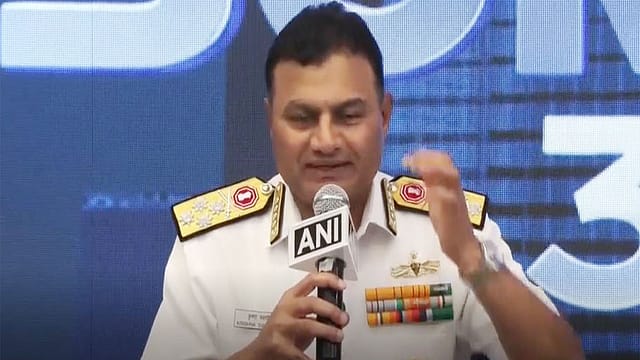
At the ANI National Security Summit 3.0 in New Delhi on Monday, Navy Chief Admiral Krishna Swaminathan spoke about two sides of this transformation: the changing character of warfare and the role of Agniveers in the force. His message was that the Navy is equipped for today's conflicts, but cannot afford to stop preparing for tomorrow's.

The Wealth Issue 2026
06 Nov 2026 - Vol 05 | Issue 45
Portraits of Dreamers and Doers under 35
Indian Navy says warfare has changed dramatically in five years
Swaminathan said the pace of geopolitical change and technological innovation had accelerated dramatically, altering how conflicts are planned and fought.
"A lot has changed in the last four decades. I would actually say a lot has changed in the last five years itself, because the speed at which geopolitics has changed in the last four or five years has been quite staggering. Technology has erupted in all kinds of forms in all streams of warfare, and so the character of war and warfare itself has changed very, very tremendously," he said.
He pointed to the growing availability of sophisticated but relatively inexpensive technology, which has expanded the number of players capable of participating in conflicts.
"The number of players who are involved in any kind of conflict has just widened quite a lot, from state actors, non-state actors, all kinds of people, because of the phenomenon that we call democratisation of technologies," he said.
Cyber, space and surveillance are reshaping the battlefield
The traditional battlefield of land, sea and air is no longer enough to describe modern military operations. Swaminathan said the Navy now recognises cyber, space and the cognitive domain as additional theatres of warfare, with electromagnetic capabilities also becoming increasingly important.
Satellite surveillance, in particular, has made it harder for military movements and installations to remain hidden.
"Because of space being such an important feature in everything that militaries do, the battlespace has become virtually transparent. The number of surveillance satellites that the world deploys simply for keeping the Earth under observation has been quite staggering, and it has increased the transparency of the battlespace quite a lot. So I would say there's been a tremendous, tremendous change," he said.
He described the Navy's own transformation over four decades as "exponential", citing improvements in stealth, construction, weapons, range and surveillance capabilities. "We are prepared for today's wars and we are preparing for future wars," he said.
Navy Chief says Agniveers can serve on ships and submarines
The Navy's readiness, Swaminathan indicated, also depends on the people operating its increasingly sophisticated platforms. Responding to a question about where Agniveers can be deployed, he said they are eligible to serve across naval operations.
"Agniveer har jagah ja sakte hain... Agniveers are not drawn from some unfamiliar or distant part of the country; rather, they have been recruited from the very same pool from which we have always drawn our personnel."
"They work in aviation, on board ships, and in submarines. We provide training to our Agniveers, and they are highly capable. They also serve on ships. While they initially joined for a four-year term, the government has now provided them with an additional opportunity. If they wish, they can extend their service by enrolling for another two years. Furthermore, at the end of those six years, they have the option to enrol as permanent, regular sailors. There is a great deal of enthusiasm."
Revised Agnipath scheme gives Agniveers another chance
The comments come after the Union Cabinet approved changes to the Agnipath framework on November 4. Under the revised arrangement, the 25 per cent selected for regular service after four years will continue to be absorbed on merit. The remaining 75 per cent of serving Agniveers will be offered an additional two-year engagement, followed by another opportunity to enter the regular cadre, subject to willingness and eligibility.
Swaminathan said selection would not be automatic. Recruits would need to meet standards for discipline, vigilance, performance and physical and medical fitness.
The revised pathway applies to Agniveers already serving under the existing batches; fresh recruits inducted after December 2026 are, for now, expected to remain under the original four-year framework, according to NDTV's report on the policy.
For the Navy, the twin priorities are clear: build a force capable of operating in an increasingly complex battlespace and give motivated personnel a credible opportunity to build longer careers in uniform.
(With inputs from ANI)