Indian Navy rescues 20 crew from Somali pirates: How 48-hour Azini operation unfolded 3,000 km from Mumbai
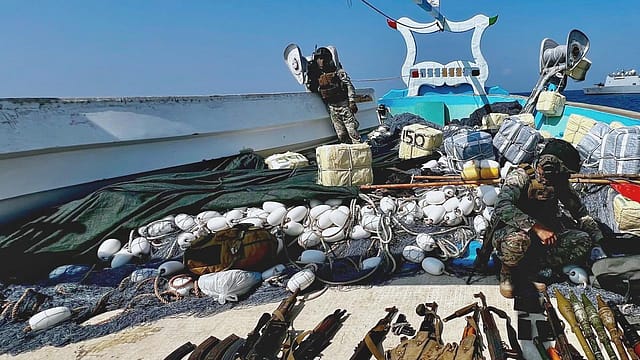
A fishing vessel seized by armed pirates off Somalia could have become a threat to ships carrying cargo through one of the world's important maritime routes. Instead, after a tense 48-hour operation, the Indian Navy brought the vessel Azini back under control and rescued all 20 crew members without any casualties or injuries.
The operation, completed on November 2, unfolded more than 3,000 kilometres from Mumbai in the Arabian Sea. It involved a naval warship, an aerial surveillance platform, Marine Commandos and support from the Indian Air Force (IAF).
The rescue also prevented what maritime security authorities feared could become a larger piracy threat in the region.

The Era of Forever Wars
30 Oct 2026 - Vol 05 | Issue 44
Coping with an explosive Middle East
Azini hijacking: Why were Somali pirates targeting the fishing vessel?
The Iranian fishing vessel was hijacked on October 29 off the northeastern coast of Somalia, between the coastal towns of Bandar Bayla and Hafun.
The European Union's Maritime Security Centre Indian Ocean (MSCIO) issued an alert on October 31, warning that armed pirates had seized the vessel and that its crew's safety was initially unknown. The centre cautioned that Azini could be used as a 'mother ship' to launch further attacks on merchant shipping.
But what does that mean? Pirates sometimes seize smaller fishing boats and use them as mobile bases to travel farther out to sea. From there, they can launch smaller boats to approach and hijack larger commercial vessels. The strategy expands their reach beyond the coastline and increases the threat to international shipping lanes.
The MSCIO had also warned that Azini was moving towards a maritime traffic route, making the possibility of its use in further attacks particularly concerning.
How the Indian Navy tracked and intercepted Azini
After receiving information about the hijacking, the Indian Navy deployed a mission-ready warship, supported by a maritime reconnaissance aircraft, to locate the vessel.
The two platforms maintained surveillance, tracked Azini's movements and used what the Navy described as calibrated non-kinetic measures to restrict its movement and prevent it from escaping. The Navy has not publicly detailed the precise methods or equipment used in this phase.
The operation then moved towards a tactical intervention. Marine Commandos were brought into the mission through a precision airdrop conducted by an IAF C-17 aircraft. Working together, the naval and air force teams overcame the armed pirate threat and secured the vessel.
The Navy confirmed that all 20 crew members were rescued safely, with no casualties or injuries.
Rajnath Singh praises Navy's anti-piracy operation
Defence Minister Rajnath Singh congratulated the Navy and the Air Force for the mission, describing it as a demonstration of India's ability to respond to maritime threats far from its shores. "The swift localisation, interception and safe release of the crew and vessel from significantly-armed pirates, with timely support from the Indian Air Force, speak well of the Indian Navy’s high operational readiness and ability to respond decisively to maritime threats across the region," Singh wrote on X.
A photograph shared by the minister showed naval personnel securing the vessel, with suspected pirates and seized weapons visible on deck.
Why the Azini rescue matters for Indian Ocean security
The operation comes amid renewed concerns about Somali piracy. The Associated Press reported that several commercial vessels had been hijacked since April, raising fears of a resurgence after years of reduced attacks.
India has maintained anti-piracy deployments in the Gulf of Aden since 2008, protecting merchant shipping and supporting maritime security across the region.
The Azini rescue reinforces that role. It also sends a message that a hijacked vessel cannot easily be turned into a floating base for attacks on commercial shipping.
(With inputs from ANI)