India Saved Its Lions. Now It Must Learn to Live With Them
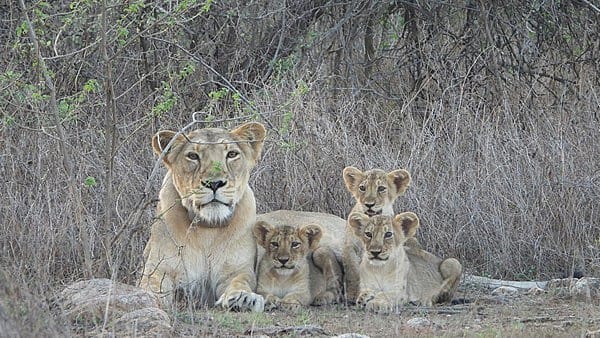
For more than a century, the world's mission was simple: save the lion. Today, India faces a problem few countries ever imagined having. Its lions are no longer disappearing. They are expanding. Their range is growing. Their numbers are rising. And increasingly, so are their encounters with people.
On the eve of World Lion Day, Gujarat announced it will build a 100-hectare natural enclosure for Asiatic lions involved in attacks on humans. It is more than a wildlife management decision. It marks the moment when one of the world's greatest conservation success stories enters its most difficult chapter: learning how humans and lions can share the same landscape.

The Identity Project
11 Sep 2026 - Vol 05 | Issue 37
Amit Shah leads the mission for a national demographic correction
How do you live with them?
On the eve of World Lion Day, Gujarat announced it will build a 100-hectare natural enclosure at Ambardi Safari Park to house Asiatic lions involved in attacks on humans. The facility, the first of its kind in the state, reflects an uncomfortable reality of modern conservation: saving a species is only half the battle. Managing its success is often far harder.
Why is Gujarat building a special enclosure?
The Forest Department says the enclosure will house lions involved in repeated attacks on people while allowing them to remain in a natural environment rather than conventional captivity. Officials say the move is aimed at reducing human-wildlife conflict without compromising long-term lion conservation. It is part of Gujarat's broader wildlife management strategy, which includes relocating injured animals, rescuing lions that stray into villages and managing populations scientifically. The enclosure will be developed inside Ambardi Safari Park near Gir, one of Gujarat's major wildlife tourism destinations.
Why are lions increasingly coming into contact with people?
Ironically, because conservation has worked. According to Gujarat's 2025 Asiatic Lion Census, the state's lion population has climbed to 891, up from 674 in 2020 and 523 in 2015. More than half now live outside the Gir Protected Area, spreading across nearly 35,000 square kilometres of Saurashtra. That expansion is widely viewed as one of India's greatest wildlife conservation achievements. But it has also increased encounters between lions and farmers, villages, roads and livestock.
How rare are Asiatic lions?
Extremely. According to the IUCN Cat Specialist Group, the world's only wild population of Asiatic lions survives in and around Gujarat's Gir landscape. Once found across the Middle East and parts of Asia, the species was pushed to the brink of extinction before decades of conservation reversed its decline. In the late 19th century, their numbers reportedly fell to barely a dozen animals. Today, there are nearly 900. That is one of conservation's greatest comeback stories.
Where are most of the world's lions?
India's lions receive enormous attention because they are unique. But Africa remains lion country. According to conservation estimates cited by the IUCN and WWF, between 22,000 and 25,000 wild lions survive across Africa, with Tanzania alone hosting the world's largest population. Botswana, South Africa, Kenya and Zambia follow behind. Yet even there, the picture is worrying. Lion populations now occupy barely 6-7% of their historic range, having disappeared from vast stretches of Africa, Europe and Asia because of habitat loss, conflict with humans and declining prey populations.
Is India facing the opposite problem?
In many ways, yes. While conservationists elsewhere worry about shrinking lion numbers, India's biggest challenge is increasingly one of coexistence. As lion territories expand beyond protected forests, they are entering agricultural landscapes, crossing highways and appearing near villages. Conservation success has brought the animals back. Now society must adapt to living alongside them.
Could one disease wipe out the entire population?
This remains one of the biggest concerns. Because all wild Asiatic lions are concentrated in a single landscape, scientists have long warned that an epidemic, a major wildfire or another natural disaster could threaten the entire population. A 2026 National Geographic report described Gir as one of the world's greatest conservation successes while also warning that concentrating an entire subspecies in one region creates long-term risks. For years, wildlife experts have argued for establishing additional free-ranging populations elsewhere in India to reduce that risk.
What exactly is Ambardi Safari Park?
Located near Dhari in Gujarat's Amreli district, Ambardi Safari Park covers roughly 365 hectares and recreates the Gir ecosystem. Visitors can already see Asiatic lions, leopards, chital, nilgai, chinkara and numerous bird species there. The new enclosure will add another dimension—serving not merely as a tourism attraction but as a management facility for lions that repeatedly come into conflict with humans.
Why does World Lion Day matter?
Observed every year on August 10, World Lion Day is intended to highlight both the majesty and the vulnerability of one of the planet's most iconic predators. Across much of Africa, the priority remains protecting dwindling lion populations. In India, the conversation has evolved. The challenge is no longer simply ensuring that lions survive. It is ensuring that people and lions can survive together. That may be the hardest conservation lesson of all.
(With inputs from ANI)