India-Japan Defence Talks Explained: Why Rajnath Singh-Koizumi Meeting Could Reshape Indo-Pacific Security
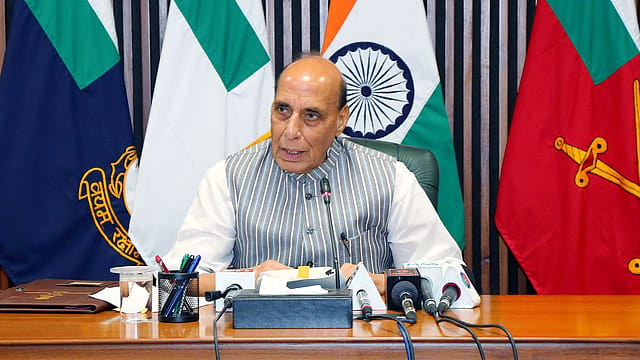
Japan’s defence minister began his first visit to India by stepping aboard an Indian-built warship. The symbolism was difficult to miss.
Shinjiro Koizumi inspected INS Chennai at the Western Naval Command in Mumbai before travelling to New Delhi for talks with Defence Minister Rajnath Singh on August 20. Maritime security will anchor the meeting, but the agenda stretches much further: joint defence technology, military manufacturing under Make in India, greater naval coordination and a possible roadmap for protecting an increasingly contested Indo-Pacific.
The timing makes the meeting particularly significant. India and Japan have just launched their first defence co-development project, while Tokyo has rewritten restrictions that long constrained its ability to export military equipment. Can the two countries now convert years of strategic convergence into a working defence-industrial partnership?
What is expected from the Rajnath Singh-Shinjiro Koizumi meeting?
The two defence ministers are expected to discuss deeper maritime-security cooperation, joint exercises and closer collaboration in defence equipment and technology. The Indian defence ministry said the meeting would seek to strengthen strategic trust, identify new areas of cooperation and build a roadmap for advancing bilateral security ties. Tokyo’s revision of its Three Principles on the Transfer of Defence Equipment and Technology creates additional room for the two countries to explore joint development, production and possible transfers of Japanese military systems under India’s Make in India framework. The immediate objective is therefore larger than signing another statement of intent. New Delhi and Tokyo will be looking for projects capable of turning political trust into equipment, technology and operational coordination.

Zeroing In on ECI
09 Oct 2026 - Vol 05 | Issue 41
Constitutional legitimacy versus political opportunism
Why has Koizumi’s visit begun with the Indian Navy?
Because the sea sits at the centre of the India-Japan strategic relationship. Koizumi visited the Western Naval Command in Mumbai, inspected a Guard of Honour and laid a wreath at the Gaurav Stambh at the Naval Dockyard. He then boarded INS Chennai, an indigenously built guided-missile destroyer. According to the Press Information Bureau, the Japanese delegation was briefed on the Indian Navy’s operational capabilities and the responsibilities of the Western Naval Command. Koizumi also held discussions with Chief of the Naval Staff Admiral Krishna Swaminathan and Western Naval Command chief Vice Admiral Sanjay Vatsayan. The stop allowed Japan’s defence minister to see India’s naval and shipbuilding capabilities before discussing how Japanese technology could be developed or integrated locally.
Why is maritime security so important to India and Japan?
Both countries depend heavily on sea lanes carrying energy, raw materials and manufactured goods. Disruption across the Indian Ocean, the South China Sea or the western Pacific could hit their economies and energy security. Japan sits near the contested East China Sea and depends on maritime routes running through Southeast Asia and the Indian Ocean. India occupies a strategic position astride major shipping lanes connecting the Gulf, Africa and East Asia. Their interests therefore overlap: freedom of navigation, secure shipping routes, maritime-domain awareness and a regional order in which no country can unilaterally alter the rules through force or coercion. The joint statement issued after the July 2026 India-Japan summit specifically called for stronger maritime cooperation through enhanced exercises, satellite-based maritime-domain awareness and naval maintenance, repair and overhaul. It also placed defence manufacturing and technology collaboration within the Make in India framework.
Is China the unspoken factor behind these talks?
Neither country’s official announcement identifies China as the target of the partnership. India-Japan defence cooperation is formally presented as an effort to protect a free, open and rules-based Indo-Pacific. Yet the wider strategic context is impossible to ignore. Japan has been accelerating its military build-up amid concern over China’s expanding capabilities, Beijing’s activity around the disputed Senkaku Islands and the risk of conflict across the Taiwan Strait. India continues to manage its own military tensions with China along the Line of Actual Control while watching Beijing expand its naval footprint across the Indian Ocean. Both countries are also members of the Quad with the United States and Australia. Reuters noted after the Modi-Takaichi summit that New Delhi and Tokyo were aligning their strategic and technological interests amid intensifying regional tensions. It is therefore reasonable to infer that China’s rise is one of the forces driving closer India-Japan coordination, even if neither side frames the relationship as an anti-China alliance.
What has changed in Japan’s defence-export policy?
For decades, Japan’s post-war pacifist posture sharply restricted the overseas transfer of military equipment. Tokyo began easing those limits in 2014, but exports remained tightly controlled. In 2024, Japan relaxed its rules to permit overseas sales of a next-generation fighter being jointly developed with Britain and Italy. Reuters reported that exports were restricted to approved defence partners and could not be made to countries involved in active conflicts. Japan went further in April 2026, lifting longstanding restrictions on the export of lethal weapons while retaining national-security approvals and safeguards. For India, the change enlarges the menu of possibilities. It could make it easier to pursue the transfer, co-development or Indian production of Japanese military systems that were previously difficult to negotiate. The policy shift does not guarantee a major weapons deal. Every project will still have to cross political, regulatory, technical and commercial hurdles in both countries. But one of the biggest structural barriers to India-Japan defence trade has begun to loosen.
What is the UNICORN project and why does it matter?
UNICORN, or Unified Complex Radio Antenna, is the clearest sign that India-Japan defence ties are moving from exercises and dialogue to actual hardware. The system combines multiple communication antennas in a single integrated mast. Its streamlined design reduces a warship’s radar signature, improving stealth while supporting secure communications. The Indian Navy plans to introduce a jointly developed version on future vessels, with Bharat Electronics Limited working with Japanese partners. The Indian Embassy in Tokyo describes UNICORN as the first case of defence-equipment co-development and co-production between India and Japan. Prime Minister Narendra Modi formally announced the project during the July summit with Japanese Prime Minister Sanae Takaichi. Modi said the naval antenna would open a new chapter in the defence technology partnership and provide a base for developing further systems supporting maritime security and a rules-based order. UNICORN matters because previous India-Japan defence-equipment discussions struggled to reach completion. The long-negotiated proposal involving Japan’s US-2 amphibious aircraft, for instance, failed to produce a deal. Delivering the antenna project would show that the relationship can finally move from promise to production.
What does Make in India mean in this partnership?
New Delhi is unlikely to be satisfied with purchasing finished Japanese systems. It wants technology transfer, local manufacturing, Indian suppliers and the ability to maintain and upgrade equipment domestically. Japan brings strengths in sensors, electronics, communications, robotics, shipbuilding and advanced materials. India offers scale, a growing defence-industrial base, lower production costs and access to a large military market. UNICORN offers a possible template: Japanese design and technological expertise combined with Indian production and integration. If that model succeeds, future cooperation could expand into unmanned systems, maritime surveillance, cyber capabilities, ship maintenance, space-based monitoring and other technologies required for operations across the Indo-Pacific.
How much military cooperation already exists between India and Japan?
The relationship already includes exercises involving all three military services. The two navies conduct JIMEX, their bilateral maritime exercise. Japan also participates in the Malabar naval drills with India, the United States and Australia. At the July summit, Modi and Takaichi welcomed the conduct of JAIMEX 2025 and Japan’s participation in India’s International Fleet Review in Visakhapatnam. They also agreed to expand exercises, improve satellite-supported maritime awareness and explore naval repair and maintenance cooperation. The next step is to connect those military interactions with shared equipment and technology. Forces that train together become more effective when they can also communicate, share information and operate compatible systems.
Why does the Modi-Takaichi summit matter to the defence ministers’ meeting?
The July summit supplied the political mandate. The Rajnath-Koizumi meeting must now develop the implementation plan. Modi and Takaichi identified defence and security as one of the partnership’s three priority pillars. They also directed their foreign and defence ministers to hold the fourth India-Japan 2+2 ministerial dialogue in Tokyo before the end of 2026. Their joint statement called India and Japan “natural and indispensable partners” in an increasingly volatile geopolitical environment. It also backed closer Quad cooperation across maritime security, critical technologies, economic security and humanitarian response. Koizumi’s visit, coming weeks later, is the first major opportunity to translate that mandate into specific defence actions.
What would count as a real breakthrough?
Another promise to strengthen cooperation would carry limited value. Tangible progress would mean timelines for the UNICORN project, additional co-development programmes, more sophisticated naval exercises and mechanisms for sharing maritime information. A serious roadmap could also identify Japanese systems suitable for Indian production, connect companies from both countries and expand collaboration between their defence research establishments. India and Japan have spent years describing their strategic convergence. The Rajnath Singh-Koizumi meeting will test whether that convergence can now build military technology, strengthen warships and shape security across the Indo-Pacific.
(With inputs from ANI)