"Will Be Able To Deter Aggression": Air Chief Marshal Says Keeping Close Watch On China
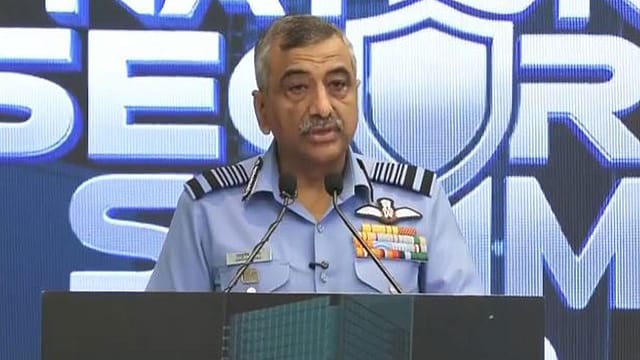
India is keeping a close watch on China and has plans in place to deter possible aggression, Chief of the Air Staff Air Chief Marshal Ashutosh Dixit said on Monday. Addressing the ANI National Security Summit 3.0 in New Delhi, he also underlined the importance of self-reliance in defence, arguing that India's combat readiness cannot depend on foreign countries for critical technology, software, spares and ammunition.
Dixit said the Indian armed forces were monitoring the activities of adversaries and aligning their procedures and capabilities to meet emerging challenges. He said the effectiveness of an adversary's aircraft and military capabilities depended on factors such as crew training, network-centric warfare and operating altitude.
“Considering all these things, our plans are in place. So we add some new technology we are inducting. So, along with that, it is okay; we are in an okay situation and not a simple but okay situation that we will be able to deter this aggression,” he said.

The Wealth Issue 2026
06 Nov 2026 - Vol 05 | Issue 45
Portraits of Dreamers and Doers under 35
He described the current situation as one of “no peace, no war”, from which conditions could shift towards an offensive or defensive posture.
AATMANIRBHARTA AS A COMBAT REQUIREMENT
In a separate address at the summit on the role of self-reliance in India's preparedness for future wars, Dixit said the Indian Air Force's dependence on network-centric warfare made access to indigenous technology an operational necessity.
“In any future conflict, our access to spares, software, munitions and data links cannot depend on decisions taken by others,” he said.
He outlined the IAF's VAYU framework for future warfare, identifying three tests of military preparedness: the ability to control systems, sustain operations and adapt faster than adversaries.
“For us, it is not a slogan; it is the foundation of combat readiness,” he said.
Dixit argued that future wars might begin in cyberspace, the electromagnetic spectrum or space rather than with a formal declaration. The advantage, he said, would belong to the side that could see first, make decisions faster and act before its adversary.
He identified four areas in which the IAF was preparing: operational readiness, production capacity, decision superiority and jointness. These include strengthening air and counter-drone defences, developing AI-enabled command systems, preparing to operate when communications or satellite navigation are disrupted, and improving coordination among the services.
OPERATION SINDOOR AND INDIGENOUS SYSTEMS
Dixit cited Operation Sindoor as an example of the importance of integrated operations and domestically developed weapons systems.
“Operation Sindoor offered a glimpse of what integrated operations can achieve,” he said, adding that the IAF's Integrated Air Command and Control System (IACCS) and the Army's Akashteer system worked together to create a common air picture.
He also cited the performance of indigenous systems such as Akash and BrahMos during the operation, arguing that India's military preparedness could not rest on capabilities controlled by other countries.
WHY SUPPLY CHAINS MATTER IN A LONG WAR
Drawing lessons from the conflicts in West Asia and Ukraine, Dixit warned that modern warfare consumes ammunition at a pace that conventional peacetime planning may not anticipate.
Citing estimates by the Centre for Strategic and International Studies (CSIS), he said the United States had used roughly two-thirds of its Patriot air-defence interceptors during this year's conflicts in West Asia. Against more than 1,000 missiles fired, it had received about 172 new ones during the fiscal year, he said, adding that rebuilding stocks could take until the end of 2030.
He also pointed to the scale of drone warfare in Ukraine. Russia launched more than 700 drones in a single night in July 2025, while Ukraine produced at least four million drones last year and planned to manufacture seven million this year, he said.
Dixit said India needed domestic production lines capable of scaling up during a conflict, deeper supply chains involving micro, small and medium enterprises, multiple sources for critical components and adequate stockpiles.
He also highlighted how rapidly drone technology was changing in Ukraine. After radio-controlled drones were jammed, both sides shifted towards fibre-optic cable-guided first-person-view drones, which are resistant to conventional jamming.
“Ukrainian and NATO experts estimate that drone technology there must be upgraded roughly every eight weeks,” he said, warning that India would struggle to keep pace if source code and critical technologies remained dependent on foreign suppliers.
TEJAS AND THE CASE FOR TECHNOLOGICAL CONTROL
Dixit cited the development of the Tejas Light Combat Aircraft's fly-by-wire flight control system as an example of indigenous technological capability.
Recalling the sanctions imposed after India's Pokhran-II nuclear tests in May 1998, he said Indian scientists had developed the aircraft's control laws despite predictions that the restrictions would delay its maiden flight by two to three years. Tejas made its maiden flight in January 2001.
“The lesson is clear: a capability that someone else can switch off in a crisis is not a capability we truly own. Aatmanirbharta does not stop at manufacturing in India. It means control over the architecture, source code, algorithms, and the data,” he said.
He acknowledged that important gaps remained, pointing to delays in the Tejas Mark 1A and HTT-40 trainer programmes linked to imported engines. He identified engines, seekers, radars and chips as critical areas for greater self-reliance.
DEFENCE PRODUCTION AND THE ROAD AHEAD
Dixit said India's defence production crossed ₹1.78 lakh crore in the financial year 2025-26, an increase of 15.5 per cent over the previous year and more than double the level five years earlier. Defence exports reached a record ₹38,424 crore, with Indian systems serving in more than 80 countries, he said.
He also cited the private sector's contribution, which accounted for around 24 per cent of standalone defence production.
Among the ongoing programmes, he referred to the order for 180 Tejas fighters, the production of 12 additional Su-30MKIs at Nashik and the completion of Astra missile firing trials on the Tejas Mark 1A.
The IAF is also inducting indigenous HTT-40 basic trainers, while the first privately manufactured C-295 aircraft built by Tata Advanced Systems Limited had undertaken its maiden flight in June, he said. He also pointed to the contract for 66 Light Combat Helicopters for high-altitude operations.
Dixit urged Indian manufacturers and technology companies to work with the armed forces in developing future capabilities rather than functioning only as suppliers.
“I urge our industry to build with us, not merely for us, and the innovators to bring us their best ideas,” he said.
With inputs from ANI