Starlink Disruption in Ukraine Highlights Risks of Satellite Dependence: CDS General Subramani
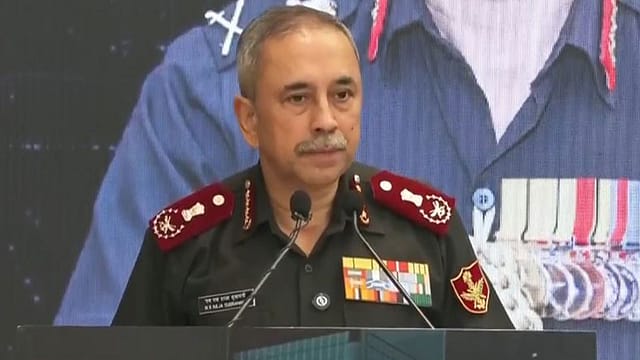
Chief of Defence Staff General NS Raja Subramani on Monday warned that the disruption of Starlink satellite services during the Russia-Ukraine war demonstrated how dependence on external communication networks could affect military operations. He said India needed to develop reliable, self-reliant space capabilities to prepare for future warfare.
Addressing the ANI National Security Summit 3.0 in New Delhi, the CDS said space-based systems had become critical to intelligence, surveillance, reconnaissance, communications and precision navigation. He cited the impact of Starlink disruption on Ukrainian long-range drones as an example of the vulnerabilities created when access to satellite networks could be restricted.
“Space will also be increasingly contested. Our adversaries will try to ensure that we are denied the ability to use space. An example of which we can see in Ukraine when Starlink was denied or degraded, Ukrainian long-range drones lost their efficacy,” he said.
He added that India needed to build its own space capabilities through ISRO as well as private commercial players.

The Wealth Issue 2026
06 Nov 2026 - Vol 05 | Issue 45
Portraits of Dreamers and Doers under 35
STARLINK AND INDIA'S SATELLITE COMMUNICATIONS SECTOR
The remarks come amid discussions over Starlink's proposed entry into India's satellite communications market. The government has maintained that it welcomes multiple players in the sector, with consumers ultimately choosing services based on pricing, value and quality.
Jio, OneWeb and Starlink have secured licences to operate in India's satellite communications sector. However, operators must meet prescribed security requirements, while the framework for spectrum allocation and pricing is being finalised before commercial services can be rolled out.
General Raja Subramani said India needed to expand its Space-Based Surveillance-3 programme to strengthen its capabilities in intelligence gathering, communications and precision navigation and timing.
He also referred to the importance of indigenous navigation systems, citing ISRO's successful launch of the NavIC satellite NVS-03 on October 30. He said the launch followed setbacks involving two successive PSLV failures and technical problems with the NVS-02 satellite.
The CDS said the ability to recover from failures and develop domestic precision, navigation and timing capabilities was vital because long-range weapons depended on such systems, which could otherwise be denied by external sources.
FIVE PRIORITIES FOR FUTURE WARFARE
General Raja Subramani identified five areas India must focus on to prepare its armed forces for future conflicts: space, algorithmic and data warfare, defence manufacturing, modernisation of legacy systems and the development of human talent.
He said the nature of warfare was changing on three fronts: the economics of weapons, the contest for technological superiority and the expansion of the battlefield.
The growing use of inexpensive drones, he said, could overwhelm sophisticated defence systems. Countries therefore needed to combine advanced military platforms with affordable equipment that could be produced in large numbers.
“If you are using a million-dollar missile to counter a $2500 or $3000 drone, then the economics of warfare are likely to go increasingly against you,” he said, citing the rapid depletion of US Patriot missiles and the time required to replenish them.
He also warned that the distinction between front and rear areas was disappearing, with industries, power centres, networks and citizens increasingly exposed to attacks.
“Front, rear and depth: the entire nation's space is a battle space. Nobody is safe,” he said.
OPERATION SINDOOR AND INDIGENOUS CAPABILITIES
Referring to Operation Sindoor, the CDS said the operation demonstrated India's ability to conduct military operations using indigenous systems, joint planning and coordination among the three services.
“Op Sindoor proved that we had the capabilities to fight India's war with India's weapons. It was a good example of joint planning and multi-domain integration,” he said.
He added that indigenous air defence systems such as Akash had helped deter Pakistani aerial attacks.
The CDS also stressed the need for domestic manufacturers to develop critical components such as servos, magnetometers and sensors, rather than focusing only on assembling complete defence systems.
He said Indian companies should have control over the intellectual property and technology required to manufacture such components at scale. He also called for engineers to work alongside military personnel in forward areas to understand operational requirements and improve equipment through field-based feedback.
AATMANIRBHARTA AS STRATEGIC INDEPENDENCE
Defining self-reliance in national security, General Raja Subramani said it was not about manufacturing everything domestically or isolating India from global partnerships.
“My definition of 'Aatmanirbharta' is the freedom to decide, the capability to act and the capacity to endure,” he said.
He argued that India needed control over critical technologies and resilient supply chains, supported by reliable partners, to retain the freedom to make its own strategic choices.
On artificial intelligence, he identified data, computing power, energy and skilled personnel as essential requirements for future military capabilities. He said the armed forces were working to improve data standards and networks so that information could reach decision-makers in time.
He also called for modernising existing military platforms with AI and open architectures, allowing older and newer systems to operate as part of an integrated network.
“The importance of rapidly adapting, having your engineers deployed in the field, and coming up with innovative solutions to whatever the enemy can throw at you is important,” he said.
The CDS said future conflicts might not be short or swift, making industrial capacity, large-scale production and resilient supply chains essential for sustaining military operations.
With inputs from ANI