INDIA IN THE ROOM | Why Modi Needs an SCO Full of Rivals, Sanctions & Competing Corridors
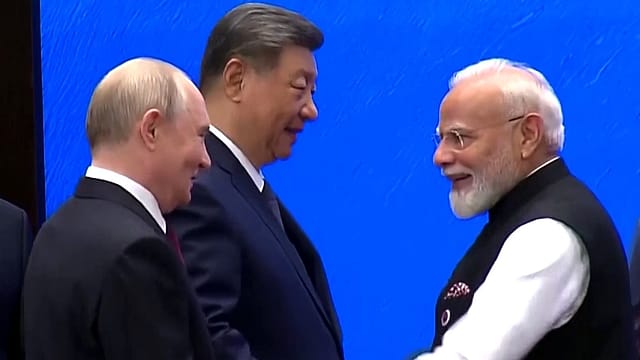
Group photographs lie politely. They arrange adversaries by height, conceal disputes behind handshakes and compress years of mistrust into a few seconds of diplomatic smiling.
The official photograph at the Shanghai Cooperation Organisation summit in Bishkek was particularly ambitious. Prime Minister Narendra Modi stood among Chinese President Xi Jinping, Russian President Vladimir Putin, Pakistan Prime Minister Shehbaz Sharif and Iranian President Masoud Pezeshkian. The leaders represent countries divided by a Himalayan frontier, terrorism allegations, sanctions, wars, rival infrastructure projects and sharply different relationships with the West.
For the camera, they became a family.
Modi was seen exchanging a few words with Xi and Putin as the leaders gathered at the Yrys Ordo Congress Hall on Tuesday. Kyrgyz President Sadyr Japarov then led the summit’s roundtable discussion, bringing together the SCO’s 10 members and representatives of its wider circle of partner and observer countries.

Zeroing In on ECI
09 Oct 2026 - Vol 05 | Issue 41
Constitutional legitimacy versus political opportunism
The photograph was the easy part. The real business of the summit concerns what India hopes to extract from a club containing some of its closest partners, most difficult neighbours and most complicated geopolitical choices.
The answer begins with a distinction New Delhi has spent years perfecting. A seat is not a side.
India Enters the Most Complicated Room in Asia
The SCO began in 2001 with China, Russia and four Central Asian republics: Kazakhstan, Kyrgyzstan, Tajikistan and Uzbekistan. Its original priorities included border stability, counterterrorism and regional cooperation.
India and Pakistan became full members in 2017. Iran joined in 2023, followed by Belarus in 2024. Together, the 10 members account for roughly a quarter of global economic output and encompass a vast geographical arc extending from Eastern Europe to China and the Indian Ocean.
That size gives the organisation visual power. Its internal contradictions deny it the cohesion of a conventional alliance.
China and India compete for strategic influence across Asia and continue to manage an unsettled border relationship. India and Pakistan belong to the same organisation while maintaining barely functional bilateral relations. Russia and China proclaim a deep strategic partnership, but Moscow remains wary of becoming the junior power in a region it once dominated.
Iran faces Western sanctions and is embroiled in a widening confrontation with the United States. Central Asian governments seek Chinese investment and Russian security ties while trying to avoid dependence on either.
The SCO does not remove these tensions. It puts them in the same room.
For India, that room matters. It provides direct access to Central Asian governments, an institutional channel to Russia and China, and a platform for discussing terrorism, Afghanistan, energy and transport corridors. It also prevents Beijing and Moscow from defining Eurasian politics entirely without an Indian voice.
Leaving the table would not make the disagreements disappear. It would merely leave India absent when they are discussed.
Modi’s Message to Putin Was Harder Than the Handshake
The summit’s most substantive Indian moment arrived before Tuesday’s family photograph.
During talks with Putin on Monday, Modi called for an end to the Ukraine war and said every additional day of conflict pushed humanity backwards. “We must move away from endless war towards an end to the war,” Modi said, according to a Kremlin transcript reported by Reuters. He pledged India’s support for efforts to stop the fighting while describing Putin as a friend and praising the resilience of India-Russia relations.
The formulation was sharper than Modi’s famous 2022 declaration that this was “not the era of war”.
It also captured India’s balancing act. New Delhi has declined to abandon its longstanding relationship with Moscow. Russia remains an important source of energy, military equipment, fertilisers and strategic cooperation. India has continued buying Russian oil despite sanctions and intense Western scrutiny.
At the same time, Modi used his televised remarks beside Putin to call openly for a cessation of hostilities. India wants the Russian relationship without inheriting Russia’s war. The two leaders reviewed cooperation across trade, investment, energy and fertiliser security. India’s Ministry of External Affairs reportedly said the partnership had continued growing despite geopolitical uncertainty.
This is strategic autonomy in practice. It is less elegant than choosing one camp and far more demanding. India buys Russian oil, participates in the US-led Quad, conducts exercises with Western militaries, negotiates with Europe and sits beside Putin and Xi at the SCO. The contradictions are the strategy.
The Few Seconds With Xi
Modi’s brief exchange with Xi at the group photograph will inevitably generate speculation.
A few words between the leaders of the world’s two most populous countries carry unusual weight after years of military tension along the Line of Actual Control. Yet a photographed conversation does not establish a diplomatic breakthrough.
The India-China relationship remains a mixture of cautious stabilisation and structural rivalry. China is one of India’s largest trading partners, but the commercial relationship is heavily imbalanced. The two governments require working communication to prevent border friction from escalating, even as they compete for influence across South Asia, the Indian Ocean and the developing world.
The SCO offers a recurring place for contact without requiring either government to portray every encounter as a bilateral concession. It also places India inside an institution increasingly shaped by China’s ambitions.
Xi has urged the SCO to play a larger role in reforming global governance and advancing a multipolar international order. In Bishkek, he and Putin pledged closer strategic coordination as both confronted deepening tensions with Washington, according to the South China Morning Post. India supports a more representative global order. It does not necessarily support a China-led one. That difference explains why New Delhi can agree with Beijing about reforming international institutions while resisting Chinese primacy within the alternative structures being constructed.
The Pakistan Problem Travels to Every Table
Shehbaz Sharif’s presence supplies the summit with another layer of discomfort.
India wants the SCO to confront terrorism without euphemism or geopolitical exemptions. Pakistan’s membership makes agreement on that language difficult.
New Delhi has repeatedly argued that terror organisations cannot be treated differently according to political convenience. At an SCO defence ministers’ meeting in Bishkek earlier this year, Defence Minister Rajnath Singh warned against “double standards” and the use of cross-border terrorism as an instrument of state policy.
The formulation was directed unmistakably at Pakistan. The SCO possesses a permanent counterterrorism institution, the Regional Anti-Terrorist Structure, based in Tashkent. Its work includes intelligence coordination and action against terrorism, separatism and extremism.
For India, cooperation through that mechanism has potential value. Yet the organisation’s consensus-based diplomacy can reduce strong commitments to language acceptable to countries with opposing definitions of terrorism.
The same platform that allows India to raise cross-border terrorism also grants Pakistan an equal seat in drafting the response. There was no confirmed Modi-Sharif bilateral meeting accompanying Tuesday’s opening session. Their coexistence in the family photograph should not be mistaken for a thaw.
It demonstrates something narrower: even frozen relationships must occasionally occupy the same frame.
Connectivity to Everywhere, Except Through Pakistan
The SCO’s economic promise is built around Eurasian connectivity. Central Asia possesses energy, minerals and markets. India wants stronger access to the region but remains separated from it by geography and politics. The shortest land routes run through Pakistan, which has denied India dependable overland access.
Afghanistan supplies another uncertain bridge. India has therefore pursued alternatives including Iran’s Chabahar port and the International North-South Transport Corridor, designed to connect the Indian Ocean with Iran, Central Asia, Russia and Europe.
Modi’s meeting with Pezeshkian in Bishkek carried significance far beyond diplomatic courtesy. The two countries have common interests in trade, transport and regional stability. Modi also stressed the protection of civilians, seafarers and commercial shipping amid the conflict involving Iran, according to reports of the bilateral meeting. Chabahar gives landlocked Afghanistan and Central Asia a potential route to the sea without passing through Pakistan. For India, it is simultaneously a commercial project and a geopolitical answer to exclusion.
China offers a competing vision through the Belt and Road Initiative. India has consistently refused to endorse the BRI because the China-Pakistan Economic Corridor passes through territory claimed by India. New Delhi’s position is that connectivity must respect sovereignty, territorial integrity, transparency and financial sustainability.
That disagreement exposes a central limitation of the SCO. Its members repeatedly promise regional integration. They do not agree on who will design the roads, control the ports or determine where the corridors run.
An Anti-Western Club India Refuses to Treat as One
Russia and China increasingly present the SCO as evidence that global power is moving beyond Western institutions.
For Moscow, the summit breaks the visual isolation created by sanctions. For Beijing, it demonstrates leadership across the Eurasian landmass. For Iran and Belarus, membership offers political company amid confrontation with the West.
India complicates that narrative simply by attending. New Delhi has no interest in turning the SCO into an Asian NATO or an organised anti-American bloc. Its economic, technological and defence relationships with the United States, Europe, Japan and the Gulf are too important. India also belongs to the Quad, which Beijing views with suspicion.
India’s participation, therefore, gives the SCO credibility while limiting its ideological uniformity. New Delhi agrees that global institutions should give developing countries greater influence. It supports a multipolar world in which power is more widely distributed. But multipolarity, from India’s perspective, must include India as an independent centre of power. Replacing Western dominance with Chinese dominance would merely change the address of the hierarchy.
From Nomadic Games to Strategic Games
The summit opened against the colour and spectacle of the World Nomad Games.
Modi joined Putin, Pezeshkian, Erdogan, Sharif and other leaders at the opening ceremony in Bishkek. India sent an 87-member contingent, including 73 athletes, to an event featuring traditional wrestling, horseback competition, archery and games rooted in the culture of nomadic civilisations.
Athletes from 104 countries were participating, Reuters reported. Xi attended the SCO summit but missed the Games’ opening because of natural disasters in Tibet. The celebration provided Kyrgyzstan with soft power and visiting leaders with a relaxed diplomatic stage before the harder conversations began.
There was an appropriate symbolism in it. The SCO itself has become a contest of strategic horsemanship. Every member attempts to move across unstable terrain without being thrown by the rivalries beside it. India may be the organisation’s most determined balancing rider.
What India Can Actually Win
The SCO cannot resolve the India-China boundary dispute. It cannot normalise relations between New Delhi and Islamabad. It cannot guarantee Central Asian connectivity, end the Ukraine war or reconcile India’s interests with every Chinese and Russian ambition.
Its value is more modest and more practical. It keeps channels open. It gives India regular access to governments across Eurasia. It creates opportunities for intelligence cooperation, energy discussions and diplomatic contact. It enables New Delhi to challenge selective definitions of terrorism and reject infrastructure proposals that violate its sovereignty.
Most importantly, membership ensures that India is present wherever the language of a new Asian order is being negotiated. Modi arrived at the Bishkek summit promising to advance three priorities: security, connectivity and opportunity. Each is obstructed by at least one country seated around the table. Pakistan complicates security. China complicates connectivity. Sanctions, wars and political distrust complicate opportunity. That does not make the summit irrelevant.
It explains why India attends. The leaders assembled once more for the official photograph. Modi spoke briefly with Xi and Putin. Sharif stood in the same diplomatic family. Japarov welcomed them all into the roundtable. The camera recorded unity. India came to manage everything the photograph left out.
(With inputs from ANI)