Delhi Gets Its First 'Poor' Air Day of the Season: Just How Bad Will Winter Smog Be This Year?
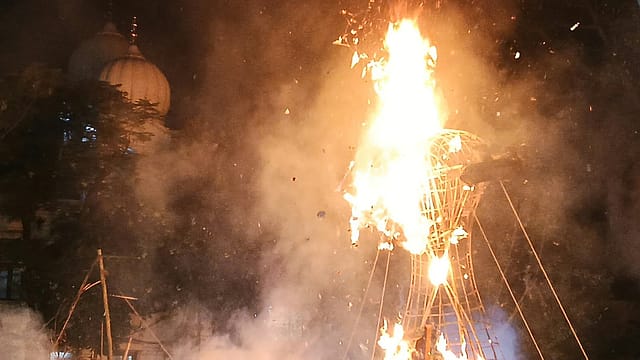
Delhi woke up on Wednesday under a grey blanket. The capital’s Air Quality Index (AQI) hit 238 at 10 am, the first “poor” reading of the season, according to the Central Pollution Control Board (CPCB). The jump from Tuesday afternoon’s 179 was 59 points in a matter of hours, and it came after a night of Dussehra celebrations.
The reading is Delhi’s first “poor” day since July 12 and 13, when the AQI was 261 and 246. Through most of October the city stayed in the “moderate” band, helped by light rain on October 12 and 16. The AQI was 187 on October 18 and 139 on October 19, before it climbed to 179 on Tuesday afternoon.

Losing Memory
16 Oct 2026 - Vol 05 | Issue 42
The making of a medical and social emergency
Two of the 56 stations reporting data, Jahangirpuri and Pusa, crossed into “very poor,” at 308 and 314. Sixteen stations, including Anand Vihar, were still in the “moderate” range, a reminder that the average hides large differences across the city.
WHY DUSSEHRA MATTERS, AND WHY IT ISN’T THE WHOLE STORY
Dussehra is the first big festival test of the pollution season. Crowds gather across the city to burn giant effigies of Ravana, often with fireworks packed into them, and the smoke and particles released overnight add to whatever is already hanging in the air.
But officials point to weather as the underlying driver. Falling temperatures and shifting wind speeds make it harder for pollutants to disperse, so they build up near the ground. In that sense, the festival acted as a trigger on a city whose air had no room to spare.
The forecast supports that reading. The weather department had forecast poor air from Wednesday to Friday, with the following six days also expected to stay poor, and the early warning system’s dashboard projected an AQI of 342, in the “very poor” band, for October 22. Skies are expected to stay mostly clear on October 21 to 23. Clear, still weather is exactly what traps smog.
WHAT LAST YEAR LOOKED LIKE
The picture is mixed. According to a government review of 2025, Delhi had a record 79 days with AQI at 100 or below, and 157 days in the “poor” to “very poor” range, plus eight “severe” or worse days, the second-lowest count of severe days in the data since 2018. That makes about 165 bad air days last year.
The year recorded 200 days with AQI below 200, and the Delhi government says the average AQI for 2025 was the best in eight years apart from the Covid year of 2020.
The bad days were not evenly spread. Still winds and unfavourable weather in December 2025 pushed that month’s average AQI abnormally high. The monsoon months looked far better than the winter.
This year’s trend has been slightly better so far. From January to September 2026, Delhi had 79 days in the “poor” to “severe+” range, the lowest in five years, against 86 in both 2025 and 2024. The first “poor” day of the autumn arrives after a relatively clean start to October, which is what makes the coming weeks the real test.
WHAT THE GOVERNMENT IS DOING
On Tuesday, Chief Minister Rekha Gupta unveiled the Delhi government’s winter pollution action plan. It takes effect from November 1. Dust-generating demolition and outdoor civil construction are banned from November 1, 2026 to January 31, 2027, and CNG and electric vehicles are exempt from the vehicle restrictions.
The plan also proposes that 50 per cent of office staff work from home to cut vehicle emissions. The Delhi government is reportedly working with the Indian Institute of Technology on pollution control.
Alongside it sits the Graded Response Action Plan (GRAP), the emergency framework run by the Commission for Air Quality Management (CAQM). GRAP has four stages: Stage I when the AQI is “poor” (201 to 300), Stage II at “very poor” (301 to 400), Stage III at “severe” (401 to 450) and Stage IV at “severe plus” (above 450).
In past years, Stage I has meant stricter dust controls at construction sites, more anti-smog guns and water sprinkling, and regular garbage collection. A “poor” reading does not by itself mean GRAP has been invoked.
‘OLD WINE IN A NEW BOTTLE’
Environmentalist Bhavreen Kandhari told Open that systemic changes are needed and that the winter action plan is “old wine in a new bottle.”
“Every winter, Delhi gets an action plan,” she said. “What’s actually new? The pollution isn’t. The announcements aren’t.”
For Kandhari, the real test lies beyond November 1. “But enforcement and all-year-round action to work on the sources of pollution will be the change-maker,” she said. Her argument underline a pattern seen in last year’s numbers. The plan can curb the spikes, but the city’s bad air days come from sources that do not stop when the season ends.
THE WEEKS AHEAD
The gap between now and November 1 is the weak spot. The city is entering the “poor” band, and probably the “very poor” one, nine days before its seasonal plan formally starts.
Diwali, another big source of smoke and fireworks, is less than three weeks away. Whether Delhi can avoid a repeat of the long December smog of last year will depend on how quickly GRAP’s curbs are applied when the AQI crosses each threshold, and on the wind.