Great Indian Bustard Makes A Comeback: How India Revived A Dying Species
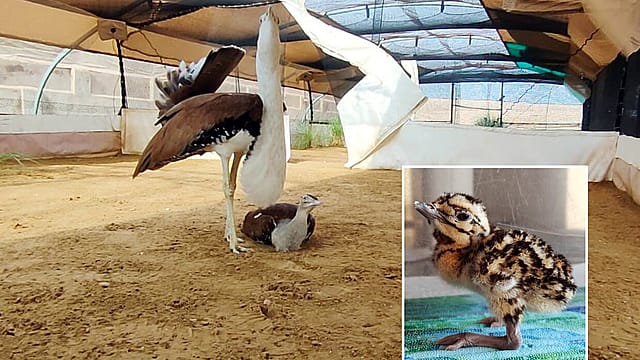
India’s conservation efforts have achieved a significant breakthrough with the revival of the Great Indian Bustard, locally known as Godawan.
Once on the brink of extinction, the species is now showing signs of recovery, thanks to sustained scientific intervention and policy focus.
What is the latest milestone in conservation efforts?
A key development has emerged from Jaisalmer, where three new chicks have been born at two dedicated breeding centres—Sudasari and Ramdevra. These facilities are located within the desert ecosystem and are central to India’s conservation strategy for the species.
With these additions, the total number of Great Indian Bustards in these centres has reached 82, marking a notable increase for a species that had seen its population collapse over the years.
How are scientists helping revive the species?
The recovery effort relies heavily on modern scientific techniques such as artificial incubation, safe rearing, and artificial insemination. These approaches have helped overcome natural breeding challenges and improve survival rates.

Losing Memory
16 Oct 2026 - Vol 05 | Issue 42
The making of a medical and social emergency
According to Brijmohan Gupta, Deputy Conservator of Forests at Desert National Park, the numbers reflect a mix of methods. “Out of these, 49 birds have hatched from captive eggs, 23 chicks have been born through AI technology, and 26 chicks have resulted from natural breeding. The three newly born chicks are offspring of the Aman-Parv, Sharky-Parv, and Akku-Leo pairs,” he told ANI.
Why is this achievement important?
The Great Indian Bustard has long been one of India’s most endangered birds, with its population declining sharply due to habitat loss, hunting, and infrastructure threats.
Gupta emphasised the importance of sustained efforts, saying, “This achievement is a positive indicator for the revival of the species and demonstrates the impact of dedicated conservation efforts supported by scientific innovation.”
What has the government said about the conservation drive?
The progress has also been acknowledged at the highest level. Prime Minister Narendra Modi recently highlighted the turnaround in conservation efforts.
“This bird used to be a hallmark of the nation's desert regions, but its numbers had dwindled,” he said, noting that while the species was close to extinction, “a major campaign is ongoing for its conservation.”
He further added, “Scientific methods are being adopted, and breeding centres have been established.”
How is conservation being expanded beyond Rajasthan?
Efforts are not limited to Rajasthan. In Kutch, a new approach called the Jumpstart method has yielded encouraging results.
Union Minister Bhupender Yadav explained that a lack of male birds in the local population had led to infertile eggs. To address this, a fertile egg from Rajasthan was transported over a 19-hour journey in a portable incubator and placed in a nest in Kutch.
The egg was incubated naturally by a female bird, resulting in the birth of a healthy chick on March 26. This marked the first such success in the region in over a decade.
What is Project GIB and why does it matter?
The conservation push is part of Project GIB, launched in 2016 to protect and revive the species. The initiative builds on an earlier vision outlined in 2011 to conserve the natural habitat of the bird, also known as Ghorad in Gujarat.
The project combines habitat protection, captive breeding, and scientific innovation to stabilise and eventually increase the population
What lies ahead for the Great Indian Bustard?
With around 82 birds currently in breeding centres and rewilding plans underway, conservationists are cautiously optimistic. The focus is now shifting from population recovery to reintroducing birds into the wild in a sustainable manner.
The recent successes signal that while the species is not out of danger yet, a coordinated mix of science, policy, and on-ground effort is beginning to turn the tide.
(With inputs from ANI)