Got a Viral Reel? Bihar Could Pay You Up to ₹1 Lakh for Talking About Government Schemes
A few years ago, governments mostly communicated through newspaper advertisements, press conferences and official statements.
Today, they want reels.
And if you're a content creator in Bihar, those reels could now come with a government cheque.
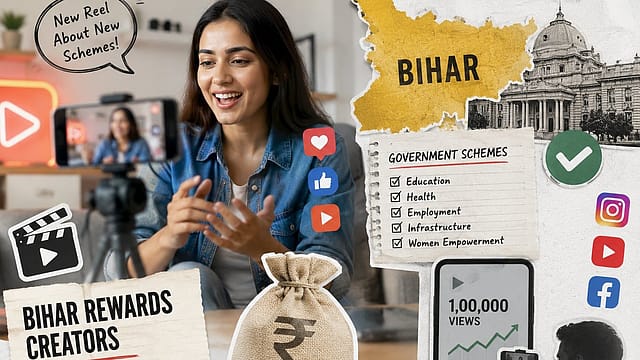
The Bihar Cabinet has approved amendments to the Bihar Social Media and Online Media Rules, allowing eligible creators to earn ₹10,000 for every one lakh views on videos promoting government schemes and programmes. The maximum payout for a single video will be ₹1 lakh, according to details announced after a Cabinet meeting.
Think about what that means for a moment.
A government that once relied on billboards and newspaper space is now entering the world of YouTube analytics, engagement metrics and viral content.
Why is Bihar paying creators?
The official answer is outreach.
The Bihar Social Media and Online Media Policy was originally introduced to use the growing influence of digital platforms to spread information about government welfare schemes, policies and achievements. The state's Information and Public Relations Department already operates an empanelment system for eligible social media creators and digital platforms.
Rise of the Pivotal Power
18 Sep 2026 - Vol 05 | Issue 38
The BRICS declaration is a strategic victory for Modi
The latest amendment takes that idea a step further.
Instead of simply publishing information through official channels, the government wants creators to become part of the communication network.
Under the revised framework, additional payments will be linked to viewership performance. The incentive applies after a replacement video completes 30 days of display, with payouts linked to the number of views generated. Reports in The Times of India said creators could receive ₹10,000 per lakh views, subject to the ₹1 lakh cap for an individual video.
Welcome to the creator economy, government edition
The decision reflects a larger shift that is happening well beyond Bihar.
Influencers are no longer limited to fashion, food or entertainment.
Tourism departments increasingly work with creators. Public-awareness campaigns use digital personalities to reach younger audiences. Government agencies across India have experimented with creator-led campaigns to expand their reach online.
Why? Because a popular creator can often reach audiences that official government handles struggle to engage.
A policy document may get ignored.
A well-made reel explaining the same scheme could be watched by hundreds of thousands of people.
But there are questions too
The announcement is likely to spark debate.
Supporters will argue that if governments spend money on newspaper advertisements, television campaigns and outdoor publicity, paying digital creators is simply an updated version of the same idea.
Critics may ask where the line lies between public information and promotion.
The details will matter.
The Cabinet has said a comprehensive notification outlining categories, eligibility criteria and payment provisions will be released by the Information and Public Relations Department. That document is expected to clarify exactly who qualifies, what kind of content is eligible and how payments will be calculated.
The bigger story isn't about one video
The Cabinet meeting itself approved 13 agenda items, including a proposed six-lane greenfield expressway linking Buxar and Bhagalpur, support for agriculture and fisheries, AI-related collaboration initiatives and other development projects.
Yet it was the social media decision that immediately grabbed attention.
Perhaps because it says something about how politics, governance and communication are changing.
The government is no longer competing only for votes.
It is competing for attention.
And attention today lives on phones, scrolls through feeds and often arrives through creators rather than official announcements.
So the next time a Bihar government scheme shows up in your recommendations, it may not come from a government spokesperson.
It could come from a YouTuber.
And if enough people watch, that view count might be worth money.
(With inputs from ANI)