GDP 7.4% estimates show how Modi Govt ducked Trump tariff bouncers
At the end of his 17-year international career, cricket great Sunil Gavaskar was sometimes described as “defensive” and “resilient” rather than “attacking.” He was certainly resilient, but defensive does not do him justice. Apart from a career Test average of 51.1, which itself indicates he was no slouch, Gavaskar’s 50-to-100 conversion rate was 43%. If batsmen who scored 20 centuries and more are considered, he is very much at par with contemporaries like Greg Chappell. He did abjure over-ambitious shots and refused to be baited by aggressive bowlers but unerringly grabbed the initiative once he settled down at the crease.
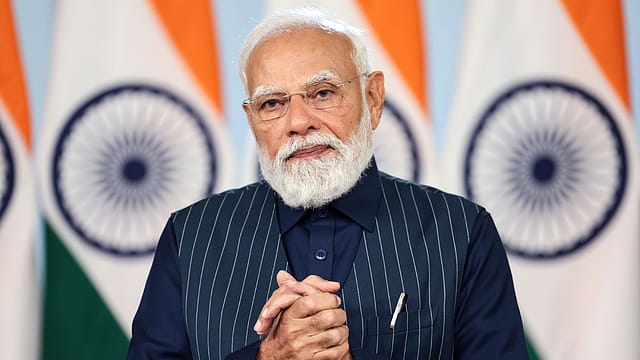
The National Statistical Office (NSO) final advanced estimates released on Wednesday provide reassuring tidings for the Modi government with the economy projected to grow at 7.4% in 2025-26, prompting Prime Minister Narendra Modi to hail India’s “reform express.” “This is powered by the NDA Government’s comprehensive investment push and demand-led policies. Be it infrastructure, manufacturing incentives, digital public goods or ‘Ease of Doing Business,’ we are working to realise our dream of a prosperous India,” Modi said.

Zeroing In on ECI
09 Oct 2026 - Vol 05 | Issue 41
Constitutional legitimacy versus political opportunism
Dealing with Trump
The strong economic data meant India had ducked United States President Donald Trump’s “tariff bouncers” and while the threat continues to loom, Modi has swayed out of the way of a hostile barrage and got on with the job on hand. This included, as he stated on Wednesday, pushing a range of reforms ranging from implementing labour codes to opening nuclear energy to private participation to overhauling the Goods and Services Tax (GST). Importantly, the Modi government kept revealing new initiatives that raised the anticipation of investors and consumers and generated a buzz about the Indian economy.
Not unlike Gavaskar did when faced with hostile bumpers, the Prime Minister let Trump’s volleys pass, including his latest claim that Modi sought his intervention for stuck Apache military chopper deliveries. Modi did make his point though. Responding to Trump’s July 30 comment on the “dead economies” of India and Russia, Modi told a rally in Varanasi on August 2, that India was set to become the world’s third largest economy and in a world where nations are pursuing narrow self-interest, India too would need to protect its stakes.
Reducing regulatory hurdles
On Trump’s claims – embellished with every telling – that he mediated an end to the May 7-10 India-Pakistan conflict, Modi has not said a word in public but categorically rejected the suggestion during a June 17 phone call. “Prime Minister Modi clearly conveyed to President Trump that at no point during this entire sequence of events was there any discussion, at any level, on an India-U.S. Trade Deal, or any proposal for a mediation by the US between India and Pakistan. The discussion to cease military action took place directly between India and Pakistan…and it was initiated at Pakistan's request. The PM firmly stated that India does not and will never accept mediation,” the Ministry of external affairs then said.
The NSO estimates and other economic data place the Modi government on a firm footing ahead of the Union Budget and this is largely a consequence of the Prime Minister’s strengthening his pivot towards Make in India and dealing with regulatory hurdles impeding investments and innovation and slowing growth. “Now we should pledge to buy those things which required the sweat of Indians…whatever new comes into our homes should be swadeshi,” he told the Varanasi rally.
A mood enhancer
With just a few weeks to go for the Budget, the challenge for the government essentially lies in external factors. The renewed focus on reforms outlined by the Prime Minister were central to ensuring that US tariffs – the initial 25% was followed by another 25% for purchase of Russian oil – did not engulf the economy in gloom. Modi’s prudence is grounded in pursuit of national interest and while he mostly ignored invective even as he spoke to Trump on September 6 with both sides affirming the “special relationship” and looking forward to positive outcomes.
The phone call did not, however, prevent Trump from brandishing the tariff sword again but the Modi government remains focussed on building on the reforms of 2025. In his heydays, Gavaskar deliberately eliminated the hook from his repertoire to reduce risks, aware of his team’s dependence on his scores. But that did not mean he could not play the shot. Modi too has punctuated periods of incremental advances with well timed big hits whether the income tax breaks in the 2025 or the GST rate reductions. This space needs watching in 2026.