From Silicon Valley to Safdarjung: Inside Delhi's first robot-assisted knee surgery
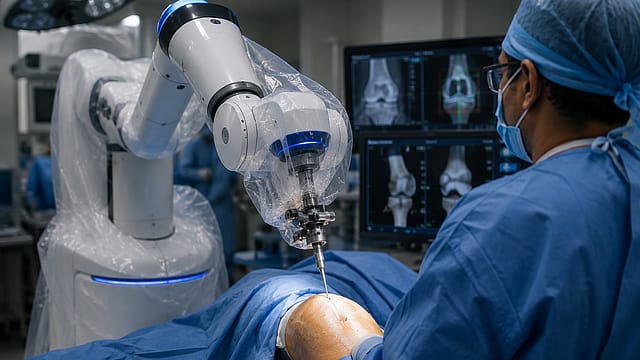
When most people hear the phrase "robot-assisted surgery", they imagine gleaming private hospitals, hefty bills and technology available only to those who can afford it.
Not Safdarjung Hospital.
Last week, a 75-year-old beneficiary under the Ayushman Bharat scheme underwent a robot-assisted total knee replacement at Delhi's Vardhman Mahavir Medical College (VMMC) and Safdarjung Hospital. The procedure, performed free of cost, marked the first such surgery at the hospital's Central Institute of Orthopaedics (CIO).
The headline-grabbing word was "robot". But the more interesting question is this: what exactly did the robot do?
And does this mean robots are now performing surgeries on their own?
The answer is no. But what happened inside that operating room could still change how thousands of Indians receive treatment in the years ahead.

Zeroing In on ECI
09 Oct 2026 - Vol 05 | Issue 41
Constitutional legitimacy versus political opportunism
What happened during Safdarjung's first robot-assisted knee replacement?
According to Safdarjung Hospital, the procedure was carried out on August 22 by an orthopaedic team led by Dr Bhagwati Prasad Sharma under the clinical guidance of Prof. Dr Sumit Sural, Director of the Central Institute of Orthopaedics. The patient was a 75-year-old man from an economically weaker background and received treatment under Ayushman Bharat.
The surgery involved a robotic orthopaedic platform that helps surgeons plan and execute knee replacement procedures with greater precision.
Contrary to popular imagination, the robot did not independently operate on the patient. Surgeons remained in complete control throughout the procedure. The robotic system functioned more like an extremely sophisticated assistant, helping doctors map the knee, plan implant positioning and improve alignment during surgery.
So what does the robot actually do?
Think of it as the difference between using a paper map and GPS navigation.
Traditional knee replacement surgery relies heavily on the surgeon's expertise, measurements and judgement. Robot-assisted systems add another layer of precision.
Before and during surgery, the robotic platform creates detailed measurements of the patient's anatomy. It helps surgeons determine exactly how much bone should be removed, where the implant should sit and how the new joint should align with the rest of the leg.
The surgeon still performs the operation. The robot simply helps make that operation more accurate.
For patients, that can potentially mean better joint alignment, improved implant positioning and more predictable outcomes, according to orthopaedic experts and hospital officials.
Why is this a bigger story than one surgery?
Because the most remarkable part is not the technology.
It is the address.
India has seen robotic surgeries for years, particularly in large private hospitals. But robotic procedures have often remained out of reach for many patients because of costs.
Safdarjung's milestone is significant because it brings advanced robotic orthopaedic care into a major government hospital. More importantly, the first beneficiary did not have to pay for it. The surgery was covered under Ayushman Bharat, the government's flagship health insurance scheme.
That raises a bigger possibility: what happens when technologies once associated with elite healthcare begin entering the public healthcare system?
Could this change treatment for future patients?
Safdarjung says the answer is yes.
The robotic platform installed at the Central Institute of Orthopaedics is designed to be upgraded over time. Beyond total knee replacements, it can support partial knee replacements and hip replacement procedures. Hospital officials say future software and technology upgrades could eventually allow robot-assisted spine surgeries as well.
In other words, this may not be a one-off achievement.
It could be the beginning of a larger shift in how advanced orthopaedic care is delivered in government hospitals.
What does this mean for ordinary Indians?
For millions of Indians, knee replacement surgery is not a futuristic procedure. It is a real and often urgent need.
As India's population ages and osteoarthritis becomes more common, demand for joint replacement surgeries continues to rise. The challenge has always been access.
The significance of Safdarjung's achievement lies in the possibility that advanced surgical technologies may no longer remain confined to premium healthcare settings.
A robot-assisted knee replacement in a government hospital does not mean every district hospital will have one tomorrow.
But it does suggest something important.
The next chapter of India's healthcare technology story may not be written in a corporate hospital boardroom or a Silicon Valley lab.
It may be written in a public hospital ward, where a patient who could never have afforded cutting-edge treatment receives it anyway.
And that might be the most revolutionary part of all.
(With inputs from ANI)