Forces accused of using 'chilli bombs' as RAF promises inquiry amidst Gen Z protest in Delhi
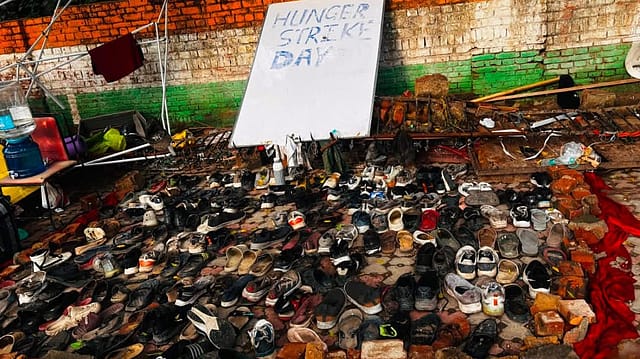
Several students who were at the ‘Chalo Sansad’ protest organised by the Cockroach Janata Party (CJP) and others say that before tear gas was fired at them in central Delhi on July 20, the forces deployed what they described as “chilli bombs”. A student said that the immediate outcome was that her face began burning intensely. It was shortly afterwards that the police used tear gas to disperse students who had headed towards Parliament House from Jantar Mantar, she added.
Although Open couldn’t independently verify the munition that was used which caused a burning sensation on the faces of the students, it is public knowledge that India has developed chilli bombs, which are hand grenades stuffed with bhut jolokia (chillies). They were developed by the Defence Research and Development Organisation (DRDO) at its Assam laboratory. It is also likely that the forces used tear gas grenades past their expiry date, as many students have alleged using videos as proof.

Losing Memory
16 Oct 2026 - Vol 05 | Issue 42
The making of a medical and social emergency
This assertion by at least five students who were near the Central Secretariat Metro Station on July 20 comes at a time when the Rapid Action Force (RAF) has initiated an inquiry into allegations of its personnel using disproportionate force and firing pellet guns during the student protests. On July 24, PTI quoted officials of the Central Reserve Police Force (CRPF) as saying that the organisation has asked the inspector general (IG) of the RAF, CRPF’s special anti-riot unit, “to verify the sequence of events its various teams undertook to ‘control’ the protesters as well as incidents where they were attacked.”

One of these students, Bhavya Singh, a final-year BTech student from Govind Ballabh Pant Government Engineering College (GBPEC), who had arrived at the Jantar Mantar protest venue around 11 am on July 20 in a cab (because Delhi Metro services were partly shut down that day), soon found herself heading towards Parliament House.
“Since barricades were erected by the police in several places, we had to walk long distances and pass by the Le Meridien hotel before we reached Sansad Bhavan. The mood was electric but soon the police in blue (RAF) started throwing tear gas canisters at us, leaving us in shock. People ran away here and there and only a few could enter the nearby Metro station because by then they had downed the shutters. We were glad that people, most of them students and young people, helped each other by offering water to wash our faces. We soon retreated and tried to head towards Jantar Mantar and it was then that the relentless lathi-charge started,” she recalls, adding that she and her friends then headed towards Connaught Place from where they took videos of the tear-gassing and lathi-charge from in front of Palika Bazaar and from near Central Park.
The march was undertaken demanding the resignation of Union Education Minister Dharmendra Pradhan over the recent NEET question paper leak and a raft of irregularities, including in the On-Screen Marking (OSM) system used by the Central Board of Secondary Education (CBSE), and other technical glitches.
Grenades stuffed with bhut jolokia were designed to smoke terrorists out of their hideouts. Bhut Jolokia is said to be one of the hottest chillies in the world.
The forces in Delhi were also accused of using pellet guns besides shock batons and lathis studded with nails. CJP, protesters and independent journalists have shared many videos displaying excessive use of force on the students. “It was only after they used the chilli bombs that the tear gas was fired,” said a student.
RAF possesses pellet guns but its standard operating procedure (SOP) allows the use of these weapons only in extremely dangerous situations where personnel face a serious threat to their lives, CRPF officials were quoted by PTI as saying.
Bhavya Singh and her friends were finally able to enter the Delhi Metro from Gate 7 around 3 pm amidst the chaos and massive police action. The incident didn’t prevent these students from returning to the site, Singh said, adding that the next day they all went back and spent the whole day at the protest site, until 8 pm in the evening.
“What I worry about is the fact that many of my friends and I struggled hard to crack competitive exams. Our lives depend on clearing them. My siblings are now preparing for such exams. So are my friends, one of whom has been working towards clearing the NEET-UG exam for years. Therefore, these exams are a matter of grave personal concern for me,” Singh told Open, adding that the challenges are far too many even after cracking such exams because of the lack of adequate facilities in government engineering colleges.
“We are forced to enter the job market with theoretical knowledge alone because the labs are under-equipped. This is the plight even after working extremely hard to clear exams. How can we not protest then? The lives of millions of students are involved. How can any government not take these things seriously?” asks Singh, an alumna of Delhi’s Mount Carmel School who is also a guitarist and has self-published a novel.
Even as the government engages in talks with the protesters, what seems to worry political leaders most is that these Gen Z protesters have seized the social media narrative – a domain where pro-government voices once held a decisive edge. That edge now appears to be eroding with the Instagram generation excelling those that thrive on Facebook and messaging apps like WhatsApp.