Anatomy of CJP Protest
IN THE LEAD-up to the 2014 Lok Sabha polls, then Gujarat Chief Minister Narendra Modi was invited to speak to students at Delhi’s Shri Ram College of Commerce (SRCC) on February 6, 2013. It was an important event as Modi was seen as the likely Bharatiya Janata Party (BJP) nominee for prime minister, a decision formally endorsed by the party’s parliamentary board six months later. Modi’s speech outlining his ideas of governance, youth empowerment and economic development attracted widespread attention and set the tone for his candidacy.
Ahead of the address at SRCC, leftist students and teachers held a protest outside the college against the institution’s decision to invite Modi. They did not just raise slogans and wave placards and black flags. They pushed and surged towards barriers placed to prevent them from entering the college and deliberately precipitated a clash with the police that had no option but to use force, including water cannons, to disperse the unruly crowd. Shortly after, the protesters alleged police highhandedness and claimed they had been injured in the baton charge. Some alleged they were jeered and molested by BJP-aligned students at the site.
Since Modi assumed office in 2014, Left organisations have been the most determined opponents of the BJP-led government and the protests in 2015 and 2016 in Jawaharlal Nehru University (JNU) followed a similar pattern. The violence that occurred at Ramjas College over a march by left students protesting cancellation of an event featuring Umar Khalid—who was later accused of conspiracy in the 2020 anti-Citizenship Amendment Act (CAA) riots in Delhi—was part of the same pattern. Left students sought to lay siege to the college while a section of students from within retaliated. The December 2019 march from JNU to the Delhi Police headquarters followed a predictable path as protesters pushed down barricades and clashed with cops.
The rioting at Jamia Millia a few days earlier—the JNU march was a ‘protest’ against the police action—had escalated into violence as anti-CAA protesters resorted to stone pelting and torched buses. They came prepared with wet towels and blankets to counter the use of tear gas. The police entered the Jamia campus as they chased stone throwers and used lathis and tear gas. Not long after, the anti-CAA protest led to a lengthy sit-in at Shaheen Bagh. The anti-Modi Left students’ organisations such as Students’ Federation of India (SFI), All India Students’ Association (AISA) and All India Students’ Federation (AISF) made common cause with the anti-CAA protests that had the support of Islamist groups like Popular Front of India and Jamaat-e-Islami Hind. They were natural allies.
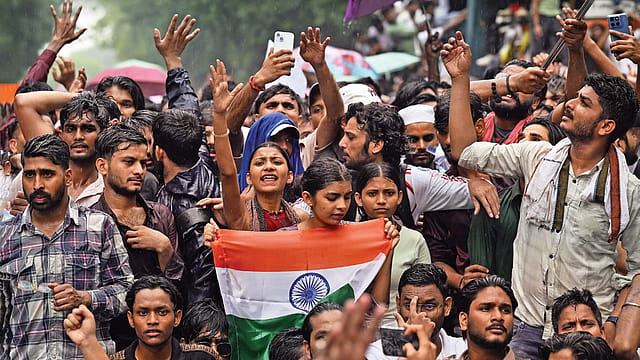
The crowd at the Cockroach Janata Party’s first protest at Jantar Mantar in Delhi on June 6 drew a modest crowd. It would have been even thinner if AISA had not mobilised on behalf of CJP leader Abhijeet Dipke. An AISA office bearer present at Jantar Mantar said the protest leaders had approached the student organisation for help and the request was accepted. AISA decided to support and participate in the protest launched by CJP in the wake of the leak of the National Eligibility-cum- Entrance Test (NEET)-UG question papers. Yet, the AISA participation on the day was limited as the organisation tested waters to see just how the situation developed. Thereafter, CJP protests in other cities yielded indifferent results before Dipke and Co returned to Jantar Mantar. This time, the protesters decided to dig in and Ladakh activist Sonam Wangchuk’s fast generated traction that was previously missing. Soon, opposition leaders found merit in visiting the protest site where they found a forum to attack the Modi government.
The violent clashes between protesters mobilised by CJP and the police in central Delhi on July 20 and 21 were as per script in view of a toolkit perfected over the past few years. The muscle for the protests was drawn from the same Left students’ organisations who have repeatedly taken to the streets to oppose the BJP-led National Democratic Alliance (NDA) government. The approach of the Monsoon Session of Parliament was the obvious trigger for demonstrations and the march announced for July 20—despite denial of police permission—was intended to disrupt life in the capital in the most dramatic manner possible. Depending on political views of the beholder, social media users amplified videos of CJP protesters stoning and damaging public property or cops lathi-charging marchers.
What is however clear is that the violence was not one-sided. In fact, unlike in the case of the crackdown on Baba Ramdev’s anti-corruption protest on the night of June 4, 2011, at Ramlila Maidan that led to several injuries and one death, police did not use force in an indiscriminate manner. It is worth recalling that Baba Ramdev’s attempts to flee the venue had attracted derision rather than outrage over the manner in which the protest was forcefully and ruthlessly broken up.
A number of protesters who heeded the CJP call were not left activists, but were youth agitated by lack of opportunities and a strong sense of dissatisfaction over their circumstances. Just how many were students is hard to say as is their ability to clear competitive examinations. Many of them do represent a section that is caught in a situation where their skillsets—or lack of them—reduce their employability. In the age of social media, they have a window that offers views of a better world, but one that may be largely out of reach. Aspirations can run into a hard and unyielding reality. It is also a fact that there are more job seekers than jobs, and this is compounded by an education system that delivers degrees but no road to gainful employment. The changes in school education, which emphasise a practical orientation, will take time to work. A focus on building manufacturing as a job-creating sector other than services and trade deals with developed nations will offer new opportunities. But not everyone will benefit. A certain set of higher order skills will be required to take advantage of such shifts in the economy.
Political activism, however, marches to its own music. SFI leader Aishe Ghosh was student union president when violence broke out at the JNU campus in January 2020, after masked outsiders entered the campus. The left activists had previously attacked the server room and prevented students from registering. Meanwhile, BJP-aligned students were allegedly subjected to systematic intimidation in hostels. More than six years later, Ghosh is in the news again for going to court claiming police videography at Jantar Mantar amounts to intrusive surveillance. It was activism rather than academics that led Ghosh to JNU. If it was not paper leaks, some other reason would suffice to serve a political cause.