Fake Bottles, Real Bills: How India’s Train Food Scam Is Making Passengers Pay More
You are halfway through a train journey.
The landscape outside is rushing past. Someone is sleeping across the aisle. A child wants a cold drink. You are thirsty, hungry and, naturally, you buy what is being offered.
That is where the trouble can begin.
The bottle looks familiar. The snack packet looks perfectly ordinary. The vendor is walking through the coach like everyone else.
But is the product actually authorised for sale on the train?
Recent inspections by the Indian Railway Catering and Tourism Corporation, or IRCTC, suggest passengers have reason to look twice.
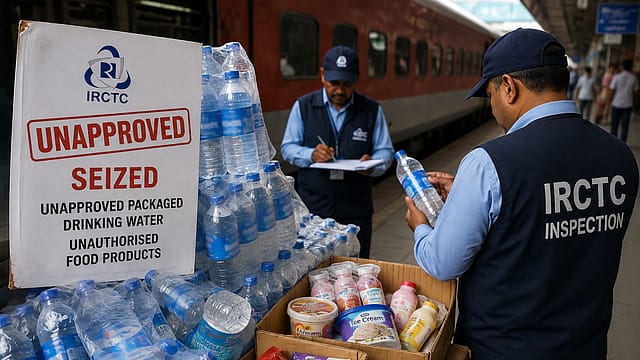
More than 8,000 bottles of unapproved packaged drinking water have been seized in a recent nationwide crackdown, along with unauthorised food products including ice cream and flavoured milk, according to reports on IRCTC's inspections. The drive began with checks in parts of northern India and has now been expanded across the railway network.
Rise of the Pivotal Power
18 Sep 2026 - Vol 05 | Issue 38
The BRICS declaration is a strategic victory for Modi
And water is only part of the story.
So, what exactly is being sold?
The first thing to clear up is the word “fake”.
Not every bottle seized by railway officials is necessarily counterfeit. The issue in the recent inspections is that vendors were found selling unapproved or unauthorised products that were not part of the railway's permitted catering system.
That distinction matters.
Railway catering contractors and vendors are required to follow approved product lists and prescribed food-safety standards. IRCTC's own tender documents say products can be removed or delisted from the approved list, after which licensees are required to stop selling them.
In the latest inspections, 5,241 bottles were seized in the Lucknow area and another 3,108 in the Chandigarh area, according to Indian Express reports. Other seizures have been reported from areas including Howrah, Sabarmati, Guwahati, Agartala and Dibrugarh.
That is why the crackdown matters.
A passenger buying a bottle of water cannot necessarily tell, just by looking at it, whether the brand is authorised for sale on that particular railway network.
And then there is the ₹14 bottle
Here's a number every train passenger should know.
₹14.
That is the current MRP for a one-litre bottle of Rail Neer and for shortlisted packaged drinking-water brands sold on railway premises and trains. The Railway Board reduced the price from ₹15 to ₹14 with effect from September 22, 2025. The 500-ml price was reduced from ₹10 to ₹9.
So if someone tells you that a one-litre bottle costs more because it is cold, because it is being sold inside the train, or because it is a different approved brand, don't simply assume that is how railway pricing works.
A 2022 case reported by Hindustan Times shows how quickly an overcharging complaint can turn into action: an IRCTC contractor was fined ₹1 lakh after a passenger alleged that a ₹15 water bottle was being sold for ₹20.
The price has since changed. The principle has not.
The food problem is bigger than water
The railway food story is not just about bottles.
The government told Parliament this month that IRCTC has imposed ₹5.13 crore in fines over the past three years for food-quality and hygiene violations. It has also issued 54 show-cause notices, terminated six catering contracts and debarred defaulting licensees.
That sounds alarming.
But there is an important piece of context.
Indian Railways says it serves roughly 58 crore meals every year, and food-quality complaints account for about 0.0008% of meals served, on average. Railway and IRCTC officials, including food-safety officers, conduct regular and surprise inspections.
So the evidence does not support the idea that every railway meal is part of some giant food scam.
It does show something more useful: violations happen, and the railway system is repeatedly having to police them.
The problem has been around for years
This is not a brand-new phenomenon.
A Comptroller and Auditor General audit of railway catering found unauthorised water brands, expired packaged products and other food-safety deficiencies during inspections. The audit also flagged problems with cleanliness and hygiene at catering units.
And individual cases keep surfacing.
In 2023, Hindustan Times reported that Central Railway seized 276 bottles of an unauthorised packaged-water brand being loaded onto a train at Mumbai's Lokmanya Tilak Terminus. Railway officials said the bottles were being loaded alongside Rail Neer for sale to passengers.
In another recent case, Hindustan Times reported that a passenger travelling on the Hemkunt Express complained after being charged ₹20 for a bottle of water and being charged more than the prescribed rates for other items. The caterer was subsequently fined ₹5 lakh, according to Railway Seva.
The pattern is familiar: a passenger buys something, notices something is wrong and complains.
So how do you protect yourself?
Start with the simplest rule: look before you pay.
Check the label. Check the seal. Check the printed MRP. And, especially with packaged water, check whether the brand is among those authorised for sale on the railway.
If something looks suspicious, don't assume that a familiar-looking label makes it legitimate.
And if you are ordering a meal online, there is an easier way to reduce the uncertainty.
IRCTC's official e-Catering service allows passengers to order through its website or the Food on Track app, with food supplied by listed partner restaurants.
That doesn't mean every other food seller is automatically unsafe. It simply gives passengers a way to order through a recognised railway-linked system rather than relying on an unknown caller, website or person approaching their seat.
What if the vendor asks for more money?
Don't quietly pay and move on.
Ask for the bill or receipt. Keep the packaging. Take a photograph if necessary.
And report the problem.
Railway passengers can use RailMadad or the railway helpline 139 to lodge complaints. IRCTC's official e-Catering service separately lists 1323 for its food-ordering service.
The more useful question, then, isn't whether Indian train food is one giant “scam”.
It isn't.
Indian Railways serves hundreds of millions of meals every year, and the government's own figures show that food-quality complaints are a tiny fraction of that volume.
But that doesn't make an unauthorised bottle any safer.
A train journey puts you in a peculiar position: you are hungry, thirsty, moving through a system you don't control, and often buying from someone you have never seen before.
That is precisely why the little things matter.
Check the bottle. Check the MRP. Ask for the bill. And if something doesn't look right, report it before the train disappears into the next station.
(With inputs from yMedia and agencies)