Keralam Is Not What It Makes. It Is What It Makes Possible
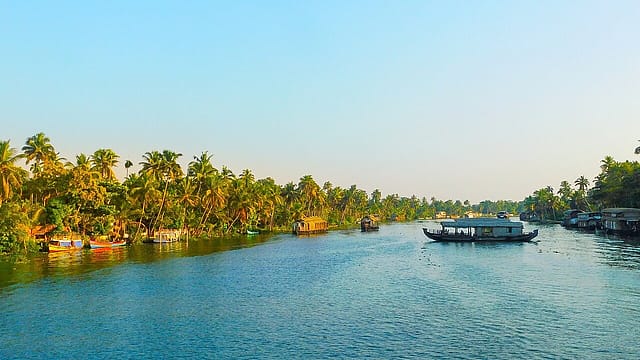
Comparative advantage has traditionally been understood as producing a good more efficiently than someone else. But what if it can also arise from producing conditions, environments in which people develop capacities, judgment, health, and wisdom, that other societies find increasingly difficult to create?
That question reframes what follows. Keralam's greatest comparative advantage may not be what it makes. It may be what it makes possible.
Beyond Possession
For most of the last century, economic success meant producing and consuming more, larger homes, more vehicles, more ownership. This model suited places with abundant land and expanding manufacturing. It suits Keralam less naturally. The state has tried, for decades, to build its future through this possession-economy logic, and its own numbers show the strain.

Zeroing In on ECI
09 Oct 2026 - Vol 05 | Issue 41
Constitutional legitimacy versus political opportunism
Remittances from Gulf migration make up roughly a sixth to a fifth of Keralam's GSDP by current estimates, a dependence recently underscored by an expected 20 per cent drop in inflows as conflict in West Asia continues. The state's own fiscal position, a persistent revenue deficit near 2 per cent of GSDP, capital expenditure among the lowest of any major Indian state, close to a quarter of revenue drawn from lotteries and liquor excise, tells the same story from the inside. Leaving a possession economy behind is not a matter of preference for Keralam. It is a model already reaching its limits.
The Deeper Claim
Economists have already noted that value increasingly comes from experiences, not only goods, but memorable travel, meaningful meals, immersive festivals. That much is established literature. The more original claim, and the one this essay actually rests on, is different.
Experiences are not merely products to be consumed. They are conditions through which human beings develop.
One way to state the fuller arc makes this precise.
Possession Economy — value built on skills and knowledge, measured by what a person accumulates and owns.
Experience Economy — the same skills and knowledge, now deepened through memorable experience, measured by what a person has felt and lived through.
Economy of Becoming — skills, knowledge, and experience together, but multiplied by capacities, judgment, discernment, health, creativity, wisdom, that determine how much of all the rest actually converts into value.
Each stage does not replace the one before it. It absorbs it and adds to it. Becoming is not a rejection of possession or experience, but their fullest use, since without discernment to govern them, skill, knowledge, and experience yield far less value than they could. Once this is seen clearly, experiences are no longer the end product of an economy. They are the medium through which human capacities emerge.
A child cycling safely through her neighbourhood does not simply enjoy an afternoon. She develops confidence and autonomy that outlasts the ride. A library does not merely lend books. It alters what a mind can attend to. A festival does not only entertain. It builds the collective memory a community draws on afterwards. A conversation in a neighbourhood tea shop is not idle time. It is where curiosity, argument, and belonging are quietly rehearsed. In each case, the experience is not the product. It is the medium through which a capacity, a judgment, a relationship, a form of health, comes into being.
This distinction matters because it changes what counts as an economic asset, and it gives us a working definition. A possession economy counts the tea shop, the library, the festival as costs, or at best as amenities. An economy of becoming counts them as the actual site of production, where a more capable, more attentive, more discerning person is made. An economy of becoming, more formally, is an economic system whose primary output is the transformation of human capacities, rather than the accumulation of possessions or the consumption of experiences for their own sake. A possession economy asks what a person owns. An economy of becoming asks who a person is developing into, through sustained encounter with a place, a community, and a practice.
What is actually forming in each of these moments is developmental enactability, the continuously evolving ability through which a person brings forth more differentiated forms of action, judgment, and participation through repeated engagement with the conditions around them. Here is why this happens. Human capacities do not accumulate in isolation like assets stored in a warehouse. They emerge through repeated coupling with environments that continually invite particular forms of attention, action, reflection, and participation. In the language of dependent origination, the capacity does not exist beforehand and then meet its conditions, but it arises together with them, each encounter shaping what becomes possible in the next. An economy of becoming therefore produces capacities indirectly, by designing and preserving the conditions through which those capacities repeatedly emerge, which is also why it cannot be built once and left standing.
This is more than a metaphor for how development feels. It is a claim about what production actually is. Classical economics treated land, labour, and capital as the primary factors of production. Knowledge economies added information and skill. An economy of becoming names another productive asset beneath all of these - developmental conditions, the social, ecological, cultural, and institutional environments through which human capacities continually emerge. It behaves unlike the factors before it. Land can be held. Capital can be accumulated and moved. This one can only be tended, and only in place, which is exactly what makes it a comparative advantage, in the strict, classical sense, harder to imitate than land, harder to accumulate than capital, because it cannot be transferred at all.
This extends a familiar intuition, that development means expanding what people can do and become, not merely raising what they own, but makes one further move. Most development thinking has been operationalised through skills and knowledge, literacy, schooling, employability, the things that show up on a resume or a national index. An economy of becoming gives equal weight to something usually left unmeasured - dispositional capacities such as attention, discernment, and coherence, which a person can lose even while holding every credential a skills-based measure would reward. An economy built only to produce skills and knowledge will keep missing this.
Why Keralam, Specifically
Keralam's case for this economy is not aspirational. It is closer to inventory. The state already possesses an unusually dense ecology of the conditions this framework describes, like slower rhythms of life, strong local communities, public libraries, cooperative networks, Ayurveda, traditional arts, biodiversity, and an enduring culture of conversation. Unlike a factory, none of this can be built quickly elsewhere. It took Keralam generations of land reform, public health investment, and civic life to accumulate. In the language of classical trade theory, this is Keralam's true comparative cost advantage, not a lower cost of manufacturing a good, but a lower cost, measured in decades already spent, of producing the conditions under which human capacities develop.
Keralam's historical trajectory also matters. Much of its twentieth-century development involved repairing the social conditions that enabled people to participate in economic and civic life through land reform, public health, education, and community institutions such as Kudumbashree and Haritha Karma Sena. The opportunity now is not merely to restore participation, but to deliberately cultivate attention, discernment, and wisdom in a population whose basic developmental foundations are already comparatively strong.
Two further pressures make this urgency rather than preference. Keralam is ageing faster than any other state. Its elderly population is already close to a fifth of the total and is projected to approach a quarter by the mid-2030s. The government has taken serious note of the situation and established India's first standalone Department for Senior Citizens. While planning for retirement homes, mobility devices, and assisted living, it is equally important to treat older citizens not as a market to be served, but as a source of judgment and continued contribution.
A further shift makes the timing sharper still. AI is steadily commoditising information, routine expertise, and increasingly even skilled cognitive work. As these become abundant, competitive advantage shifts away from what people know toward the environments that cultivate judgment, discernment, creativity, and wisdom. An economy built to manufacture goods efficiently has little answer to this shift. Keralam, whether by design or accident, has been building the alternative kind of infrastructure for many decades.
Producing Conditions, Not Only Goods
The conventional question is about what Keralam produces. The more useful question is what conditions Keralam enables. Can it become the best place to recover from burnout, the finest place for lifelong learning, a global centre for ecological education and reflective living, the preferred destination for healthy ageing? These are not tourism strategies. They describe a different economic logic, in which Keralam exports transformation rather than only goods, visitors leaving healthier, students leaving wiser, entrepreneurs leaving with new ideas.
This requires treating certain things as infrastructure that are usually dismissed as amenities, like safe streets, public libraries, community festivals, urban forests, and spaces for dialogue. Keralam already has an unusually rich version of this infrastructure, much of it built for other declared reasons such as land reform for equity, public health for its own sake, cooperative networks like Kudumbashree for women's economic participation, and only now visible as a single coherent asset once named correctly. A road network and a library network are both forms of infrastructure in this framework, but they address different questions. One moves people and goods, the other builds the capacities that determine what people do once they arrive. What Keralam has not yet done is to name this second kind, measure it, and deliberately design for its continued strength against unplanned urbanisation and indiscriminate consumerism.
This recognition is not happening in isolation. Scotland, Iceland, New Zealand, Wales, and Finland, the Wellbeing Economy Governments partnership, have begun building budgets and policy explicitly around wellbeing rather than GDP growth alone. The Global Flourishing Study, following over 200,000 people across 22 countries, has found a negative relationship between a nation's wealth and its citizens' reported sense of meaning, evidence that beyond a point, more possession stops producing more becoming. Keralam's advantage is that it inherited this infrastructure rather than having to build it from scratch, and now needs only to recognise it as a coherent economic strategy.
One Institution Already in Hand
Keralam's library network makes the case concretely. When P.N. Panicker organised 47 rural libraries into an association in 1945 under the slogan "read and grow," the ambition was developmental, not merely informational. The network grew to some 6,000 libraries within his lifetime and now numbers over 8,495 libraries affiliated with the Kerala State Library Council, the highest density of rural libraries per head of any Indian state, and earned UNESCO recognition in 1975.
Elsewhere, this same institution is being rebuilt around a sharper question, not what a library lends, but what it makes possible. Helsinki's Oodi library devotes only a third of its space to books, the rest given to makerspaces and rooms tailored to specific communities, on the premise that a library's task is capacity-building, not circulation. What Helsinki designed, Keralam inherited, a public trusted enough, across three generations, to walk into more than 8,000 buildings unbidden. Reimagining the Grantha Sala network as human-becoming centres, with room for craft, intergenerational exchange, and reflective practice alongside books, would cost far less than building that trust from scratch, and it already has a use waiting for it. Keralam's proposed "skill bank," in which retired professionals contribute their expertise to local governance, currently has no institutional address. An intergenerational room in each Grantha Sala gives it one, in a network that already reaches nearly every panchayat.
Ageing also confers a capacity the skill bank alone doesn't capture. Social and emotional judgment tends to sharpen with age, and in farming and fishing communities this shows up as sensing, elders noticing shifts in monsoon timing, soil, or fish stock well before any formal system registers them. The same library network could carry this too, a channel for observations that otherwise disappear with each generation.
A Principle to Govern How This Is Built
Any proposal to bring older citizens back into active contribution risks repositioning them into roles a younger generation is already competing for, quietly transferring scarce opportunity from young to old rather than creating anything new. The discipline for avoiding this comes from what strategists W. Chan Kim and Renée Mauborgne call non-disruptive creation, building genuinely new value rather than displacing an existing claimant to it. The idea is to create a category with no prior occupant, rather than hand an old role to a new person. An ecological sensing register displaces no one, since no formal role currently captures observation at this granularity. A discernment circle convened before major panchayat decisions displaces no elected official either, since it offers judgment rather than authority. Keralam's task is to keep every version of elder engagement passing this same test.
What This Changes
Comparative advantage itself may need to be redefined for the times ahead. In an age when goods, information, and even expertise become increasingly abundant, the scarce resource is the ecology through which judgment, health, creativity, and wisdom continue to emerge. Places that can cultivate these conditions will possess an advantage far harder to imitate than lower production costs or larger factories.
Keralam's own advantage was never really about what it manufactures. It is what it makes possible, in the people who live there, and increasingly, in the people who come to encounter it. Whether in Keralam or elsewhere, the places that flourish in the coming decades may be those that learn to cultivate not only industries or experiences, but the developmental conditions through which judgment, creativity, health, and wisdom continually emerge. Comparative advantage may increasingly belong to societies that make human becoming possible.