EXPLAINED | Who Was Verghese Kurien, and How Did Operation Flood Transform India's Dairy Sector?
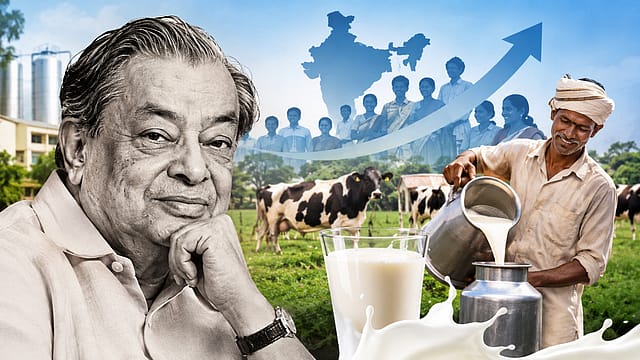
November 26 marks the birth anniversary of Dr Verghese Kurien, the dairy technologist and institution-builder credited with transforming India's milk economy. Born in 1921, Kurien is widely remembered as the Father of the White Revolution for his role in building a cooperative model that connected millions of milk producers with urban consumers.
The date is also observed as National Milk Day. At the centre of Kurien's legacy is Operation Flood, a programme launched in 1970 that reshaped India's dairy sector and sought to give milk producers greater control over the market.
Here is a look at who Kurien was, what Operation Flood set out to achieve and how it changed India's dairy economy.

Anatomy Of A Stillborn Revolution
20 Nov 2026 - Vol 01 | Issue 01
Whatever Happened To The Cockroach Janta Party?
WHO WAS DR VERGHESE KURIEN?
Dr Verghese Kurien was an Indian dairy technologist and the architect of the country's White Revolution. He was the founder chairman of the National Dairy Development Board (NDDB), serving from 1965 to 1998.
Kurien's contribution went beyond increasing milk production. He helped build institutions and cooperative networks through which dairy farmers could collectively procure, process and market milk.
He also served as the founder chairman of the Gujarat Cooperative Milk Marketing Federation (GCMMF), the organisation that markets Amul products. His approach placed farmers at the centre of the dairy business, giving them a greater stake in the value generated by their produce.
Kurien received several honours, including the Ramon Magsaysay Award, the Padma Shri, the Padma Bhushan and the Padma Vibhushan. He died on September 9, 2012, in Gujarat.

WHAT WAS THE WHITE REVOLUTION?
The White Revolution refers to the transformation of India's dairy sector through a significant expansion of milk production, procurement and distribution.
Before this transformation, India faced shortages in milk supply and relied on imports to meet part of its demand. Milk production was fragmented, and farmers often depended on intermediaries to sell their produce.
The cooperative model sought to change this arrangement. By organising milk producers into village-level cooperatives and linking them to larger processing and marketing networks, the movement aimed to ensure a more reliable market for farmers and a steady supply for consumers.
Kurien became the central figure in building and expanding this model. His work helped make dairy development a tool for rural economic growth.
WHAT WAS OPERATION FLOOD?
Launched in 1970 by the NDDB, Operation Flood was one of the world's largest rural development programmes. Its objective was to create a nationwide milk grid connecting producers in rural areas with consumers in major cities.
The programme was built around village milk producers' cooperatives. These institutions collected milk from farmers, facilitated its processing and transportation, and connected producers to urban markets.
The idea was to reduce the dependence on middlemen, limit seasonal and regional variations in milk prices, provide producers with a regular market and make milk available to consumers at reasonable prices.
Operation Flood also drew on international assistance. Its first phase was financed through the sale of skimmed milk powder and butter oil donated by the European Economic Community through the World Food Programme.
HOW DID OPERATION FLOOD WORK?
The programme was implemented in three phases over more than two decades.
Phase I (1970–1980): The first phase connected 18 major milk-producing areas, or milk-sheds, with consumers in India's four metropolitan cities—Delhi, Mumbai, Kolkata and Chennai. It also helped establish the foundation for a national dairy cooperative network.
Phase II (1981–1985): The programme expanded significantly, increasing the number of milk-sheds from 18 to 136 and extending distribution to 290 urban markets. By the end of 1985, a network of 43,000 village cooperatives covering 4.25 million milk producers had been established.
Phase III (1985–1996): The final phase focused on consolidating the cooperative system and strengthening infrastructure. It expanded veterinary services, animal healthcare, feed and artificial insemination facilities. It also encouraged research into animal health and nutrition, while women's participation in dairy cooperatives increased.
HOW DID IT CHANGE THE LIVES OF DAIRY FARMERS?
One of Operation Flood's most significant contributions was its attempt to change the relationship between milk producers and the market.
Instead of selling milk individually through intermediaries, farmers could become members of village cooperatives. These societies collected milk, arranged procurement and provided access to services that could improve livestock productivity.
The cooperative structure also gave producers a collective voice in the dairy economy. By linking village societies to processing facilities and urban markets, the programme sought to ensure more regular payments and fairer returns for farmers.
The NDDB has described the programme as much more than a dairy initiative, viewing it as a rural development model that generated employment and regular incomes for millions of people.
WHAT WAS KURIEN'S CONNECTION WITH AMUL?
Amul became one of the most visible examples of the cooperative model that Kurien helped build.
The cooperative movement in Gujarat had begun before Kurien's arrival. The Kaira District Cooperative Milk Producers' Union, associated with the Amul brand, was established in 1946. Kurien joined the dairy movement in Anand and played a crucial role in expanding its operations and developing a model that could be replicated elsewhere.
The success of the Anand cooperative model became the basis for the NDDB's efforts to expand dairy cooperatives across the country.
Amul eventually became a nationally recognised dairy brand, while the cooperative structure behind it demonstrated how farmers could collectively participate in processing and marketing their produce.
WHY IS NOVEMBER 26 OBSERVED AS NATIONAL MILK DAY?
National Milk Day is observed every year on November 26 to commemorate Kurien's birth anniversary and recognise his contribution to India's dairy sector.
The observance was initiated in 2014 by the Indian Dairy Association, the NDDB and 22 state-level milk federations.
Kurien was born on November 26, 1921, in Kozhikode, Kerala. November 26, 2026, marks his 105th birth anniversary.
The day also recognises the role of dairy farmers and cooperatives in India's rural economy. From village-level milk collection to a nationwide distribution network, the White Revolution demonstrated how institution-building and collective enterprise could transform an entire sector.
Kurien's legacy, therefore, is not simply about producing more milk. It is also about building a system in which farmers could become participants in, rather than just suppliers to, the dairy economy.
With inputs from ANI