Trump offers India 17% tariffs if PM Modi signs trade deal: What's the catch?
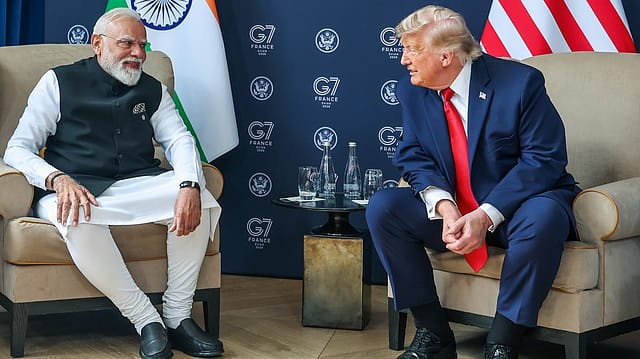
The United States has put a number on the trade pressure facing India: tariffs of up to 25 per cent on Indian goods. But Washington has also indicated a possible way to bring that rate down to 17 per cent: a reciprocal trade agreement that addresses its concerns about India's manufacturing policies and industrial practices.
In a statement on November 25, the Office of the United States Trade Representative (USTR) proposed tariffs of up to 25 per cent on Indian goods, with exemptions for certain products. The proposed duties would be applied net of existing Section 301 tariffs. The USTR also said it would consider adjusting additional duties to account for existing Section 301 and Section 232 measures.

Anatomy Of A Stillborn Revolution
20 Nov 2026 - Vol 01 | Issue 01
Whatever Happened To The Cockroach Janta Party?
The lower 17 per cent rate would be considered if India reaches an Agreement on Reciprocal Trade with Washington that addresses the findings of the US investigation. The distinction is important: neither rate is a new tariff already in force. These are proposed measures, and the process now moves into public consultation.
Why has the US proposed tariffs on India?
The announcement follows a determination by US Trade Representative Jamieson Greer that the acts, policies and practices of 14 economies, including India, relating to structural excess capacity and production in manufacturing sectors are unreasonable and burden or restrict US commerce.
The investigation was initiated on March 11, 2026, under Section 301 of the Trade Act of 1974. It covers major trading partners, including India, China, Japan and the European Union.
In its assessment of India, the USTR flagged industrial plans to expand manufacturing, what it described as inadequate labour protections, financial repression policies and sustained barriers to market access. It also alleged that India had failed to address global excess capacity and production, including through imports and foreign direct investment from non-market economies.
The USTR argued that these practices limit commercial opportunities for American producers and exporters, both in India and in other markets. It said they contribute to losses in US manufacturing production, exports, jobs and investment, while increasing economic security risks.
The US particularly pointed to pharmaceuticals and medical devices, steel, solar energy and information and communications technology (ICT) as sectors of concern.
How do India's proposed tariffs compare with other countries?
India is not the only economy facing proposed action. The USTR has recommended tariffs of up to 35 per cent on Vietnam, 20 per cent on China and Singapore, and 18 per cent on Bangladesh, Cambodia, Indonesia, Malaysia and Thailand.
For the European Union, Japan, South Korea, Switzerland and Taiwan, it proposed tariffs of up to 15 per cent, net of Most Favoured Nation (MFN) rates and existing Section 301 duties.
Washington has also indicated that lower rates could be considered for some economies if they reach agreements or make commitments addressing the investigation's findings. Vietnam could see its proposed rate reduced to 20 per cent, while Singapore's could fall to 10 per cent.
The proposed 17 per cent rate for India would therefore put it below several competing Asian economies, if a trade agreement is reached. But the figure is not simply a concession: it is linked to negotiations and Washington's demands.
What does the proposal mean for the India-US trade deal?
The announcement puts the unfinished trade agreement between New Delhi and Washington back in focus. On November 15, Commerce and Industry Minister Piyush Goyal had said the US had assured India of preferential trade access, with lower duties than those imposed on competing countries. "India will get preferential trade access in the US with lower duty than our competitor countries," Goyal said while speaking to the media in Cairo, Egypt.
He added that the assurance was part of a broad framework agreement reached between Prime Minister Narendra Modi and US President Donald Trump. "This was already agreed between the leaders, President Trump and Prime Minister Modi, when they announced that we have both come to a broad framework agreement a few months ago," Goyal said.
The proposed 17 per cent rate gives that assurance a more concrete shape, although the final terms of a reciprocal trade agreement remain crucial. It also sits below the 18 per cent rate outlined in the February framework for an interim trade deal.
When could the proposed tariffs take effect?
The USTR has invited public comments on the proposed measures. Written submissions and requests to appear at hearings must be filed by January 5, 2027, while hearings are scheduled to begin on January 25.
These dates mark the consultation process, not a confirmed date for the tariffs to come into force. The final measures will depend on the outcome of the process and any trade agreement reached with the countries concerned.
For India, the immediate challenge is to secure the preferential access promised during negotiations while weighing the demands attached to it. The choice Washington has put forward is clear: a proposed tariff of up to 25 per cent, or the possibility of 17 per cent if the two sides reach an agreement that addresses the US investigation's findings.
(With inputs from ANI)