EXPLAINED | Hindu Outfits Protest, BJP Slams TVK as SC Order 'Defied': What is Tamil Nadu's Deepam Row
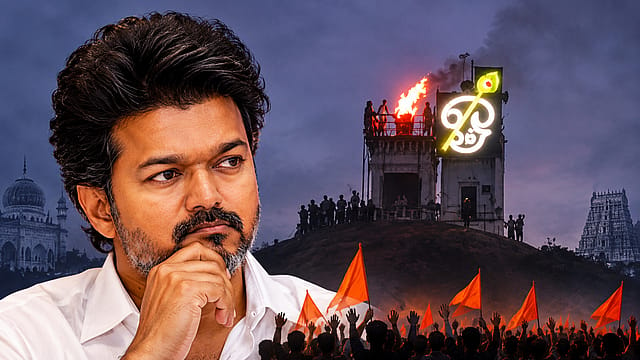
Thiruparankundram, a hill in Madurai, is an important pilgrimage site for Hindus. It is home to the Arulmigu Subramaniya Swamy Temple, dedicated to Lord Murugan, and also has the Hazrat Sultan Sikandar Badusha Auliya Dargah and a mosque near the hilltop. The two religious sites have existed in close proximity, but disputes over the use of the hill and its surrounding land have surfaced periodically.
The latest controversy concerns the annual Karthigai Deepam, a festival during which lamps are lit in Tamil Nadu. The disagreement is over the location of the ceremonial lamp. The temple administration and the state government maintain that the lamp is traditionally lit at the Deepa Mandapam near the Uchi Pillayar temple. Hindu organisations and petitioners have demanded that it also be lit at a stone pillar on the hilltop, which they identify as the Deepathoon.
The Wealth Issue 2026
06 Nov 2026 - Vol 05 | Issue 45
Portraits of Dreamers and Doers under 35
The pillar is close to the dargah. The distance between the two sites, and the question of whether the pillar is historically meant for lighting the lamp, have become central to the dispute. The argument is no longer confined to religious practice: it has moved into the courts and become a political confrontation involving the BJP, the ruling Tamilaga Vettri Kazhagam (TVK) government and parties on both sides of the state’s political divide.
WHY ARE THE TWO SIDES DISAGREEING OVER THE PILLAR?
The dispute is partly about history and partly about religious custom. Those demanding the lamp at the Deepathoon say the pillar is an ancient lamp post and that the ritual should take place there. The state government and temple administration have argued that the established practice is to light the lamp at the mandapam near Uchi Pillayar temple, and that there is no proven custom of lighting it at the disputed pillar.
The disagreement over the pillar's identity has also acquired a political dimension. Congress leader Manickam Tagore, responding to BJP general secretary BL Santhosh, cited a 1981 book titled Thiruparankundram, published by the Tamil Nadu Department of Archaeology. He referred to a passage describing a Nayak-era pillar and an inscription, along with a sculpture of Hanuman. Tagore argued that this description matched the pillar where the lamp was lit, and accused the BJP leader of confusing it with a British-era survey stone.
Santhosh, meanwhile, had shared a post by researcher T Nivethitha referring to the same book and questioning what had changed in the identification of the pillar between 1981 and 2026. These are competing interpretations being advanced in the political debate; the historical identity and legal status of the site remain matters before the courts.
HOW DID THE DISPUTE REACH THE COURTS?
The question of lighting the lamp at a location other than the customary mandapam has a longer history. The issue came before the Madras High Court in 1994, when a petition sought to prevent Hindu Munnani volunteers from lighting a lamp at the top of the hill. In a 1996 order, the court dealt with the temple's responsibility for the ritual and left room for the temple administration to consider requests for another suitable location, subject to conditions.
The dispute returned to court in November 2025, when worshippers sought permission to light the Karthigai Deepam at the stone pillar. On December 1, 2025, a single judge of the Madras High Court directed the temple administration to light the lamp there. The temple administration and the state opposed the move, arguing that the ritual had traditionally been performed at the mandapam and raising concerns about the proximity of the dargah and possible law-and-order problems.
On January 6, 2026, a division bench of the Madras High Court upheld the direction to light the lamp at the Deepathoon. The state subsequently challenged the High Court's decisions in the Supreme Court.
WHAT DID THE SUPREME COURT ORDER?
On November 20, 2026, the Supreme Court permitted the Karthigai Deepam to be lit at the Deepathoon on November 24, but only as a one-time arrangement. The bench of Justices Aravind Kumar and Vipul M Pancholi made it clear that this permission did not establish a customary religious practice, settle ownership of the land or create a right that could be claimed in subsequent years.
The court also laid down strict conditions. Only a restricted team authorised by the temple administration and government officials could access the pillar. The general public was not permitted to accompany them, and processions, demonstrations, public gatherings and slogan-raising at the site were prohibited. The district collector was made responsible for coordinating the arrangements, with the police tasked with security. The court also said that access to and worship at the adjoining dargah and mosque should not be disturbed.
The Supreme Court's order was therefore limited: it allowed the ritual at the disputed location for that year's festival without deciding the larger questions of religious custom, property rights or the legal status of the pillar. The state government filed a review petition challenging the interim order.
WHY DID THE LAMP NOT GET LIT AT THE DEEPATHOON?
On November 24, the Maha Deepam was lit at the customary location above the Uchi Pillayar temple, rather than at the Deepathoon. No lamp was lit at the disputed pillar, despite the Supreme Court's interim direction. The ceremony took place amid heavy police deployment, restrictions on movement and tensions between protesters and the authorities.
The decision triggered sharp criticism from the BJP and Hindu organisations. Advocate Niranjan S Kumar, one of the petitioners, accused the state government of deliberately disobeying the Supreme Court's order and said he would consider contempt proceedings. BJP leader Tamilisai Soundararajan also alleged that the TVK government had violated the court's directions.
The government, however, has maintained that the ritual was conducted at the customary location. The legal dispute is now likely to turn on the district administration's compliance report, which the Supreme Court had directed the Madurai collector to submit within three days of the festival.
WHY IS THE BJP TARGETING TVK?
BJP is challenging the TVK government on the question of Hindu religious rights. BL Santhosh accused Chief Minister C Joseph Vijay's government of disregarding the Supreme Court's order and alleged that it had done so to appease its alliance partners. BJP leaders have demanded accountability from the government, with state BJP president Nainar Nagendran also calling for its dismissal.
The party's argument is that the government failed to implement a court order that allowed the lamp to be lit at the Deepathoon. By framing the issue as one of respect for the Supreme Court and the sentiments of devotees, the BJP has sought to turn a dispute over the location of a ritual into a larger political confrontation.
The BJP and Hindu organisations have also taken the protests beyond Madurai. Demonstrations and road blockades were reported in Ramanathapuram and Pollachi. Police registered cases against around 300 BJP and Hindu outfit members in connection with the Thiruparankundram protest, citing allegations including unlawful assembly, breach of public peace and obstruction of government servants.
WHY IS THE TVK GOVERNMENT UNDER PRESSURE?
The controversy puts Vijay's government in a difficult position. It has to respond to a Supreme Court order while managing a sensitive dispute involving two religious sites in close proximity. The government has argued that the lamp should be lit at the customary location, while the BJP has accused it of yielding to political pressure.
The BJP's reference to the TVK's alliance partners is significant. The Congress is part of the ruling arrangement, while parties representing different social and religious constituencies are also part of the state's political landscape. The BJP has alleged that the government chose not to implement the court's direction to keep its allies on board. This is a political allegation, not an established explanation for the administration's decision.
The government also faces the prospect of further legal proceedings if the Supreme Court finds that its interim directions were not followed. The court's compliance report and the state's response to the review petition will therefore be important in determining the next stage of the dispute.
WHERE DO THE DMK AND CONGRESS STAND?
The DMK, now in opposition after the change of government in Tamil Nadu, has criticised the BJP and the Sangh Parivar over their role in the controversy. DMK spokesperson TKS Elangovan accused these organisations of trying to provoke communal tension and argued that the dispute was being used to disturb the state's social harmony. He also maintained that the pillar being identified by Hindu organisations was a survey stone and not the traditional location for the lamp.
Congress leader Manickam Tagore has taken on BL Santhosh over the historical claims surrounding the pillar. By invoking the 1981 archaeology department publication, Tagore has sought to challenge the BJP's account of the site.
The positions of the DMK and Congress are not identical in every respect, but both have pushed back against the BJP's attempt to frame the dispute as a test of the government's commitment to Hindu religious practices.
WHAT HAPPENS NEXT?
The immediate question is whether the Supreme Court will accept the state's explanation for not lighting the lamp at the Deepathoon. The Madurai collector's compliance report, the review petition and any further proceedings initiated by the petitioners will determine the legal course of the dispute.
The larger questions remain unresolved. Is the Deepathoon historically a lamp pillar? Is lighting the Karthigai Deepam there an established religious custom? What authority does the temple administration have over the ritual, and how should the rights of worshippers be balanced with access to the adjoining dargah and mosque?
The Supreme Court has deliberately left these questions open while permitting a one-time arrangement for the 2026 festival. But the political battle has already moved ahead.
In Tamil Nadu, where questions of religion, language, identity and the role of the state have long shaped electoral politics, the Thiruparankundram Deepam row is unlikely to end with this year's festival. The next round will be fought in the courts as well as in the political arena.
With inputs from ANI