Royal Family Challenges State Over Mysuru Dasara
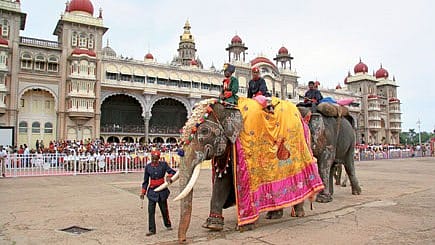
A quarrel over barricades and protocol at this year’s Mysuru Dasara has reopened one of Karnataka’s oldest property disputes—who owns Mysore Palace. The royal family holds that the palace is its private property under a 1950 agreement between the Union government and Jayachamarajendra Wadiyar. The state holds that the Mysore Palace (Acquisition and Transfer) Act, 1998, passed a year after the Karnataka High Court ordered the palace’s management returned to the family, vested it in the government for public use. The family’s challenge to the Act is pending in court. In the meantime, the palace is run by the Mysore Palace Board, a government body, and the family lives in a portion of it. The 750-kilogram Ambari that carries Goddess Chamundeshwari through the city on Dasara day continues to be with the royal family. The government pays an annual honorarium for it, running into lakhs of rupees.
On Sunday, the rajmata, Pramoda Devi Wadiyar, whose son Yaduveer Krishnadatta Chamaraja Wadiyar is the BJP’s Member of Parliament for Mysuru-Kodagu, released a letter saying the family might reconsider lending the howdah. Now, the Congress government’s district-in-charge minister, Yathindra Siddaramaiah, has responded to the letter, saying that the Palace Board, the palace and its grounds belong to the government, and that the family had only been given space to live there.

Look Who's Talking Regime Change
23 Oct 2026 - Vol 05 | Issue 43
Mysuru Dasara is two festivals held in the same buildings. One is the Nada Habba, the state festival the government runs. The other is the family’s Khasagi, or private Dasara where the head of the household performs rituals inside the palace.
Pramoda Devi is the widow of Srikantadatta Narasimharaja Wadiyar, and adopted Yaduveer as heir in 2015. In her four-page letter, she described a Dasara marked by poor coordination between departments, excessive barricading and interference with the family’s religious observances. She alleged that police personnel and their families crowded around the Ambari to take photographs, and that palace representatives were shoved when they went to retrieve it after the procession. “The attitude of the police personnel is totally unacceptable,” she wrote. She said police vehicles had occupied parking reserved for the family, and that she learned which elephant would carry the Ambari only at the last minute, after contacting the Deputy Conservator of Forests.
The rajmata now wants the government’s cultural programmes confined to the first seven days, and the palace left to the family on Ayudha Puja and Vijayadashami. She also wants the Ambari procession to be moved to the day of the goddess’s Rathotsava at Chamundi Hill. The state’s Dasara, she wrote, has no connection to the family’s observances. She and Yaduveer called the government’s attitude vindictive, an attempt to set aside the arrangement made with the family at Independence, and she noted that the family could go to court over its rituals.
Yathindra has rejected both the seven-day proposal and the claim of separation. “The Government’s Dasara has its own history dating back to 1971,” he said. The family, he said, should have written to the government before writing to the press. On the elephant, he said the forest department had taken time to decide and was not, to his knowledge, obliged to inform the family.
The dispute had begun earlier on Vijayadashami, at the Nandi Dhwaja puja near the Kote Anjaneya Swamy temple inside the palace. Chief Minister DK Shivakumar walked in with Yathindra beside him. The Superintendent of Police on duty stopped the three ministers behind them: Shivaraj Tangadagi, Minister for Kannada and Culture; PM Narendraswamy, Minister for Agriculture; and KS Basavanthappa, Minister for Muzrai, the department that administers the state’s temples. All three are Dalit. Congress MLA Tanveer Sait was also reportedly held back. The ministers said they knew of no rule barring them. Shivakumar intervened to get them in and, the next day, ordered the chief secretary, Shalini Rajneesh, to inquire into the episode. Three days later, Yaduveer made a statement saying that the Chief Minister and one or two officials were enough for the ritual.
Shivakumar had invited the chief ministers of Kerala and Telangana, VD Satheesan and A Revanth Reddy, and for the first time leaders from other states offered flowers to the goddess. The BJP MLA TS Srivatsa said only eight dignitaries were authorised to do so, yet the chief secretary and Shivakumar's wife, Usha, also went to the podium.
The Vajramushti Kalaga did not take place this year. In the bout, held at the Kalyana Thotti inside the palace, wrestlers fight with a knuckle-duster until the first drop of blood is drawn. It is staged just before the royal representative sets out on the Vijayadashami procession. The wrestlers said police delayed their entry to the palace, and some alleged harassment and demands for money and alcohol. Pramoda Devi said one group had entered while another was held at a gate. Yathindra said the police had raised no objection despite the wrestlers’ late arrival, and that the government was checking where the lapse occurred. Against Kannada news reports that the bout had been cancelled for the first time in Dasara’s history, and readings of it as a bad omen, Pramoda Devi has said that it had been omitted on occasions in the 1970s and 1980s, and in 2020, during the pandemic.
Reporters were stopped too. Police moved the media entry from the usual Karikallu Thotti gate to the Brahmapuri gate, where officers turned away journalists holding official passes, accused some of carrying fakes and, according to the Mysuru District Journalists’ Association, tried to assault a senior journalist. The reporters protested on the spot.
This was Shivakumar’s first Dasara as Chief Minister, and his predecessor’s son was the minister in charge of the district. Twenty-two ministers were assigned Dasara responsibilities. Reports have surfaced that Public Works Minister Satish Jarkiholi and Energy Minister KJ George allegedly held departmental reviews without Yathindra.
The state also used its authority to reimagine the festival this year. It added Kambala, the buffalo race of coastal Karnataka, to the Dasara programme for the first time, over objections from farmers’ groups, environmentalists and cultural organisations about animal welfare, water use, pressure on the site and whether the race belonged in Mysuru at all. The races were held on 18 and 19 October.
But this is not as radical a break from the past as it sounds. The Mysuru Dasara has in fact been changing with the times. From 1610, when Raja Wadiyar took up the Vijayanagara rite at Srirangapatna, Dasara was the king’s festival, and the maharaja himself rode through Mysuru in the golden howdah. That ended in 1970, when the then President VV Giri derecognised the former rulers. Jayachamarajendra Wadiyar withdrew his rituals to the Durbar Hall and, for the next few years, left his sword on the throne in his place. Outside the palace that year, the Kannada activist Na Nagalingaswamy staged a people’s Dasara with a sandalwood idol of Chamundeshwari, a wooden howdah lent by the palace and an elephant rented from the forest department. In the 1970s, Devaraj Urs’s government took over the procession and borrowed the golden howdah for the goddess.
Nor is it the first time the royal family has hit out against perceived acts of disrespect. In 2015, Pramoda Devi went to the police after a Palace Board official tried to uncover the golden throne before the private durbar had ended. The previous year, with the 1998 Act in dispute and no heir yet named, she held the durbar with the royal sword on the throne. In 2001, the family filed a writ claiming ownership of Chamundi Hills. In 2024, Pramoda Devi separately obtained an interim stay against the implementation of the Chamundeshwari Kshetra Development Authority Act.
Through all of it, the howdah went out on Vijayadashami. This year, the family has made what is the last seat of royal authority in public view a bargaining chip. Without the howdah, the state’s procession would lose its centrepiece. The family sees it the other way round. To its own Navaratri, Pramoda Devi wrote, the government-organised Dasara has “no relevance or religious significance”. She has asked the public to back her, and in Mysuru, where the procession belongs to the crowds on the Rajamarga, that support could well translate into sympathy for the BJP.