Drones, Missiles and Air Defence: Rajnath Singh Sets Out India’s Military Priorities
The battlefield is changing faster than traditional military structures can adapt. Drones can track troop movements and deliver precision strikes, missiles can reach targets across long distances, and air defence systems have become critical to protecting military assets and civilian infrastructure. For India, preparing for this new environment means more than buying advanced weapons. It requires changes in technology, training, organisation and the country's ability to manufacture its own equipment.
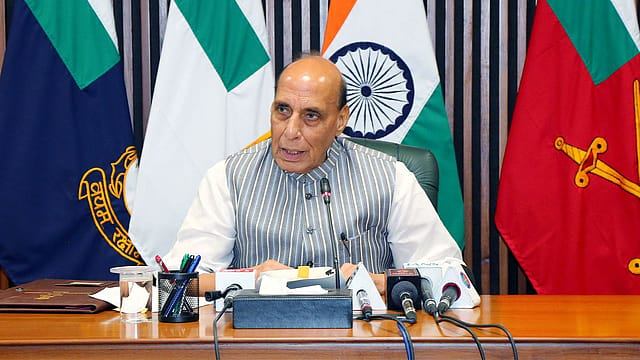
That was the central message from Defence Minister Rajnath Singh at a meeting of the Ministry of Defence's Consultative Committee in Jaisalmer, Rajasthan, on November 3. Singh told parliamentarians that modernisation of the Armed Forces was a priority, with financial resources, indigenous technology and trained personnel forming its three key pillars.

The Era of Forever Wars
30 Oct 2026 - Vol 05 | Issue 44
Coping with an explosive Middle East
“The role of drones, missiles and air defence systems is growing, and our Armed Forces must be prepared to meet future challenges,” he said.
Why is India changing its military modernisation priorities?
Recent conflicts have demonstrated how unmanned systems, precision weapons and layered air defence can influence military operations. The growing use of drones for surveillance and attacks has also forced armies to rethink how they organise troops and respond to threats.
Singh said India's modernisation effort was therefore not limited to acquiring new equipment. It also involved developing domestic capabilities and restructuring military formations to suit changing operational requirements.
He pointed to new Army formations, including Ashni drone platoons, Bhairav battalions and Shaktibaan regiments, as examples of this transition. These specialised units are designed to strengthen drone operations, rapid response and precision strike capabilities. Their development reflects the Army's attempt to integrate technology more closely into frontline operations.
How much is India spending on defence modernisation?
The financial commitment is substantial. According to the Union Budget 2026–27, the Ministry of Defence has received an allocation of ₹7.85 lakh crore, around 15.19 per cent higher than the previous year's Budget Estimates.
Of this, ₹2.19 lakh crore has been allocated under the capital head for the Defence Services, while ₹1.85 lakh crore is earmarked for capital acquisition. The latter covers purchases of equipment and platforms, including aircraft, ships, submarines, drones and advanced weapons.
“The biggest requirement is the availability of financial resources. Keeping this in mind, we have consistently increased the modernisation budget year after year and ensured its effective utilisation,” Singh said.
Can Indian defence manufacturing reduce dependence on imports?
The government is also linking military modernisation with domestic manufacturing. Singh said India's defence production had risen from ₹46,429 crore in 2014–15 to a record ₹1.78 lakh crore in 2025–26.
Defence exports have grown too. Ministry of Defence figures put exports at ₹38,424 crore in 2025–26, compared with ₹686 crore in 2013–14. India now exports defence products to more than 80 countries, according to the government. “Our target is to take defence production to Rs 3 lakh crore and defence exports to Rs 50,000 crore by 2029,” Singh said.
The private sector is expected to play a larger role in this expansion. The government has earmarked ₹1.39 lakh crore in the 2026–27 defence budget for procurement from domestic industries, including private companies.
Why are technology and military personnel equally important?
Singh identified technology as another central pillar, pointing to the Defence Research and Development Organisation's work on new weapons, missiles and systems. He said private companies, from micro, small and medium enterprises to large corporations, were increasingly contributing to the sector.
But equipment alone cannot make a force future-ready. Singh also stressed the importance of skilled personnel and organisational restructuring as warfare evolves.
“Modernisation does not simply mean procuring new weapons and equipment. It means strengthening the operational preparedness of our forces, equipping them with modern technology and developing capabilities within the country that we can rely on over the long term. Strategic autonomy and indigenous technological capabilities are essential requirements for national security,” he said.
The larger test will be whether higher spending, new formations and domestic research translate into operational capabilities. India's modernisation push is gathering pace; building a force that can respond to the next generation of threats will require sustained investment, innovation and coordination across the military and industry.
(With inputs from ANI)