Diamonds Aren’t Forever: Why Belgium Has Returned to India After 20 Years
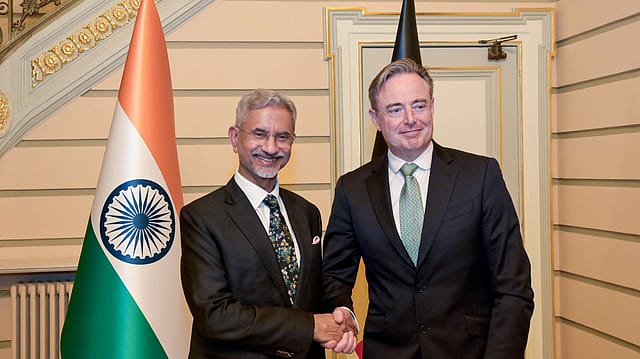
Bart De Wever landed in New Delhi on Wednesday night. In some ways, Antwerp arrived with him.
Before becoming Belgium’s Prime Minister in February 2025, De Wever served as the mayor of Antwerp for 12 years. He knows the port that connects Belgium to the world, the diamond district that made the city famous and the economic anxieties now running through both.
On Thursday, he will meet Prime Minister Narendra Modi in Delhi. On Friday, he will travel to Mumbai, visit the Bharat Diamond Bourse, inaugurate the new offices of HRD Antwerp and attend an event organised by the Port of Antwerp-Bruges.
The itinerary reveals the real story of the first visit by a Belgian prime minister to India in 20 years.

Losing Memory
16 Oct 2026 - Vol 05 | Issue 42
The making of a medical and social emergency
For centuries, Antwerp has sold the world a promise: diamonds are forever. Belgium’s Prime Minister has arrived carrying evidence that the business built around them is not.
India and Belgium created one of globalisation’s most extraordinary partnerships. Rough diamonds flowed through Antwerp. Indian expertise, concentrated overwhelmingly in Surat, cut and polished the stones. The finished gems travelled onwards to jewellery markets across the world.
A precious stone could cross continents several times before reaching a finger. Antwerp supplied the marketplace, finance, certification and credibility. India supplied the skilled hands and competitive costs that turned rough stones into objects of desire.
Now both ends of that assembly line are under pressure.
Sanctions have disrupted Antwerp’s access to Russian diamonds. Lab-grown stones have demolished old assumptions about price and scarcity. Weak demand in the US and China has hurt the entire natural-diamond industry. Dubai has steadily challenged Antwerp’s position as the indispensable trading hub.
India, which cuts and polishes around 90 per cent of the world’s diamonds, has suffered alongside it.
India’s cut and polished diamond exports fell 16.8 per cent to $13.3 billion in 2024-25, according to data cited by Reuters. That was their lowest level in nearly two decades. Imports of rough diamonds declined 24.3 per cent to $10.8 billion as exporters reduced purchases in response to weak demand and excess inventory.
Antwerp’s numbers tell an equally uncomfortable story. The city’s diamond trade declined 22.4 per cent in 2025, according to the Antwerp World Diamond Centre. Its total value fell from nearly $41 billion in 2022 to $32.5 billion in 2023, $24.5 billion in 2024 and about $19.1 billion last year.
A relationship built around sparkle has encountered a prolonged loss of shine.
The Diamond Mayor Comes to India
De Wever is unusually well placed to understand the crisis.
Antwerp is not a ceremonial attachment to his political biography. It was the source of his national power. He became its mayor in January 2013 and remained in office until he became Belgium’s first Flemish nationalist prime minister in February 2025. He remains the city’s titular mayor.
Now, as Prime Minister, he has brought Antwerp’s biggest commercial relationship to India.
The visit comes at a seemingly favourable moment. India and the European Union concluded a long-awaited free trade agreement in January after nearly two decades of negotiations. Once ratified and implemented, the agreement will reduce India’s import duty on natural polished diamonds of European origin from 5.5 per cent to 2.5 per cent.
The Antwerp World Diamond Centre has publicly celebrated the concession, describing it as the result of sustained lobbying with the European Commission. The lower rate will make Antwerp-polished diamonds more competitive in India and, importantly, prevent India from changing the duty unilaterally.
For Antwerp, certainty has acquired its own value. India’s tariff on polished diamonds has moved from 2 per cent to 2.5 per cent, then to 5 per cent, climbed to 7.5 per cent in 2018 and later declined to 5.5 per cent.
The FTA can remove some friction. It cannot manufacture desire.
Cheaper access to the Indian market will not make American and Chinese consumers buy more diamonds. It cannot erase the price difference between natural and lab-grown stones. It cannot automatically restore Russian supplies or reverse Dubai’s ascent. It also offers no immediate rescue because the agreement must still pass through legal scrutiny and political ratification before it comes into force.
The visit, therefore, is as much about finding life beyond diamonds as it is about saving them.
Seven Deals Searching for a New Relationship
Belgian Defence and Foreign Trade Minister Theo Francken is accompanying De Wever along with officials, business leaders and representatives of the country’s defence industry.
Francken told Belgian broadcaster Terzake before the visit that “seven major defence contracts” were expected to be signed. Their nature, value and participants had not been disclosed before the Modi-De Wever talks.
The number is more significant than its monetary value, which remains unknown.
Defence has historically occupied a minor place in India-Belgium relations. Belgium’s decision to station a defence attaché permanently at its embassy in New Delhi for the first time from September 1 points to an attempt to change that.
The two countries are also holding a defence CEOs’ roundtable during the visit. Belgium brings specialised capabilities in aerospace components, ammunition, sensors, communications, cybersecurity and advanced manufacturing. India offers scale, rising procurement and a government determined to push foreign suppliers towards local production.
The seven expected contracts could mark the beginning of a second commercial engine. They could also end up as modest business agreements inflated by the optics of a prime ministerial visit. Their identities, values and local-manufacturing commitments will determine which interpretation survives.
That scepticism matters. Diplomatic visits frequently produce crowded lists of memoranda whose commercial consequences remain impossible to measure. India and Belgium already demonstrated their ability to generate paperwork when a 338-member Belgian economic mission led by Princess Astrid visited India in March 2025 and produced 38 agreements.
The unanswered question is how many became factories, investments, technologies or sustained revenue.
De Wever’s visit must, therefore, be judged by what follows the signing ceremonies.
Why Tiny Belgium Matters to India
Belgium has fewer people than several Indian cities. Its strategic value cannot be measured by the size of its domestic market.
Brussels hosts the principal institutions of the European Union and the headquarters of NATO. Antwerp-Bruges is Europe’s second-largest port and a gateway to the continent’s industrial heartland. The country possesses capabilities in chemicals, pharmaceuticals, machinery, clean technology, logistics, nuclear research and advanced manufacturing.
Belgium is also among the European economies expected to benefit disproportionately from the India-EU FTA.
India accounted for only 0.8 per cent of Belgium’s total exports in 2025 but was its fourth-largest trading partner outside Europe, after the US, China and Turkey, according to an analysis by Belgian bank KBC. Diamonds made up 37 per cent of Belgian exports to India, chemicals 16 per cent and machinery and equipment 10 per cent.
Together, the three categories represented almost two-thirds of Belgium’s exports to India.
The FTA will largely eliminate Indian tariffs of up to 22 per cent on chemicals and substantially reduce duties that currently reach 44 per cent on machinery and equipment. KBC estimates that machinery could be the biggest Belgian winner, with the agreement potentially lifting the sector’s real value added by 1.75 per cent over 10 years.
That helps explain why the Belgian delegation is speaking about far more than stones.
Clean energy is another opening. Belgian engineering company John Cockerill is developing a two-gigawatt electrolyser manufacturing facility in Kakinada with India’s Greenko. Ports offer a natural extension: the Port of Antwerp-Bruges is positioning itself as a future gateway for green hydrogen and its derivatives entering Europe.
In July, the V.O. Chidambaranar Port Authority signed an agreement with Port of Antwerp-Bruges International and the APEC Antwerp-Flanders Port Training Center to collaborate on green and digital port infrastructure.
For India, the attraction is clear. Belgium can provide technology, access and an entry point into Europe. India can provide market size, manufacturing capacity, engineering talent and the clean fuels Europe will increasingly need.
Diamonds once moved from Antwerp to Surat and then to consumers around the world. The emerging ambition is to recreate that movement with machinery, chemicals, defence components, data, green molecules and container cargo.
Antwerp Versus Dubai
There is another player sitting silently at the India-Belgium table: Dubai.
Antwerp has dominated the global diamond trade for centuries, but Dubai has used lower taxes, lighter regulation, geographical proximity to India and aggressive infrastructure development to take business away from it.
The emergence of lab-grown diamonds has sharpened the divide. Antwerp has largely defended an identity centred on natural stones. Dubai has been more willing to trade both.
That leaves India with leverage. It is simultaneously the world’s dominant polishing centre, a growing jewellery market and one of the biggest producers of lab-grown diamonds. Antwerp needs Indian traders and manufacturers to keep its historic ecosystem relevant. India does not have to rely solely on Antwerp to reach the world.
Belgium has begun responding. It eased work-permit rules for foreign diamond polishers and sorters from January 2026, a move aimed partly at attracting skilled Indian workers and manufacturers. HRD Antwerp’s enlarged presence in Mumbai is another attempt to carry Belgian certification and expertise closer to the centre of Indian trade.
The India-EU FTA offers Antwerp a tariff advantage. Whether it can overcome Dubai’s cost, convenience and willingness to embrace the synthetic future remains uncertain.
This is why De Wever’s Mumbai visit matters as much as his meeting in Delhi. When the former mayor of Antwerp walks into the Bharat Diamond Bourse, he will be entering the headquarters of a partner, a customer and a competitor. The Indian industry needs Antwerp’s access and credibility. Antwerp needs India’s skill, scale and continuing belief in its relevance.
That is an economic negotiation hidden inside a diplomatic embrace.
A New Vow After 20 Years
The previous visit by a Belgian prime minister to India took place in 2006. Much has changed since then.
India is a far larger economy and more assertive geopolitical player. China is a strategic concern for Europe. The US has become a less predictable commercial partner. Russia’s war in Ukraine has altered energy, defence and commodity flows. Supply-chain resilience has moved from corporate jargon to national strategy.
Belgium has also discovered the risks of allowing one sparkling commodity to dominate its India relationship.
Bilateral trade reached $13.01 billion in 2025-26, according to India’s Ministry of External Affairs. Belgium invested approximately $4.2 billion in India between April 2000 and December 2025. Those numbers are substantial, but they conceal the continued weight of diamonds and the vulnerability created by it.
De Wever has come to India to preserve that old marriage while writing new vows.
His visit begins with Modi and the possibility of defence agreements. It moves to an Indian business gathering shaped by the India-EU FTA. It ends in Mumbai among diamond traders, certification experts and representatives of one of Europe’s largest ports.
Governments, guns, gems and gateways have been packed into three days.
Diamonds gave India and Belgium a reason to trust each other. Their troubles have now supplied the urgency to move beyond them. The success of this visit will not be measured by whether Antwerp regains its lost sparkle. It will be measured by whether India and Belgium can finally build a relationship strong enough to survive without it.
With inputs from agencies