Delhi’s Pollution Worsens, GRAP Stage 1 Invoked: Winter Action Plan To Begin From November 1
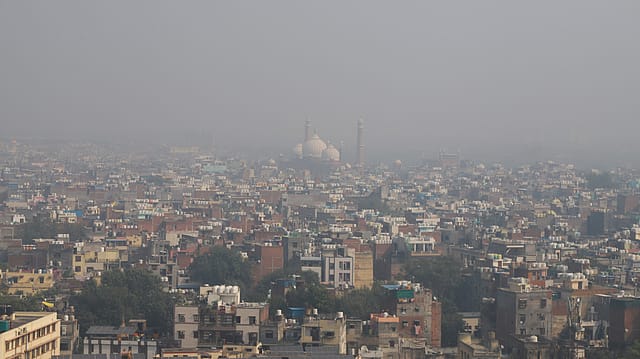
Delhi recorded an Air Quality Index (AQI) of 226 at 7 am on Thursday, remaining in the ‘poor’ category as the Commission for Air Quality Management (CAQM) invoked Stage 1 of the Graded Response Action Plan (GRAP) across Delhi-NCR. The move comes as authorities step up measures to tackle dust pollution, vehicular emissions and other sources of poor air quality ahead of winter.
The capital recorded its first ‘poor’ air quality day of the season on Wednesday, when a layer of haze covered parts of the city following overnight Dussehra celebrations. Delhi’s AQI rose to 238 at 10 am on Wednesday, up from 179 on Tuesday afternoon, according to data from the Central Pollution Control Board (CPCB).

Losing Memory
16 Oct 2026 - Vol 05 | Issue 42
The making of a medical and social emergency
Several monitoring stations reported elevated pollution levels on Thursday. Jahangirpuri recorded an AQI of 309 and Chandni Chowk 307, both in the ‘very poor’ category. Patparganj recorded 298, Rohini 291, Alipur 273, Bawana 275, ITO 280 and Wazirpur 253, among other areas.
Under CPCB classifications, an AQI between 201 and 300 falls in the ‘poor’ category, while readings between 301 and 400 are classified as ‘very poor’.
CAQM STEPS UP DUST CONTROL
The CAQM invoked GRAP Stage 1 after reviewing the region’s air quality and forecasts from the India Meteorological Department and the Indian Institute of Tropical Meteorology, which indicated that pollution levels were likely to remain in the ‘poor’ category.
The Commission has directed agencies across the National Capital Region to implement and monitor the measures under Stage 1, intensify enforcement and prevent air quality from deteriorating further.
At a review meeting on Wednesday, CAQM Chairperson Rajesh Verma and the Chief Secretary of the Delhi government met officials from concerned agencies to assess dust pollution and strengthen coordination.
The Municipal Corporation of Delhi (MCD) was directed to step up dust mitigation on roads and open spaces. The Delhi Pollution Control Committee (DPCC) was asked to coordinate with agencies to ensure that pollution-control measures are implemented effectively.
The Commission also flagged lapses at construction sites, where agencies have allegedly failed to install wind barriers, dust screens and other dust-control systems, particularly during excavation work. Departments were directed to take prompt action against violations, including those by officials and project agencies. District magistrates will monitor compliance in their respective jurisdictions.
BS-VI VEHICLE RULES FROM NOVEMBER 1
Delhi Environment Minister Manjinder Singh Sirsa said the government was implementing an 11-point pollution-control plan involving around 30 agencies, covering traffic management, road dust, industrial emissions and green cover.
Under the announced measures, restrictions will apply from November 1 to vehicles entering Delhi from outside the city that do not meet BS-VI emission standards. Exemptions will apply to specified vehicle categories and essential services under the relevant rules.
Sirsa also said the government would strictly enforce Pollution Under Control Certificate (PUCC) requirements and the ‘No PUC, No Fuel’ campaign. Fuel stations have been directed not to provide fuel to vehicles without valid certificates, while vehicles entering Delhi through its borders and the Eastern and Western Peripheral Expressways are being monitored.
The minister said 608 anti-smog guns had been installed at 283 construction sites, with additional units at around 200 high-rise buildings. Delhi has also deployed 103 mechanical road sweepers. Construction premises covering more than 3,000 square metres are required to provide anti-smog guns and mist systems as prescribed.
Round-the-clock monitoring through the Integrated Command and Control Centre is being used to track pollution-related activities and complaints. The government has increased monitoring teams responding to complaints through the 311 app, including those concerning open waste burning and violations of dust-control norms.
GOVERNMENT CITES 214 CLEAN-AIR DAYS
Sirsa said Delhi had recorded 214 clean-air days so far this year, the highest in a decade outside the COVID-19 period, according to a government press release. He said 78 lakh saplings had been planted against a target of 70 lakh.
The government’s broader action plan also includes a proposed ban on outdoor construction and demolition activities from November 1 to January 31, restrictions on open burning, higher parking charges to discourage private vehicle use and work-from-home arrangements for 50 per cent of office employees. These measures are subject to the applicable orders and guidelines.
Sirsa urged residents to keep their pollution certificates valid, use public transport and carpool where possible, avoid burning waste and report pollution-related violations to the authorities.
With inputs from ANI