Delhi’s Liquor App Row: Who Approved It, and Why Is AAP Demanding Its Withdrawal?
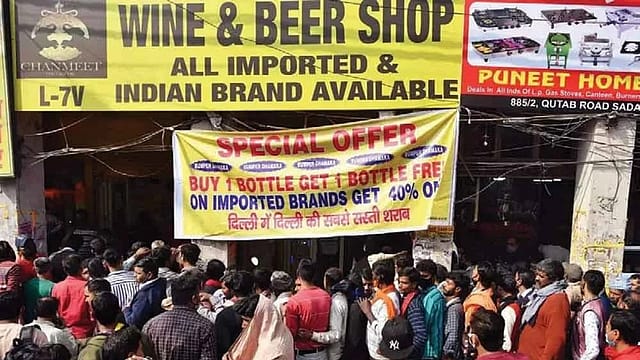
What has set off Delhi's latest liquor fight?
The bottle still has to be collected from the shop. The political fight has already reached the doorstep.
AAP’s Delhi president Saurabh Bharadwaj has threatened a mass agitation unless Chief Minister Rekha Gupta’s government withdraws an online liquor-booking facility within 24 hours. He has accused the government of worrying about queues outside liquor shops while patients wait for medicines and residents struggle to access public services.
But the controversy contains two complications.
The facility does not deliver alcohol to homes. And the government corporation operating it says development was approved in December 2024, when AAP was in power, before its eventual rollout in November 2025. AAP disputes responsibility and wants the approval documents produced.
What initially looks like a fight over doorstep delivery is becoming a dispute over administrative records, political ownership and the purpose of making liquor purchases easier.

Look Who's Talking Regime Change
23 Oct 2026 - Vol 05 | Issue 43
CAN DELHI RESIDENTS NOW GET LIQUOR DELIVERED HOME?
No. The Delhi Liquor Booking service allows customers to check availability, select products and pay online. They must then visit the selected outlet to collect their purchases.
The facility covers 208 shops operated by the Delhi State Industrial and Infrastructure Development Corporation, or DSIIDC. Buyers have to collect their orders within 48 hours of payment.
Booking from home and receiving a delivery at home are different services. This app provides the former.
That distinction changes how the controversy should be understood. The immediate policy question concerns advance reservations and digital payments at existing shops. Describing the facility as an operational home-delivery scheme gives readers the wrong picture.
WHAT DOES THE APP ACTUALLY CHANGE?
It moves part of the transaction away from the counter.
A customer can see whether a preferred brand is available before travelling, choose the bottle size and quantity, and complete payment digitally. Collection still requires a shop visit and order verification.
Customers must be at least 25. Orders can be cancelled before collection, but bottles already collected cannot be returned, according to the reported operating conditions.
The facility also has a limited footprint. Delhi’s four government retail corporations together operate more than 700 liquor shops; this service currently covers DSIIDC’s outlets.
It therefore changes the purchasing process at participating shops without creating a citywide doorstep distribution network.
WHY DOES DSIIDC SAY IT INTRODUCED THE FACILITY?
The corporation’s explanation extends beyond shorter queues.
DSIIDC says the app was intended to improve transparency and reduce “brand pushing”.
The concern is straightforward: a customer approaching a counter may be steered towards a particular product. Showing available stock digitally gives the buyer more information before that conversation begins.
An electronic booking can also create a clearer record of what was selected and paid for.
Those are the stated objectives. Establishing whether the app has delivered them would require evidence about stock accuracy, complaints, collection times and retail practices. The existence of an app alone cannot demonstrate that these problems have been solved.
WHO APPROVED IT: AAP OR BJP?
According to DSIIDC’s account, its management reportedly approved development in December 2024. A development work order followed on January 2, 2025. The corporation says the service was rolled out in November 2025 after trials. A QR-code-enabled microsite expanded access to iOS users on September 6, 2026.
That sequence places development approval during AAP’s tenure and the operational rollout during the BJP government’s tenure.
AAP disputes the political responsibility being attached to the earlier approval. Bharadwaj has challenged officials to produce a file carrying an AAP minister’s signature and has demanded a Vigilance inquiry. BJP spokesperson Praveen Shankar Kapoor has blamed the previous administration.
The distinction between corporation-level approval and ministerial approval is central. A date falling within a government’s tenure does not, by itself, establish which minister authorised a decision.
Publishing the approval file, work order and rollout instructions would make the competing claims easier to test.
WHY IS AAP THREATENING A PROTEST?
Bharadwaj’s argument concerns government priorities. He says the administration is easing liquor purchases while neglecting more pressing public needs.
He warned that AAP would seek Minister Manjinder Singh Sirsa’s resignation if the scheme was not withdrawn. He also demanded an apology to Delhi’s women.
His slogan, “Har-Har Rekha, Ghar-Ghar Theka”, turns a retail-booking facility into a broader attack on the chief minister.
The political allegation should nevertheless remain distinct from the service’s actual operation. Easier booking may be criticised on its merits. The current facility still requires collection from a licensed shop.
IS THIS APP ALREADY A BIG BUSINESS?
The reported figures suggest a modest operation.
DSIIDC’s October 28 status note, records 3,629 transactions worth ₹12.93 lakh between November 10, 2025, and March 31, 2026. From April 1, 2026, to the date of the note, it records another 10,730 transactions worth ₹29.90 lakh.
Together, that is 14,359 transactions worth ₹42.83 lakh.
These are bookings, not a count of individual customers. The political attention is substantial. Evidence that the facility has transformed Delhi’s liquor market is considerably thinner.
HASN’T DELHI DISCUSSED HOME DELIVERY BEFORE?
Yes. In June 2021, amended excise rules allowed holders of the relevant L-13 licence to accept home-delivery orders through apps and online portals. Media reported at the time that implementation still required licensing and operating arrangements. No L-13 licence had then been issued.
That history explains some of today’s confusion. A legal provision permitting a licensed activity and a functioning delivery service are separate stages.
The 2021 amendment cannot be used as proof that the current DSIIDC booking app provides doorstep delivery.
HOW DOES THIS CONNECT TO THE EARLIER EXCISE-POLICY CONTROVERSY?
Delhi’s 2021–22 excise policy shifted retail sales to private operators. After its withdrawal, government corporations returned to retail liquor sales from September 1, 2022.
The present app operates through that government retail system.
The earlier controversy supplies the political backdrop, but this facility needs examination through its own documents and operating conditions. Allegations about the previous excise regime do not establish wrongdoing in the development of this app.
WHAT SHOULD DELHI ANSWER NOW?
The government and DSIIDC should explain who approved development, who authorised the rollout and how age verification works during collection. They should also publish the rules governing uncollected orders, refunds and customer complaints.
AAP, meanwhile, needs to specify whether its objection concerns digital booking itself, the approval process or an alleged expansion of alcohol access.
The decisive evidence is in the paperwork. Until it is published, Delhi has a functioning booking facility, competing accounts of its origins and a protest threat built around a service that still requires a trip to the shop.