Conversion, Caste And Quotas Don’t Mix
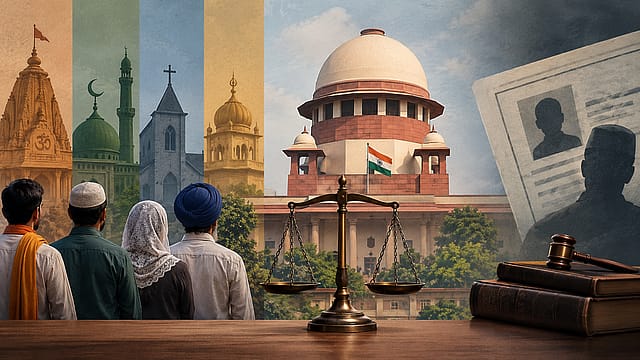
In a letter dated 06.02.24, the Tamil Nadu Backward class commission said that after considering the question of issuance of backward class Muslim community certificates to persons from OBC, most backward classes, denotified communities and scheduled castes who have converted to Islam it had decided to recommend that such individuals could avail reservations benefits they were eligible for in their new faith too. It was an extraordinary decision as it flew against constitutional provisions and the most obvious fact of their conversion to a religion that does not recognize caste as a part of its social organization.
The subsequent government order issued by the then Dravida Munnetra Kazhagam (DMK) government on 09.03.24 formalised this remarkable sleigh of hand. The TN government decided that a person who was eligible for OBC reservation and had converted to Islam could be placed in any of the seven recognized backward class Muslim communities covered by a 3.5% quota in educational institutions and state government jobs. So, not only would a proselyte retain quota benefits, such a person could be placed in any of the seven communities recognized by the state government.
Zeroing In on ECI
09 Oct 2026 - Vol 05 | Issue 41
Constitutional legitimacy versus political opportunism
The Claim at Hand
The decision of the DMK government has immediate implications for one Sameer Ahmed who was born to Hindu parents and was Paramasivara before he embraced Islam and was issued a certificate to this effect by the Sunnath Jamath on 11.09.2015. Ahmed then submitted an online application seeking a backward class Muslim community certificate as a “Muslim Labbai,” a trading community, eligible for OBC quota. The application was rejected on 13.11.2020 on the grounds that while Ahmed had discarded Hinduism and accepted Islam, he had converted to a religion and not a caste.
Ahmed approached the Madras High Court which took up the matter on 16.06.22. Sometime after the Tamil Nadu government decided – on basis of the TNBC Commission recommendation -- to grant reservation benefits to persons like Ahmed who then submitted to the court that the GO upheld his claim. The High Court impleaded the state government and examined the effect of conversion to Islam upon caste or community status and the position of the seven backward Muslim communities recognized by the Tamil Nadu government. In recognizing certain Muslim communities as OBC, Tamil Nadu was no different than many other states with similar provisions though there is no quota for “SC Muslims or Dalit Muslims” within reservation of the scheduled castes. A 1950 presidential order recognizes only Hindus, Sikhs and Buddhists as eligible for SC quota.
High Court rejects TN order
In its order dated 25.06.24, the High Court rejected the validity of the DMK government’s GO and noted the obvious – That a person who embraces Islam becomes a Muslim and cannot merely by the fact of conversion become a member of a Backward Muslim community. The GO could not change the existing legal position set out in previous judicial orders. The court ruled the GO as unconstitutional and rejected Ahmed’s writ. In effect it undid the Tamil Nadu government’s attempt to provide converts to Islam access to reservation under the OBC quota. The Tamil Nadu government criticized the decision on the ground that the court had considered matters beyond an individual petition in striking down the GO though it was hard to see how the validity of the government order could not have been considered in deciding Ahmed’s claims.
When the matter reached the Supreme Court, the Tamil Nadu government argued that validity of the GO had not been contested by Ahmed. The state submitted that it does not dispute that mere conversion to Islam cannot lead to becoming a member of a notified Muslim community. The GO does not do so either and preserves an entitlement to OBC reservation to a person who enjoyed such benefits prior to conversion. Referring to the well-known Indra Sawhney order, the state said backward classes may exist across religious communities and conversion does not dismantle social and educational backwardness. The DMK government claimed that principles applicable to determining reservation for the scheduled castes had been incorrectly applied to determining backward class status of persons defined by the GO.
Religion and Social Status
In its ruling on the plea, the SC examined the argument that the High Court had travelled beyond the writ before it. “The validity and legal effect of the GO have necessarily arisen for consideration because the very right claimed by respondent no 1 (Ahmed) is founded on it,” the SC said. The apex court said that the principle that relief should not be granted on an issue that has not been pleaded is not a “mechanical prohibition” on a constitutional court examining an instrument that is inseparable from the relief before it. The SC noted that the Tamil Nadu additional advocate general had addressed the question on court and had filed a counter-affidavit.
Dwelling on the “substance” of the controversy, the SC said there is a need to appreciate the distinction between religious identity, community affiliation and social status. The apex court accepted that despite Islam’s foundational basis of equality and a lack of any defined caste system, hereditary and occupation among Indian Muslims represent features of social stratification that cannot be disregarded because the religious doctrine is egalitarian. At the same time there is no uniformly applicable religiously prescribed scheme in the social organization among Indian Muslims. Despite “caste-like” structures, the Ashraf, Ajlaj and Arzal classifications of Muslims are not equivalent to homogenous castes, the SC said. The question therefore was whether the social circumstances that made a person “backward” in the social order from which he converted can continue – post conversion – to provide the rationale for a constitutional claim to affirmative action? Looking at the Indra Sawhney ruling and Article 16(4) of the Constitution that seeks to address social backwardness, the court said mere membership of a caste is not conclusive proof that all members suffer from social disadvantages. The creamy layer is excluded and backward is sought to be defined in both educational and social terms.
Foundational Basis of Quotas
In answering the central issue defined above, the SC said that in the Hindu social order caste has been the “…foundational institution through which social hierarchy, birth-based status, hereditary occupation, social intercourse and access to social and educational opportunities have historically been structured. Coming to the crux of the matter in Ahmed’s conversion to Islam from Hinduism and the Tamil Nadu government’s GO, the SC concluded that “Upon conversion to Islam and Christianity, or to any other non-Hindu social order in which caste is not recognized as a basis of social status or classification, that foundational basis ceases to operate in the same manner.” This would be the case even if the consequences of earlier disability may continue in the form of educational deprivation, occupational disadvantage, economic hardship or other material circumstances cannot carry the “antecedent social backwardness” into the new religion, the SC order states. Social backwardness cannot be transposed from one religion into another which does not recognize such classification.
A person converting from a religion where he has access to reservation cannot facilitate being made a member of a Muslim community notified as a backward class and the GO errs in making just such a conflation, the SC held. The claim that the GO was only preserving an existing access to quotas fails to answer the legal question as to be basis on which someone who was not a member of the notified Muslim community can become one after conversion. “When the State directs that a person who was not previously a member of Labbai, Rowther, Marakkayar or another notified Backward Class Muslim community may, upon conversion from Hindu social order, be certified as belonging to one of them, it necessarily creates an artificial route to present membership of the notified class,” the SC said. It further noted: “…that the seven notified Backward Class Muslim communities themselves constitute distinct social groups, and the State's own framework recognises that not every Muslim is a Backward Class Muslim.” It categorically rejected the state’s claim that the Jamath can decide if a convert “fits” into any of the seven communities and issues a certificate to the effect and doing so is “abdication” of the state government’s duties.
The Political Faultline
In its conclusions, the SC also noted that “re-conversion” to the original faith may not restore access to reservation and will need an evaluation by a fact-finding authority. The SC’s rejection of Ahmed’s case and the GO have important political and religious implications not directly germane to the case the court considered. The demand that persons who convert to non-Hindu faiths be allowed to reservation benefits is a sensitive faultline with the Vishwa Hindu Parishad and the Rashtriya Swayamsewak Sangh (RSS) holding that permitting this will lead to aggressive proselytization by evangelical groups and encourage Islamist organisations. The Bharatiya Janata Party (BJP) has supported the viewpoints of the Sangh and VHP and has legislated “anti-conversion” laws in states where it is in office. The court’s ruling will provide much needed quietus on an issue that is socially divisive and has been the source of communal tensions. The policies of parties seeking to “farm” minority votes harm social equilibrium and deepen communal divides.