‘Cockroaches’ or ‘Lions’? Kerala Governor Weighs In on VC’s Remark That Sparked Row
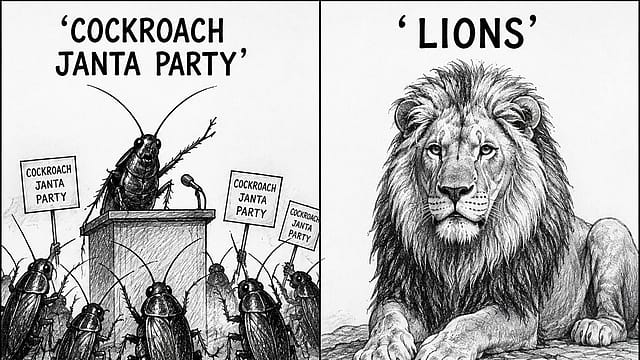
What would you rather be called? A cockroach or a lion?
That unusual question has been echoing across Kerala's campuses in recent days, moving from university auditoriums into political conversations, social media debates and now even the Raj Bhavan.
On Thursday, Kerala Governor Rajendra Vishwanath Arlekar became the latest public figure to weigh in on the controversy surrounding Kerala University Vice-Chancellor Mohanan Kunnummal's remarks about students being “cockroaches” or “lions”.
But before taking a side, the Governor made one thing clear.
He said he did not know the full context in which the Vice-Chancellor had originally used the term. “I heard Mohanan Kunnummal earlier speaking about cockroaches. I do not know the context in which he made that remark,” Arlekar said while speaking in Thiruvananthapuram.

Rise of the Pivotal Power
18 Sep 2026 - Vol 05 | Issue 38
The BRICS declaration is a strategic victory for Modi
Then he offered his own interpretation. “Am I a cockroach? Cockroaches can be found everywhere, but can I become a lion...” he said. And just as quickly, he added a clarification. “I am not referring to Jantar Mantar. I am referring to what I should be and I don't want to be like other cockroaches.”
The statement may have sounded philosophical. But it landed in the middle of a debate that has become increasingly political.
So where did the “cockroach” remark come from?
The controversy began with comments made by Kerala University Vice-Chancellor Mohanan Kunnummal during an address to students.
The Vice-Chancellor asked students a question. “Do you know what some people call students like you? They call you 'cockroaches'. Are you cockroaches? Then what are you? You are the lions who represent the strength of this country.”
His message, at least in its original context, was motivational rather than derogatory.
Kunnummal urged students to reject labels that sought to diminish them and instead see themselves as confident, capable young people who could compete globally. He spoke about academic excellence, self-belief and pursuing fields they were passionate about.
Why did the remark become controversial?
Because the word “cockroach” already carried political baggage.
In recent months, the insect has become an unexpected symbol in student politics, particularly after the emergence of the so-called “Cockroach Janata Party” (CJP), a protest movement that gained visibility during student demonstrations at Delhi's Jantar Mantar. The image later appeared in posters and campaigns on university campuses, including at Mahatma Gandhi University in Kerala, triggering disputes between student groups and university authorities.
That meant Kunnummal's metaphor was heard by many not merely as a motivational speech, but through the lens of an already heated political debate.
The Vice-Chancellor himself has remained a polarising figure in Kerala's higher education landscape. In recent weeks, he has also attracted attention over remarks related to Vande Mataram and participation in public events that drew criticism from political opponents and student organisations.
What is the bigger debate here?
Look beyond the insect and the animal for a moment.
The real argument is about how students are described in public life.
Should young people be viewed as agitators? Protesters? Activists? Future professionals? Nation-builders?
Kunnummal's answer was clear. He wanted students to see themselves as “lions” — confident, ambitious and capable of achieving excellence.
Arlekar's response was different in tone but similar in spirit. He used the same imagery to suggest that people should aspire to something larger than merely blending into the crowd.
Why has this struck a nerve?
Perhaps because metaphors have a way of escaping the rooms in which they are first spoken.
A motivational line delivered to students can become a political slogan. A campus speech can become a statewide debate. And once words like “cockroach” and “lion” enter public discourse, people begin attaching their own meanings to them.
That is exactly what appears to be happening in Kerala. What started as a question posed to students has evolved into a wider conversation about identity, aspiration, protest and politics.
And somewhere between the cockroach and the lion lies the reason the debate refuses to die. Because this was never really about insects or animals. It was always about how a generation sees itself — and how others choose to describe it.
(With inputs from ANI)