Cockroach uprising unmistakably a warning for the Centre: Sumantra Bose
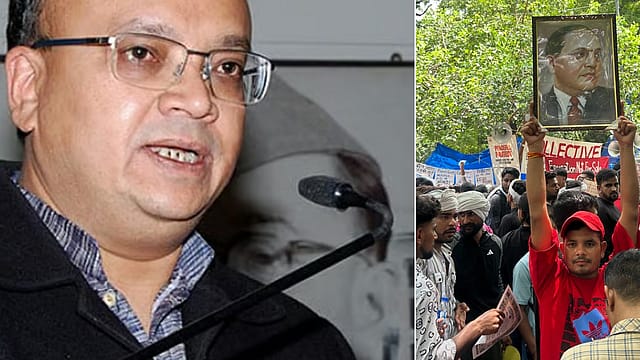
Noted political scientist and author Sumantra Bose argues that following the success of the recent Jantar Mantar protests, the Central government is now scrambling in a belated, nearly desperate damage-limitation exercise. Bose, formerly Professor of International and Comparative Politics at the London School of Economics and who currently holds a similar position at Krea University in Andhra Pradesh, notes that the government also failed to anticipate the almost visceral response the Jantar Mantar protest would generate across the country, and just how effectively the protest organisers would invoke and weaponise the Supreme Court Chief Justice’s cockroach slur. An alumnus of Amherst College, Massachusetts, and Columbia University, Bose avers that this protest had the advantage of being both limited and focused--limited to the exam-paper leak scandal and focused on the education minister’s resignation. Edited excerpts:
Why do you think that the recent Gen Z protests in Jantar Mantar were a success? Is it because they chose an issue that affects relatively elite or aspiring students?
I think this protest had the advantage of being both limited and focused--limited to the exam-paper leak scandal and focused on the education minister’s resignation. In other words, a very concrete issue and a very specific demand. Its other strength was that its intensity and rapid spread took the government by surprise. Street protest against a Leviathan-like state apparatus necessarily resembles guerrilla warfare. Taking a far more powerful adversary by surprise is key to successful guerrilla warfare.

Losing Memory
16 Oct 2026 - Vol 05 | Issue 42
The making of a medical and social emergency
Farmers had to mobilise several lakhs of people five years ago and their protests didn’t get as much visibility as this one -- which began spreading to multiple cities. Why so?
The farmer protests in the winter of 2020-2021 were mostly contained on the outskirts of Delhi. This protest (Jantar Mantar) was in the nerve-centre of New Delhi’s official quarter. The farmer protests mainly involved smallholding agriculturalists from the Punjab and western Uttar Pradesh. This protest had much wider, nationwide resonance, at least among the urban middle class broadly defined and its student/youth cohort ("Gen Z") in particular.
Is there something about Gen Z’s mastery over social media and knowledge of apps that work without the internet that they could hold on to their protests and dominate the narrative, pushing even the BJP IT cell behind?
It's not primarily about mastery of the latest technologies of mass communication. The government failed to anticipate the almost visceral response the Jantar Mantar protest would generate across the country, and just how effectively the protest organisers would invoke and weaponise the Supreme Court Chief Justice’s cockroach slur. (Activist-engineer Sonam) Wangchuk’s fast provided an additional source of publicity. The failed violent crackdown of Monday 20th July sent the situation beyond tipping point. But even before that happened, rallies and marches in solidarity with the protesters’ march to Parliament had been scheduled for 20th July on campuses across India. The government did not grasp the deep chord of discontent and anger the Jantar Mantar agitation had catalysed.
A striking feature was the diversity of campuses. In my hometown, Kolkata, solidarity events had been organised at Presidency University and Jadavpur University, “usual suspect” institutions with a hallowed record of student activism that goes back many decades. But students at Krea University-- a private university in south India which is barely seven years old and where I am currently professor of international and comparative politics--had also come together and organised a solidarity protest on Monday 20th July. The Jantar Mantar agitation gripped the attention and fired the imagination of students everywhere in the country. The government looked completely out of touch with the groundswell in this sector of public opinion--not only among the "Gen Z" crowd but quite naturally their parents and grandparents as well. The turn of events since 20th July has left the government--and the prime minister personally--comically trying to play catch-up on Instagram.
How do you see the government dealing with protests in the future? And these protesters too? Will there be a silent clampdown?
Modi is the most skilled and successful dream merchant (sapnon ka saudagar) ever in the annals of Indian politics. For a dozen years now, he has been stoking the most expansive hopes of progress and prosperity among Indians in general, and the youth in particular, who constitute one of the four collectives he has pledged to serve: GYAN (Garib, Yuva, Annadata, Naari). That promise collides with a disconcerting reality in which the nation's per capita income is stagnant around the level of $2,500, two-fifths of very young Indian graduates are unemployed, and two-thirds of unemployed youth are graduates.
The government’s discourse of development has sought to manage the sky-high expectations aroused by Modi's rhetoric by--literally--kicking the can down the road. Thus, Modi told the 'Viksit Bharat Young Leaders' Dialogue' sponsored by his government in New Delhi last year that "no force can stop India from becoming a developed nation by 2047, thanks to its human capital in the form of youth power (Yuva Shakti)." The problem is that a young Indian aged twenty-one today--about the age of the students I teach and interact with--is understandably unwilling to suspend disbelief until they are in their forties and wait patiently for the unfolding Amrit Kaal to culminate in Viksit Bharat. At the minimum, they want decent governance and they want it now, not the shambles revealed by the NEET-UG fiasco and a government defined by hubris and tone-deaf to legitimate grievances.
The government is now scrambling in a belated, nearly desperate damage-limitation exercise. The episode as it has turned out is a personal humiliation for Modi and a serious blow to his waning but still potent leader cult. Had he acted earlier and say, moved (Education Minister Dharmendra) Pradhan to another ministry, that may have taken the sting out of the protests. Despite the raft of remedial measures now promised, Modi is very unlikely to forget--and even less forgive--the humiliation inflicted on him and his government by a band of self-styled cockroaches. Since Amit Shah's Delhi Police with their tear-gas guns and water cannons, and even the pellet gun-firing RAF proved unequal to the challenge on this occasion, protests and protesters in the near future can expect more insidious tactics of suppression, rather than simply the blunt-instrument response symbolised by the British colonial-style lathi charge.
The slogans of freedom and revolution given full-throated articulation at the protest site and scrawled on its walls notwithstanding, the writing is not on the wall--yet--for Modi's government. India's politics is far too multi-faceted and complex for that, and the institutional political opposition remains ineffective and fragmented. But the cockroach uprising that took the capital and the country by storm in July 2026 is unmistakably a signal, and a warning: Prime Minister, do wake up and smell the coffee.