Can marriage override consent? Supreme Court takes up India’s marital rape debate
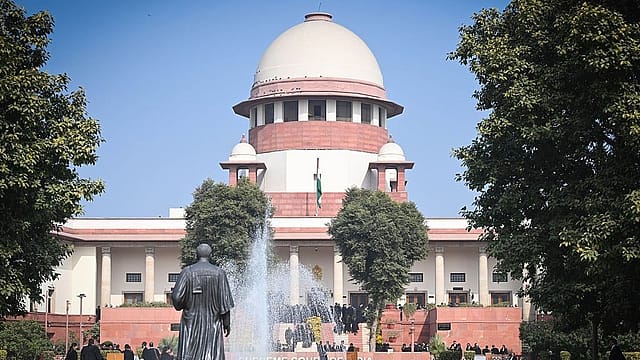
There are some questions that refuse to go away.
For decades, one of them has hovered over India’s criminal justice system: can a marriage override consent?
This week, the Supreme Court signalled that it is ready to take a fresh and detailed look at that question. A bench led by Chief Justice of India Surya Kant agreed to examine the constitutional validity of the marital rape exception under both the old Indian Penal Code (IPC) and the Bharatiya Nyaya Sanhita (BNS), the new criminal code that replaced it.
The issue has been debated in courtrooms, Parliament, universities and homes for years. Now, it is heading back to the country's highest court.
Why the Supreme Court is revisiting the marital rape exception
At the centre of the case is a legal provision that excludes sexual intercourse by a husband with his adult wife from the offence of rape.

Zeroing In on ECI
09 Oct 2026 - Vol 05 | Issue 41
Constitutional legitimacy versus political opportunism
Petitioners challenging the exception argue that it violates constitutional guarantees of equality, dignity, bodily autonomy and personal liberty. They contend that marriage cannot be treated as permanent consent.
The Supreme Court made it clear on Wednesday that it intends to examine the constitutional validity of the provision itself rather than prejudge individual criminal cases. The bench observed that while marriage does not extinguish individual autonomy, the court must decide whether an existing statutory exception can be read down or struck down through constitutional interpretation.
The Karnataka marital rape case that brought the issue back into focus
The court will also hear an appeal arising from a landmark Karnataka High Court ruling of March 2022.
In that case, the High Court refused to quash rape charges against a husband accused of sexually assaulting his wife. The court had observed that a man could not claim immunity merely because the alleged victim was his spouse.
That judgment became one of the most closely watched decisions in India's marital rape debate and is now part of the broader proceedings before the Supreme Court.
What the judges are actually trying to decide
The question before the court is more complex than it may appear.
The judges are not only examining whether the exception is constitutional. They are also considering whether a court can permit prosecution for an offence when the law expressly excludes that conduct from the definition of rape.
During the hearing, the bench observed: "We would definitely protect the victims but is it within the domain to prosecute a person where there is direct exclusion..." according to reports from the proceedings.
In simple terms, the court is asking whether constitutional principles can override a statutory carve-out created by Parliament.
Why the debate now includes India’s new criminal law
This is no longer just an IPC story. When the Bharatiya Nyaya Sanhita replaced the IPC, it retained a similar marital exception under Section 63. As a result, the challenge now extends to both the old and new legal frameworks.
Lawyers appearing in the matter argued that the court must examine whether the continued exclusion of non-consensual sex within marriage is compatible with constitutional protections guaranteed to all citizens.
What the Centre’s position has been so far
The Union government has historically opposed criminalising marital rape through judicial intervention, arguing that marriage is a unique social institution and that any change involves complex social and legislative considerations.
The Centre has already filed its response in the current proceedings, and the Supreme Court has directed that copies be shared with all parties before detailed arguments begin.
Why this case is bigger than one law
The Supreme Court itself indicated that the matter is not simply about social morality.
"What is social morality?" the bench observed during the hearing, adding that courts ultimately test laws against the Constitution rather than public sentiment. That distinction may prove crucial.
The case is not about whether marriage is important. Nor is it about whether courts should rewrite criminal law overnight. It is about a narrower but far-reaching question: can a legal exception that removes criminal liability in a marriage survive constitutional scrutiny in modern India?
The answer, whenever it comes, is likely to shape one of the most consequential debates on consent and personal autonomy in the country’s legal history.
(With inputs from ANI)