Power Bank, Big Danger: Why a Pocket Charger Can Trigger a Flight Emergency
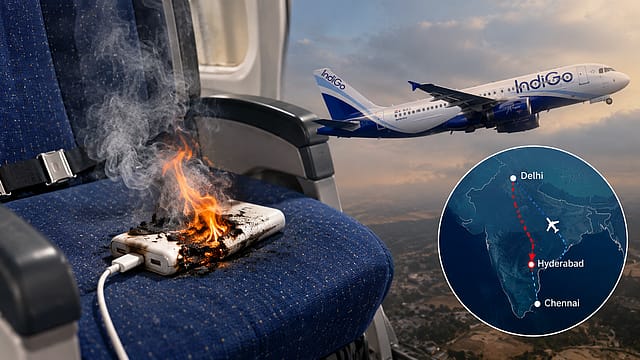
It is small enough to slip into a seat pocket. When it catches fire, the entire flight can become an emergency.
On October 11, a Delhi–Chennai IndiGo service diverted to Hyderabad after a passenger’s power bank reportedly caught fire. The crew contained the incident, the aircraft landed safely and passengers were evacuated. The airline said it was arranging onward travel to Chennai.
The precise cause of the battery failure has not yet been established. But the incident joins a succession of fires and smoke scares involving portable chargers, with consequences ranging from interrupted departures to emergency evacuations—and, in South Korea, a destroyed aircraft.
Here is what the major reported incidents across 2025–26 reveal.

Zeroing In on ECI
09 Oct 2026 - Vol 05 | Issue 41
Constitutional legitimacy versus political opportunism
WHAT HAPPENED ON THE DELHI–CHENNAI FLIGHT?
Smoke from a passenger’s power bank triggered an onboard emergency. Cabin crew responded while the pilots diverted to Hyderabad’s Rajiv Gandhi International Airport. The aircraft landed safely and everyone onboard was unharmed.
What remains unanswered is why the device failed: whether it was damaged, defective, charging or affected by another problem. Identifying a power bank as the source of a fire does not, by itself, establish what triggered it.
HAS THIS HAPPENED IN INDIA BEFORE?
Yes. Two other reported IndiGo incidents within roughly the past year show that the danger can emerge at different stages of a journey.
Delhi, October 19, 2025: A Dimapur-bound aircraft returned to its parking bay after a minor fire while taxiing. A passenger’s power bank apparently led to this. IndiGo’s statement described personal electronic equipment stored in a seat-back pocket. The crew contained the incident, and no injuries were reported.
Chandigarh, May 5, 2026: A Hyderabad–Chandigarh flight was evacuated using emergency slides after a power bank reportedly caught fire following landing. Six passengers were injured during the evacuation, including one who suffered a leg fracture.
That second incident exposes another consequence: even when a fire is controlled, getting people out urgently can itself result in injuries.
WHAT ARE THE MAJOR INCIDENTS OVERSEAS?
The following are prominent documented or reported cases. They are not a complete worldwide register. The January and March 2025 incidents fall outside a strict 12-month window but help explain the subsequent tightening of rules.
Air Busan, January 28, 2025: A Hong Kong-bound Air Busan aircraft reportedly caught fire in an overhead luggage compartment before departure from Busan. Everyone onboard escaped, but the aircraft was destroyed. An interim investigation identified a power bank as a possible ignition source; that was not a final finding.
Hong Kong Airlines, March 20, 2025: A power bank reportedly caught fire in an overhead compartment on a Hangzhou–Hong Kong flight, forcing a diversion to Fuzhou. Crew extinguished the blaze and the aircraft landed safely. An official incident notification identified thermal runaway in the device.
Virgin Australia, July 21, 2025: A power bank inside a backpack reportedly caught fire in an overhead locker as a Sydney–Hobart flight descended towards its destination. Crew extinguished the flames, cooled the bag with water and monitored it until the aircraft landed safely. Australia’s transport safety investigator confirmed thermal runaway.
IndiGo, October 19, 2025: A Dimapur-bound IndiGo aircraft reportedly returned to its parking bay at Delhi airport after a passenger’s power bank reportedly caught fire while taxiing. The airline said the affected electronic equipment was in a seat-back pocket. Crew contained the fire and no injuries were reported.
Scoot, November 22, 2025: An overheated power bank reportedly sparked a small fire on a Hong Kong–Singapore flight. According to the airline, cabin crew quickly extinguished the flames and nobody was injured.
Asiana Airlines, January 8, 2026: A passenger reportedly suffered burns after a power bank caught fire on an Incheon–Hong Kong flight. Crew used an extinguisher to contain the blaze, and the aircraft landed safely in Hong Kong.
IndiGo, May 5, 2026: A passenger’s power bank reportedly caught fire after a Hyderabad–Chandigarh flight landed, prompting an evacuation using emergency slides. Six passengers were injured during the evacuation, including a woman who suffered a leg fracture.
The outcomes differ sharply. A battery incident can end with a controlled fire, a diversion, an evacuation or substantial aircraft damage. “Small device” does not mean “small operational problem”.
WHY CAN A POWER BANK SUDDENLY CATCH FIRE?
Most power banks use lithium-ion cells, which store considerable energy in a compact space.
The central danger is thermal runaway: an uncontrolled rise in temperature within a failing cell. The failure can generate intense heat, smoke and fire, and may affect neighbouring cells.
According to the US Federal Aviation Administration, triggers can include damage, overheating, overcharging, improper packing and manufacturing defects. A device can fail without obvious advance warning. This is why an investigation matters. Similar-looking cabin fires can have different underlying causes.
DOES IT HAVE TO BE CHARGING TO BE DANGEROUS?
No. Charging is one possible factor, but battery damage or an internal fault can cause trouble independently. A power bank sitting in luggage is still an energy-storage device.
The Hong Kong Airlines incident provides a particularly useful warning. According to the BEA’s preliminary notification, the device was rated at 20,000mAh and was permitted onboard, yet experienced thermal runaway. An allowable capacity is a carriage limit. It is not a guarantee that an individual battery cannot fail.
WHY ARE OVERHEAD LOCKERS A CONCERN?
Because visibility and access matter. A device buried in a backpack can begin overheating before anyone notices. Once smoke appears, crew may have to locate the affected bag, identify the battery and reach it while managing passengers.
The ATSB’s Virgin Australia investigation illustrated that difficulty: the burning power bank was inside a backpack, complicating access and containment. Keeping a device accessible helps people detect trouble earlier and helps crew respond. It does not eliminate the possibility of failure.
WHY MUST POWER BANKS STAY OUT OF CHECKED BAGGAGE?
Power banks are treated as spare batteries and must travel in the cabin under the relevant battery-carriage rules.
The FAA says they must be removed if a cabin bag is subsequently checked at the gate or beside the aircraft. Their terminals must also be protected against short circuits.
The practical point is access: in the cabin, passengers can report warning signs and trained crew can intervene. A power bank should not remain in a bag simply because that bag started its journey as hand luggage.
HAVE THE INTERNATIONAL RULES CHANGED?
Yes. ICAO announced changes effective March 27, 2026, limiting passengers to two power banks and prohibiting passengers from recharging the power banks during flight.
IATA’s accompanying 2026 guidance distinguishes power banks from other spare batteries. Its passenger table permits power banks up to 100 watt-hours, while marking those above 100Wh and up to 160Wh as forbidden.
This is a significant distinction for travellers who have seen older advice allowing certain larger spare batteries with airline approval. That allowance should not automatically be applied to power banks.
DOES “ALLOWED ONBOARD” MEAN “ALLOWED TO USE”?
No. Carrying, storing, using and recharging are separate questions.
ICAO’s prohibition on recharging a power bank concerns charging the bank itself. Airlines may impose additional restrictions on using it to charge a phone.
Policies also differ. Southwest’s published rules, for example, limit passengers to one power bank, prohibit overhead-bin storage and onboard recharging, and require the device to remain visible when in use.
Check the operating airline’s current instructions before travelling, including on connecting flights. Permission from one carrier does not establish permission from another.
HOW DO CREWS DEAL WITH A BATTERY FIRE?
Putting out visible flames is only part of the response. A battery may remain dangerously hot and reignite.
In the Virgin Australia case, crew used extinguishers and then water to cool the affected bag. They continued monitoring it before landing. The response depends on the circumstances and the airline’s procedures. Passengers should alert crew immediately and follow their instructions, giving them space to work.
WHAT WARNING SIGNS SHOULD PASSENGERS REPORT?
The FAA advises immediate notification if a battery or device is:
Overheating.
Expanding or swelling.
Smoking.
Burning.
Do not wait for flames before speaking up. Before travelling, check for damage and recalls. Keep the device protected, accessible and within the airline’s capacity and quantity limits. Southwest’s guidance explicitly excludes recalled, damaged and defective batteries.
CAN WE SAY THESE INCIDENTS ARE SURGING WORLDWIDE?
The reports establish a recurring hazard. They do not, on their own, establish a precise worldwide rate.
The FAA maintains a database of lithium-battery incidents involving smoke, fire or extreme heat, but explicitly warns that it is not a complete listing. It also says recording methods have changed over time. Those events include different battery-powered devices, not only power banks.
Combining scattered reports into a definitive global total would therefore be misleading.
What the record does show is enough to explain the tighter rules: an everyday charger can fail, and the speed of detection and response matters enormously onboard an aircraft.
With inputs from ANI & agencies